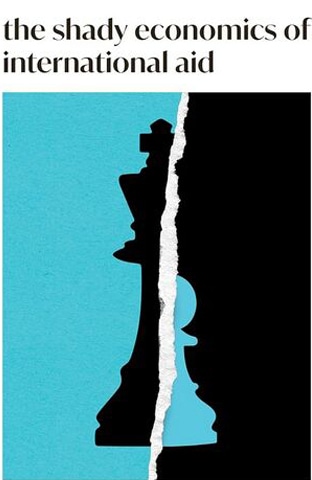
The Shady Economics of International Aid
By Dr Saeed Ahmed
Upriver Press
ISBN: 979-8-9906236-6-8
300pp.
The book under review, The Shady Economics of International Aid by Dr Saeed Ahmed, is broadly in the same genre as the famous 2004 bestseller by John Perkins, Economic Confessions of a Hitman, only on a broadly Pakistan-centric canvas.
Dr Ahmed, who is a former senior adviser to the International Monetary Fund and chief economist at the State Bank of Pakistan, makes the point that Pakistan’s economic travails — long periods of low growth, high poverty and vulnerability to shocks — persist despite Pakistan’s status as one of the foremost recipients of international aid. By ‘aid’, the author specifically refers to grants and concessional loans extended directly to governments, multilaterally or bilaterally. By that token, it excludes humanitarian or emergency external assistance.
Both bilateral and multilateral donors are large bureaucracies and are structured in a way that their policy and disbursement arms are separate from each other. As such, there is little or no accountability for disbursements. Amongst multi-laterals, accountability is diffused, while for bilaterals, there may be accountability at higher levels, but not much amongst their execution arms.
The book’s real contribution is that it zooms in on specific instances of abject failures in donor assistance in Pakistan. The author illustrates this through three disparate case studies that he is familiar with.
A book by a former chief economist at the State Bank of Pakistan critiques international aid and its deleterious impact on developing countries, but its real value lies in zooming in on specific instances of abject failures in donor assistance in Pakistan
Since the 1980s, the World Bank has executed 22 power sector projects worth US $4.2 billion, and the Asian Development Bank (ADB) has executed 145 projects worth US $10.32 billion. The results of this borrowing are clear: over three trillion rupees in circular debt, some of the highest per-unit electricity rates in the region, and large swathes of the country suffering backbreaking load shedding, leaving the country hugely indebted in the process.
The author correctly asserts that both these multilateral funders should “accept responsibility for the failure to make progress in their energy sector reforms.” And considering that they have worked in the sector for over four decades, they kept throwing good money after bad, learning nothing from past failures.
Similarly, the World Bank, the ADB and the British Foreign Commonwealth and Development Office (FCDO) have poured hundreds of millions of dollars to reform the Federal Board of Revenue (FBR) with little to show for it. The broad contours of donor-funded tax reforms essentially entail enhancing the tax-GDP ratio through reducing tax evasion and avoidance, as well as making the system fairer by broadening the tax base and improving progressivity in the system. Not one of these goals has been achieved.
Pakistan’s tax-to-GDP ratio has remained below double digits for the last two decades (in comparison, similarly placed countries to Pakistan have an average 18 percent tax-GDP ratio), nor is there any tangible evidence that efficiency or progressivity in the taxation system has improved.
The author extensively cites an array of studies that demonstrate that there is no relationship between the quantum of aid and long-term growth. More poignantly, he cites the most prominent growth stories of China and India, which did not rely on foreign aid, to make the point that countries that do not depend on foreign aid do well on the developmental front.
The author cites the much-heralded Tax Administration Reform Project (TARP), launched by the World Bank in 2005, as a case in point. At the end of the project, not only was Pakistan’s tax-to-GDP ratio lower than what it was when the project began, but the rate of compliance in terms of filing of tax returns also decreased. This ‘abject failure’ of the programme was even acknowledged by the World Bank which, in characteristic understatement, termed it as “moderately unsatisfactory.” The World Bank again led a multi-donor programme in 2014 for tax reforms, which failed equally spectacularly as its predecessor.
The third case study is not about project failure but about donor manipulation through collusive behaviour. The State Bank of Pakistan (SBP) started working on a Financial Inclusion Initiative in the 1990s with the aim of broadening credit outreach to the underserved economic and geographical segments of the country.
According to the author, who worked at the SBP at that time, the initiative took off in earnest around 2008, in expanding the outreach of microfinance and other instruments of financial inclusion. Around then, the British Department For International Development (DFID) was engaged through a small grant of 50 million GBP for implementing the programme. The author claims that the local team at the SBP managed to complete the tasks without resorting to the available donor funding and invested those funds in treasury bills.
Some years down the road, the donors asked them to provide two million GBP to another international donor from the technical assistance fund. The staff, including the author, resisted this request for some time, but then had to relent under pressure.
As for Pakistan’s addiction to the IMF, much of the blame has to be borne by domestic policy makers. The IMF is the borrower of last resort for countries that are in an unsustainable balance-of-payments quagmire. As discussed often, Pakistan has made a habit of resorting to IMF funding rather than putting its house in order. The only criticism that can be directed towards the IMF is on the speed of adjustments that they require, and perhaps that their stabilisation prescriptions do not provide a pathway to a sustainable growth transition.
The book then zooms out to engage, albeit briefly, on the economics of foreign aid. Apart from stabilising an imbalanced foreign exchange situation, in which countries resort to IMF help, the basic economic premise on which foreign assistance is beneficial is that countries with low savings rates require investible capital to put them on a sustainable track for growth, structural change and poverty reduction.
The author extensively cites an array of studies that demonstrate that there is no relationship between the quantum of aid and long-term growth. More poignantly, he cites the most prominent growth stories of China and India, which did not rely on foreign aid, to make the point that countries that do not depend on foreign aid do well on the developmental front.
The book under review is a useful addition to critiques of international aid and its deleterious impact on developing countries. Its true value, however, lies in helping policy practitioners and social activists understand Pakistan’s conundrum of low growth, high indebtedness and persistent poverty.
The next step, of course, is to think and chart strategies to create appropriate forms of statecraft and societal compacts needed to shed our existing aid addiction.
The reviewer is an economist, researcher and consultant on social and economic policy at the Collective for Social Science Research and a member from Sindh on the 11th National Finance Commission
Published in Dawn, Books & Authors, February 15th, 2026