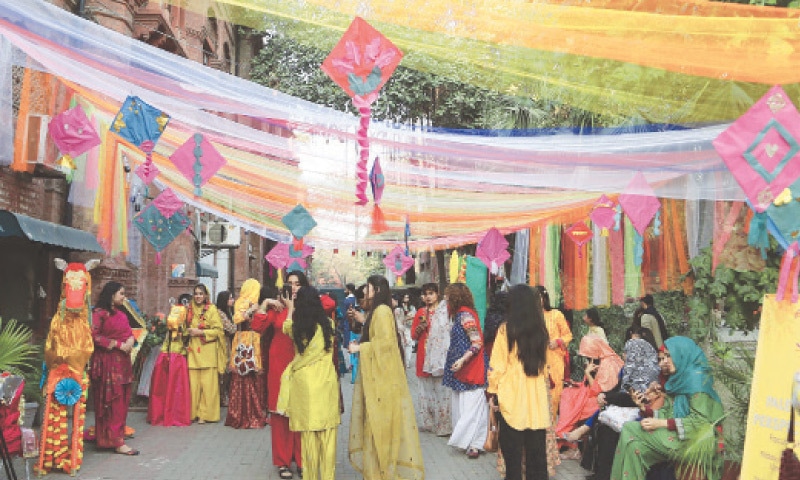

After more than two decades of absence, an abundance of colorful kites were once again seen flying across the skies of Lahore as Basant, the traditional Punjabi spring festival, made its long-awaited return. The people of Lahore will never turn down an opportunity to celebrate any occasion and this particular one was welcomed with extra intensity and zeal.
However, for the Lahoris belonging to Gen Z, those in their late teens and 20s such as this author, Basant was always limited to old photos and parents’ stories rather than with no personal experience. Many people from Gen Z grew up hearing about the vibrant spring rooftop gatherings and kite flying but they never saw the festival for themselves because of the ban on the festival from the mid-2000s until now.
Lahoris born during or after the ban on Basant describe the festival now as finally happening as something that ‘belongs’ more to their parents and grandparents who flew kites during the 1990s and 2000s rather than to themselves. The common sentiment among them is that this festival feels like stepping into someone else’s childhood memories rather than into a lived tradition of their own. That said, the return hasn’t just been nostalgic, for many young people, it’s also their first chance to really feel the excitement of participating, learning the skill of kite flying and finally creating their own memories of Basant.
I spent the entirety of the first day of Basant on a rooftop in the Wall City, which everyone knew was the place to be, simply because no other part of the city could compete with its skyline, a dense and haphazard layering of rooftops, minarets, and colours, with the sun basking, like icing on the cake.
By the time I got into the car to head home, I was exhausted, but in a way that felt pleasant. The kind of tiredness that comes from standing for hours, heads craning towards the sky, eyes constantly scanning for kites, ears filled with the sound of music and chatter, hands smelling faintly of quintessential Pakistani street snacks. The adults, showing visibly more excitement than we did, waited patiently as the craftsmen balanced the guddi, adjusted its frame, and tied the twine with a seriousness that made it clear that this was not just preparation for an activity, but an honoured, historical ritual.
When the first paicha took place, the energy shifted completely. The rooftop that had been a conversational gathering place in small groups of people earlier turned electric with a shared energy. Shouts erupted at once, people leaned forward in anticipation and, for a few seconds, everyone seemed to be holding their breath. Then came the triumphant and loud holler of kata! It was chaotic and precise all at once, and watching it felt like watching a language we were only just beginning to understand while trying not to interfere by stepping on a loose twine.
Children lined up eagerly, waiting for their turn to fly the kite. You could tell that the adults were having too much fun to let go easily, but they always did, eventually. They handed the string over carefully, guiding small hands. It felt intentional and also urgent as if they weren’t just sharing a game, but making sure that their children would grow up with at least a fragment of the same experiences that once shaped them.
Music played nonstop in the background and songs I had never heard before somehow felt familiar by the end of the day. The lyrics to dil hua bo kata and dil te churiyan chalaiyan lodged themselves into my head and stayed there, looping long after the kites finally came down at dinnertime. As the hours passed, the cold that should have stung simply didn’t. The wind moved leisurely, almost kindly, and the weather felt impossibly perfect. It was the kind of weather that should be celebrated as our ancestors did decades ago. I can say with complete confidence that Lahore and its people did not disappoint by doing justice to the tradition.
There is no denying that the most tangible impact of the revived three-day Basant was the opportunities provided to local craftsmen as well as the veteran artisans who were able to reopen their workshops and begin producing and selling kites again, passing on their skill set to the next generation. The boom in sales benefitted not only them and big rooftop rental markets but also small food vendors and street sellers and at the same time.
Basant also represents the preservation of culture for all Punjabis alike. As Basant unfolded, the sky that winter once turned ominous with fog had transformed into something mesmerising. Lahore’s skyline is never still and always has a spectacle to offer, much like the people who live beneath it. I hope that in the years to come it will be possible to experience the liveliness of Basant for the members of the generation who were alien to it.
(The writer is a student at LUMS)
Published in Dawn, February 11th, 2026