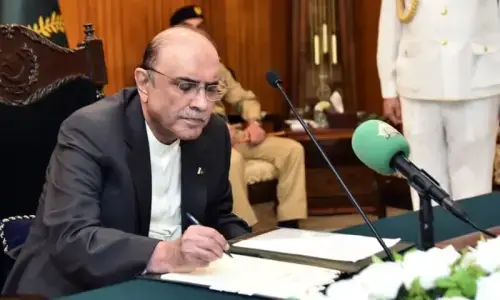
PRESIDENT Asif Zardari’s warning on Sunday that conditions in Afghanistan today resemble the situation in that country in the run-up to the Sept 11, 2001, attacks are not without substance. Just as Al Qaeda and other terrorist groups found refuge in Afghanistan during the Taliban’s first stint in power, today, the TTP and various other terrorist entities operate with freedom.
While some, such as IS-K, are enemies of the Afghan Taliban, most others, including the TTP, share cordial ties with Kabul’s rulers. President Zardari added that India was “assisting the Taliban regime and threatening … Pakistan”.
In a related context, the federal interior minister had said that the alleged mastermind of Friday’s suicide bombing in Islamabad had been nabbed, and that he was an Afghan national. Moreover, IS has claimed responsibility for the atrocity in the capital. The minister also observed that India had increased funding for terrorists.
The complexity of the threats — both internal and external — require the federal and provincial governments to put aside political differences and focus on the threat of terrorism. However, the federal information minister’s remarks and off-colour joke that the PTI was responsible for the resurgence of terrorism in the country will do little to foster unity at a time when it is direly needed.
Just last week, we had seen positive movement in this regard as KP Chief Minister Sohail Afridi chaired his first meeting of the province’s Apex Committee. Mr Afridi had stressed the need for the provinces, the centre and the military to work in unison to confront terrorist violence.
Moreover, the interior minister had also praised the KP CTD for their role in the arrest of the Islamabad blast suspects. All political actors must display a similar spirit; this is not the time for snide remarks or debates about who is responsible for allowing terrorists to regroup, through acts of commission or omission.
After all, it is a lengthy debate and would entail all factors over the past several decades that allowed terrorism to take root in Pakistan. For now, all sides must focus on the one-point agenda of defeating terrorism.
It is also a matter of great concern that the terrorist attack on the Islamabad imambargah last week has been linked to IS. The group is not on good terms with the Afghan Taliban, but operates in the border areas between Pakistan and Afghanistan. That it was able to organise an attack apparently in KP, and target the nation’s most secure city, should raise red flags.
More intelligence-based operations are needed to thwart any future attacks by this bloodthirsty outfit. The state already has its hands full dealing with the TTP’s terrorist attacks; it cannot afford to give any quarter to IS.
Published in Dawn, February 10th, 2026