0
0

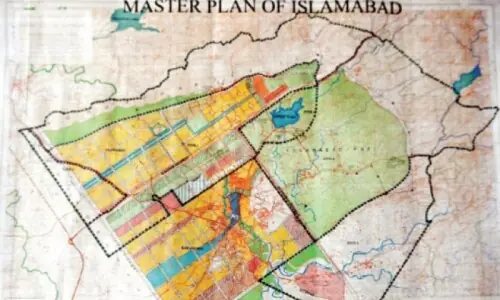
ISLAMABAD: Though the master plan of Islamabad could not get a proper revision so far, another change has been proposed to the commission that has already seen several changes in the past.
The Capital Development Authority (CDA) had sent the names of the proposed commission several times to the federal government in the last four years and the latest one has been prepared a few days ago with majority of new names.
Sources in the interior ministry said the new list of 18 members will be sent to the federal cabinet for approval.
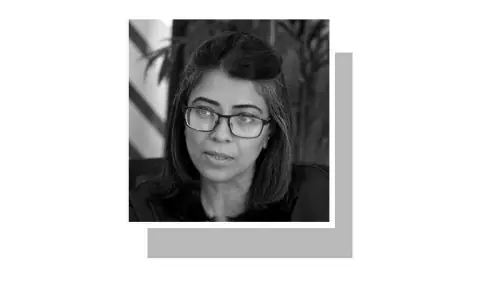
The new list stated that CDA Chairman will be the convener of the commission. It will have two urban planners - Nimra Qazi, senior architect and urban planner, adviser at Comsats Islamabad and Architecture School Nust, and former chairman CDA Kamran Lashari.
New list of 18 members will be sent to federal cabinet for approval, says official
“Ms Qazi is renowned architect and recently she won design of Jinnah Medical Complex, but instead of putting her name as an architect, she was shown as an urban planner,” said a source.
The source added that if Mr Lashari’s expertise was required and his name should have been added in the list as an expert, not in category of urban planner, which is a specialised field of town planning. The source said that Islamabad High Court (IHC) in its judgement in 2018 had directed the federal government for revision of the master plan through a commission of professional experts “preferably of international repute, in the field of town planning, environmental management and finance.”
The new proposed commission has no representation of Environment Protection Agency (EPA) and Islamabad Wildlife Management Board (IWMB) and local landlord of Islamabad (in previous list, finalised last year, they also had representation).
The new list stated that an Assistant Professor at Comsat Architectural Wing will be member of proposed commission as regional planner while Mazhar Iqbal, former consultant at Lahore Rapid Mass Transit System, will be member as transportation planning specialists.
The new list stated that renowned Architects Faheem Ahsan and Environmentalist Rizwan Mehboob and lawyer Qasim Chauhan will be member of commission.
Similarly, the name of Shafiq Akbar (Urban Economist from University of Cambridge) is also included in the proposed commission. Sources said Mr Akbar from Imarat Group had launched several real estate projects in Islamabad.
The list stated that Syed Mohammad Mehar Ali Shah, Pakistan Commissioner for Indus Water and Additional Secretary, will be member as water resources management expert while Surveyor General of Pakistan will also be member of the commission. Member planning, member environment CDA, DC Islamabad and DG RDA will be ex-officio members.
It is relevant to note here that Islamabad, one of the well-planned cities in the world, is now facing several challenges due to the delay in its master plan revision.
Islamabad has seen 51 amendments to its master plan by successive governments, mostly without an expert input.
Despite these changes, it is still regarded as one of the world’s most beautiful cities with planned construction in urban areas, adequate green cover and a relatively clean environment.
However, due to the absence of a proper mechanism to regulate rural areas, particularly private land in Zone III, the city faces serious planning threats.
“In many areas of Islamabad, construction is turning the city into slums. In localities like Tarnol, the northern side of Margalla Road, Lehtrar Road, areas along the Expressway, Bhara Kahu, and almost all rural zones, massive unregulated construction has already taken place,” said an official.
He added that there is a need to bring all new construction under proper regulations, including in Zone III. “This Zone largely belongs to locals, but under current CDA rules, construction is prohibited throughout the zone under a blanket ban. “Still, construction continues as people argue that they have the right to build homes on their own land,” the official said.
The city has also witnessed rapid growth in both population and built-up areas. An official said that Islamabad’s built-up area expanded massively between 1990 and 2020—from 2,693 hectares to 18,465 hectares. During this period, the city saw a mushroom growth of both legal and illegal housing schemes and slums, even in posh sectors such as F-6, F-7, G-7, G-8, and F-8. Islamabad is also facing major challenges of water scarcity and urban flooding. Last year several people lost their lives in floods.
Successive governments also ignored the recommendations of Doxiadis Associates, the Greece-based firm that prepared Islamabad’s master plan in 1960. The firm had advised that the plan be revised every 20 years to meet the city’s evolving needs.
Instead of conducting proper revisions, successive governments made “selective” changes without consulting experts. So far, around 50 such changes have been made to the city’s blueprint, including four by the incumbent government.
“Changes should have been made with expert input to avoid future planning issues. For example, Sector I-8 was reserved for a transportation centre in the original plan, but decades ago it was converted into a residential sector.
As a result, the CDA built a bus depot for electric buses on a greenbelt along Srinagar Highway last year after chopping trees.
Published in Dawn, February 10th, 2026