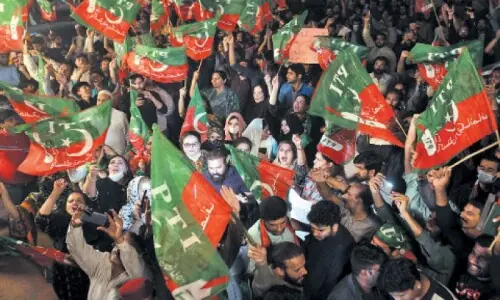
IT was the monsoon of 2021. The opposition Pakistan Democratic Movement (PDM) alliance was locked in a direct confrontation with the government of then-prime minister Imran Khan.
At the centre of this political standoff was then-leader of the opposition, Shehbaz Sharif, who had taken a hard line against the ruling PTI.
During a lengthy and closely watched visit to Karachi in August 2021, the three-time Punjab CM spent three days meeting industrialists, businessmen, political leaders, intellectuals, media professionals and other stakeholders.
As his visit drew to a close, he hosted a select group of journalists over a cup of tea at a local hotel.
While ministers — both past and present — claim a lot has been spent on the economic hub over the past decade, critics argue it is far less than needed for a city of this size and significance
It came as a pleasant surprise to many in attendance when he spoke with rare candour about the neglect the city had long endured, and laid out his plans for Karachi’s rebuilding and development.
“Believe [me] when I was chief minister of Punjab, I came to realise that funding or resources for development has never been an issue,” he said.
“I firmly believe Karachi only needs political will and ownership to turn things around…The federal government would have to pump in more money every year for Karachi than what is allocated by the Sindh government in its annual budget for the city’s development. And this cycle should continue for 15 or maybe 20 years. Then we would be able to fix this city’s problems,” he had asserted.
When these statements hit the headlines the next day, many in Karachi believed their voices had finally been heard. More than four years later, however, those hopes have proven to be little more than wishful thinking.
Stalled initiatives, unkept promises
So why has the prime minister not been able to translate his for Karachi into tangible outcomes? Is this due to a shift approach, or are there concrete plans that may materialise in the coming years?
When contacted, Minister for Planning and Development Ahsan Iqbal did not directly respond to these questions.
Instead, he pointed to the shrinking fiscal space available to Islamabad, and the growing resources available to the provinces over the years.
“Federal government share in national development budget has shrunk from 50 per cent to 25 pc, whereas provincial governments share has increased from 50pc to 75pc. Despite that, the federal government is making contribution towards the development of Karachi through billions of rupees worth projects like Green Line extension project, Site area development project and K-IV water project,” he told Dawn.
However, this explanation is contested by his predecessors, such as Asad Umar. As finance and planning minister under the PTI government, he oversaw several federally-funded projects for the city under the Karachi Transformation Plan, and maintains that viable initiatives for Karachi were taken to advanced stages, before being stalled under subsequent administrations.
Questioning the argument about limited fiscal space, he referred to the Lahore-Bahawalnagar motorway, a project located entirely within one province, which had also been approved under the federal PSDP. “If development spending is to be undertaken at the federal level, it should be applied consistently. Why is Karachi treated like a stepchild?” he asked.
Umar said the PTI’s Karachi Transformation Plan completed the Green Line BRT’s first phase and road and drainage projects.
The federal government had assumed full responsibility for the K-IV water supply scheme, he claimed.
But a closer examination of official budgetary allocations also raises questions about the scale and seriousness of Islamabad’s claimed contribution.
Despite repeated references to flagship projects, the federal government has earmarked only Rs3.2 billion for the K-IV water supply scheme in the current fiscal year which is far short of the estimated annual requirement of around Rs40 billion to keep the project on track.
Similarly, beyond a limited extension of the Green Line BRT covering only a few additional kilometres, there appears to be no major federally funded infrastructure initiative currently planned or underway for Karachi.
Karachi ‘handed over to Sindh govt’
In recent months, a group of 15-20 leading businessmen and experts from Karachi formed a committee, holding detailed discussions on how the city’s deteriorating infrastructure and governance challenges could be addressed.
Among those involved was prominent businessman Hanif Gauhar. The federal government’s involvement in Karachi is far less than it should be, given the city’s economic significance, he said.
“This is exactly what frustrates us. This city generates the highest revenue, yet when we look at even the roads, the support is minimal. [NA Speaker] Ayaz Sadiq himself told us that his constituency received a budget of Rs38 billion. Just imagine if a single MNA gets Rs38 billion for their area, you can see tangible results. Why can’t Karachi, which contributes so much more, see the same level of federal attention?” he asked.
Among those raising these concerns is City Council opposition leader Advocate Saifuddin, who said the city’s grievances remain largely unaddressed despite repeated promises from federal and provincial authorities.
According to him, the federal government has effectively “handed over” Karachi to the Sindh government, absolving itself of responsibility for the city’s long-neglected infrastructure and development needs.
“Projects that fall squarely under the Centre’s domain have either been ignored or left incomplete for years,” he said.
“Out of the federal PSDP of Rs1,100 billion, Karachi receives only around Rs40 to Rs50 billion. Based on population alone, the city’s share should be at least Rs200 billion and if revenue contribution is taken into account, it should be closer to Rs300 billion,” he said.
Comparing Karachi to Lahore, Saifuddin alleged a clear imbalance in federal spending. “Lahore has been given far more development schemes than Karachi,” he said, criticising both tiers of government.
A detailed version of this article can be accessed on Dawn.com
Published in Dawn, February 9th, 2026