

IN geopolitics as in physics, actions do cause reactions which, even though they may be opposite, aren’t necessarily equal or immediate. And these reactions, when they do become apparent, can be stunning. Take, for example, the sight of F-16 jets patrolling the skies above Mogadishu — not on a bombing run as may have been the case in the past, but as part of a ‘gift’ to Somalia from their Turkish allies. This means that Somalia, which has not had an air force since 1991, is now one of only three African countries to field F-16s.
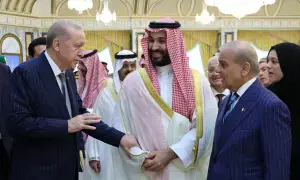
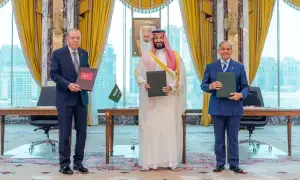
Speaking of opposites, the last week also saw Saudi Arabia and Turkiye sign a far-reaching accord encompassing everything from economic ties to strategic cooperation, which is quite something considering the low ebb that relations sank to after the blockade of Qatar in 2017 and the 2018 murder of Jamal Khashoggi. Now these erstwhile rivals are on the proverbial same page when it comes to Yemen, Sudan and — crucially — Somalia.
Why is Somalia important? Situated on the Horn of Africa on the Red Sea coast, Somalia stands at the crossroads of critical maritime trade routes that connect Europa, Asia, the Middle East and Africa. This means that whoever has a foothold in Somalia can effectively choke trade and interdict vessels, much as the Houthis managed to do in the recent past.
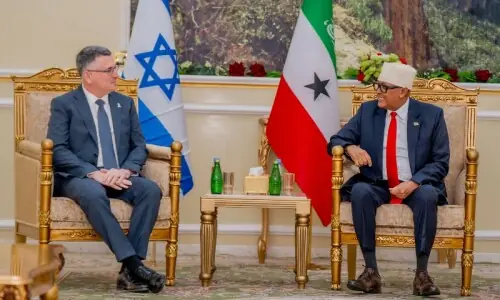
What added urgency to Turkish and Saudi efforts to shore up Somalia militarily and diplomatically was in large part the Israeli recognition of Somaliland last year. Somaliland, a breakaway province of Somalia, has effectively been independent since 1991, and has since cooperated deeply with the UAE to develop its port of Berbera, which was intended as yet another node in the UAE’s network of ports and bases, all located at strategic choke points. The possibility of an Israeli deployment in Somaliland raises alarms in Saudi Arabia, which rightly fears an encirclement of sorts. Riyadh is now willing to act against any such possibility, as evidenced by the rout of the Southern Transitional Council in Yemen last year, a group that Riyadh claims is a UAE proxy. Had the STC succeeded in grabbing a large part of Yemen, Riyadh would be faced with the untenable scenario of a potentially hostile proxy in power on its terrestrial southern border and also across the Red Sea in Somaliland. Since then, Saudi-UAE ties have taken a serious downturn, with the latest signal of this being the withdrawal of several UAE defence firms from the Riyadh-based World Defence Show to be held this week.
This realignment brings Riyadh closer to Ankara, overcoming decades of mistrust and confrontation. Turkiye’s involvement makes sense not only due to its old antipathy towards the UAE’s strategic designs — a feud that dates at least as far back as the Arab Spring — but also its increased wariness of and confrontation with Israel, which views Turkiye as one of the only regional powers capable of checking its ambitions.
Whoever has a foothold in Somalia can effectively choke trade.
With the backing of two powerful regional nations, Somalia then acted against the UAE by annulling all agreements with that country, bringing Somali-UAE ties to their lowest ebb ever. Nevertheless, Somaliland stands defiant, and while the UAE has not officially recognised them as an independent state, the president of Somaliland was prominently in attendance at the recent World Governments Summit in Dubai, an appearance that naturally drew condemnation from Mogadishu. Now, with both Riyadh and Ankara loudly condemning Somaliland and reaffirming Somalia’s territorial integrity, the outlines of a new regional order, and of rival camps, can clearly be seen. It is also worth noting that the Somali air chief and interior ministers were both in Pakistan recently, and while Somali commentators and analysts are hinting at the prospect of military cooperation and defence deals with Pakistan, nothing is official at the moment.
But the ripples of this regional alignment are being felt as far as Libya and Sudan. In Libya, we can see clear efforts being made to wean off Gen Khalifa Haftar, the de facto ruler of large parts of Libya, from the UAE and while these efforts are largely being made by Turkiye, we should also note (again) that Khalifa Haftar was also recently in Pakistan. Then there’s Sudan, where the Sudanese army has scored some recent successes against the UAE-backed Rapid Support Force, and they have Turkish and growing Egyptian military support to thank for that. The lines have been drawn. The axes and alliances are broadly coalescing. And the reason all this is happening is because this is a reaction to unbridled Israeli aggression coupled with the UAE’s growing reach and influence. Moves and countermoves are in play and you shouldn’t be surprised if you hear of Ethiopian involvement soon. But that’s a topic for another day.
The writer is a journalist.
Published in Dawn, February 9th, 2026