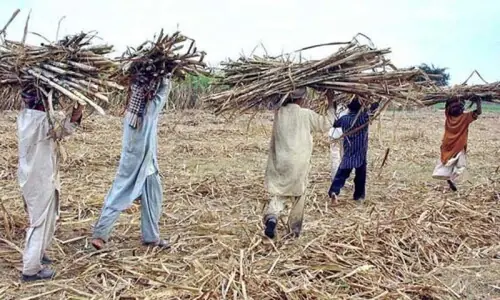
LAHORE: A record increase in sugarcane prices and incentives offered by sugar mill owners to growers has heightened fears of a further decline in cotton cultivation next year, even as environmental pollution caused by sugarcane farming continues to damage cotton quality.
Despite an unprecedented fall in overall cotton production, lint consumption — rather than production — has now emerged as a major challenge for the country, while India has surprisingly raised its cotton production target for the 2025-26 crop year.
Cotton Ginners Forum Chairman Ihsan-ul-Haq said that the persistent failure to enforce crop zoning laws across Pakistan has led to a steady expansion of sugarcane cultivation in traditional cotton zones over the past few years, along with the establishment of new sugar mills.
This trend, he said, has not only caused a record decline in cotton acreage and national output but has also adversely affected cotton quality due to environmental pollution linked with sugarcane farming.
As a result, export-oriented textile mills have become increasingly dependent on imported cotton. He noted that despite national cotton production falling sharply from 14.8 million bales to around 5.5m bales, ginners are still struggling to sell their entire produce.
Mr Haq said sugar mill owners provide billions of rupees annually to sugarcane growers in the form of loans for fertilisers, pesticides and agricultural machinery. This year, sugarcane prices have increased by at least 25 per cent, reaching Rs500 per 40kg, with further increases expected. This has raised concerns that sugarcane cultivation will expand further in the 2026-27 cotton year, forcing textile mills to import even more cotton and increasing edible oil imports, costing the country billions of dollars in foreign exchange.
He stressed that strengthening the national economy requires strict enforcement of crop zoning laws to improve both the quantity and quality of lint. He also called for aligning electricity and gas tariffs, markup rates and taxes for the entire cotton industry with those of neighbouring countries, and for immediately reducing interference by various federal and provincial departments in industrial affairs.
Mr Haq pointed out that Pakistan is the only major cotton-producing country in the world where national output is declining every year, causing the country to slip from fourth to fifth or sixth position among global cotton producers. He said India had earlier set its cotton production target for the 2025-26 season at 30.95m bales, which has now been increased to 31.70m bales. In contrast, Pakistan’s federal government fixed a target of 10.18m (170 kg) for the current year, while actual production is expected to remain around 5.6m bales (160 kg).
He urged the government to restore the one-year-old income tax regime for the export-oriented textile industry to help boost Pakistan’s exports significantly.
Published in Dawn, January 27th, 2026