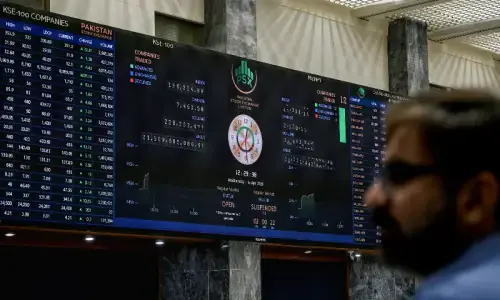
Pakistan’s capital market is poised to enter a faster and more efficient phase as the Pakistan Stock Exchange (PSX) transitions from a T+2 to a T+1 settlement cycle, effective February 9, 2026.
This shift, led by the Securities & Exchange Commission of Pakistan (SECP), will allow securities transactions to be settled within one business day instead of two, bringing the country’s market infrastructure closer to international practices.
India’s experience offers a useful benchmark. When the Bombay Stock Exchange and National Stock Exchange (NSE) completed the shift to a T+1 settlement cycle in January 2023, cash flows across the market improved materially. Data from the NSE show that faster settlements released investor funds and broker margins a full day earlier, reducing capital locked in unsettled trades. Importantly, trade-related defects declined sharply — nearly halving from about 0.82 per cent to 0.41pc.
Equally important is the reduction in systemic and counterparty risk. Longer settlement periods expose markets to uncertainty, especially in volatile environments like ours.
By adopting the T+1 settlement, the Pakistan Stock Exchange demonstrates regulatory seriousness and operational maturity that could help improve foreign portfolio inflows
Prices can swing, counterparties can fail, and confidence can erode in the gap between trade execution and settlement. A T+1 framework cuts this exposure window in half, strengthening financial stability and making the market more resilient to sudden shocks.
From the perspective of global investors, the shift sends a reassuring signal. International institutional funds do not look only at valuations or short-term returns; they study market infrastructure carefully — how quickly can trades be settled? How robust are clearing mechanisms? How aligned is regulation with global norms?
By adopting T+1 settlement, Pakistan demonstrates regulatory seriousness and operational maturity — qualities that enhance credibility and, over time, can help improve foreign portfolio inflows.
The shift from T+2 to T+1 also lowers the cost of doing business within the capital market. Faster settlements reduce margin requirements, free up working capital for brokers and investors, and contribute to tighter bid-ask spreads. Over time, these improvements support better price discovery, deeper markets, and a stronger platform for capital raising. For companies seeking equity financing or issuing corporate debt, a more efficient market can mean lower costs and broader investor participation.
In the broader economic context, efficient capital markets play a vital role in sustainable growth. They allocate resources more effectively, reward productive enterprises, and discipline inefficiency. While the move to T+1 settlement will not transform the economy overnight, it strengthens the institutional foundations on which durable economic progress depends.
Meanwhile, Pakistan has taken another, very different step toward financial modernisation. The government has recently signed a memorandum of understanding (MoU) with SC Financial Technologies, a company linked to World Liberty Financial — a cryptocurrency venture associated with the family of Donald Trump — to explore cooperation in digital payments and financial innovation.
According to officials, the MoU aims to examine the potential use of a US dollar–pegged stablecoin, known as USD1, particularly for cross-border payments and remittances. For Pakistan, a country heavily reliant on overseas remittances and burdened by high transaction costs, such instruments could, if properly regulated, improve efficiency, reduce settlement delays, and lower fees for international money transfers.
It is important, however, to understand what this agreement is and what it is not. The MoU is exploratory and non-binding. It does not commit Pakistan to adopting any specific digital currency. Rather, it facilitates technical discussions, knowledge sharing, and regulatory engagement. This distinction matters. It signals openness to innovation while preserving regulatory caution, allowing authorities time to evaluate risks related to financial stability, compliance, and monetary sovereignty.
While this engagement reflects interest in innovation within a dollar-linked framework, it unfolds against a backdrop of much larger structural shifts in global finance — most notably China’s deliberate and methodical expansion of its financial infrastructure.
Through bilateral currency swap agreements, yuan clearing banks, and the Cross-Border Interbank Payment System (CIPS), Beijing has created a parallel payments architecture allowing participating central banks to exchange local currency for renminbi (RMB). The People’s Bank of China has signed over 40 bilateral currency swap agreements, more than 30 of which are currently active, including one in Pakistan.
The expansion of CIPS further strengthens this ecosystem. With dozens of RMB clearing banks operating across multiple jurisdictions, transactions between Pakistani and Chinese firms can be routed through fewer intermediaries, settled faster, and completed at a lower cost. In an era marked by tariff uncertainty, sanctions, and geopolitical financial tools, such infrastructure offers a degree of insulation that smaller economies increasingly require.
Equally significant is the yuan’s rising role in global trade settlement. For Pakistani exporters and importers, access to RMB-based settlement channels provides diversification away from a dollar-centric system.
Taken together, these developments point to a larger reality. China’s financial rise is not merely symbolic; it offers Pakistan concrete tools to stabilise trade, diversify currency risk, and strengthen resilience. While exploratory engagements with dollar-linked digital finance may deliver efficiency gains, deeper integration with the RMB ecosystem addresses structural vulnerabilities at a more fundamental level.
Published in Dawn, The Business and Finance Weekly, January 26th, 2026