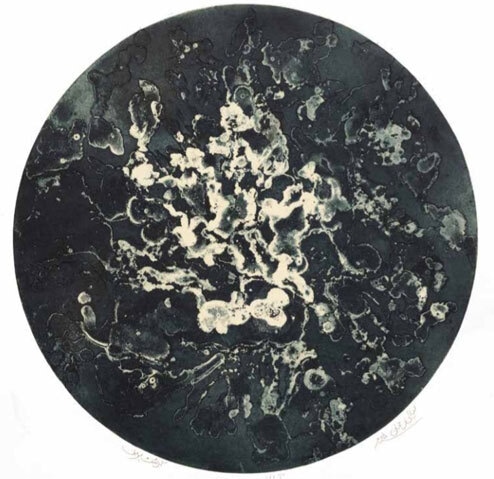
Laila Rahman’s recent show at Canvas Gallery, ‘Witness’, imaginatively investigates an ancient core of cosmic creations. Etchings and sculptural works in monochromatic black and white tell the story of the genesis of the universe and its inhabitants.
Rahman’s visuals engage with the most primal origins of things that belong to a past before recorded history. These include physical as well as metaphysical phenomena, such as water and life, time and myth. Mircea Eliade, a historian of religions, termed this stage “In illo tempore [in that time].” In this elemental stage of cosmogenesis, all is sacred and the realm of the profane has not yet come into being.
Rahman’s narratology of cosmic phenomena is ascribed to divinity. Her fecund imagination visualises creation through a combination of personal iconography (such as the pomegranate fruit) and select scriptural references from the Quran and Bible. These references build a sacred history of genesis from which foundational archetypes emerge to become encoded in myth, religion and moral order.
All cultures narrate stories of origins with unique frames of reference. Greek origin myths explain birth as order emerging from chaos. Islamic narratology maps the foundational order of the cosmos as geometric. The circle and the square also comprise the basic shapes in Islamic geometrical drawing. Their interlacing produces complex arabesques similar to the replacement of the primal void with complex presences.
Laila Rahman’s recent exhibition in Karachi drew upon religion, myth and scripture to fascinating effect
Rahman captures the geometry of a moment prior to genesis in an etching called Void II. Dense black and radiating lines emerge from a central rectangle into a circle. Another etching, The Greater Light to Rule the Day and the Lesser Light to Rule the Night II, reveals the light-giving heavenly bodies: the sun and the moon. The title is taken from Genesis 1:16.
The wide lip of the crescent moon bears the verse in Urdu. As etchings reverse the marks on the copper plate on to paper, Rahman had to dexterously carve the fine lettering in reverse onto the plate. The combination of the verse from the biblical Book of Genesis written in Urdu with the Arabic script creates a profound connection between scripture and languages.
The largest installation at the exhibition is a composite steel relief, eponymously titled Witness. It comprises a large central disc representing the full moon surrounded by eight smaller discs representing lunar phases. Rahman likens the moon to the Honorable Scribes (the Kiraman Katibin) who bear witness to the deeds of humans and — according to Islamic tradition — record every deed in order to testify on the Day of Judgement. The symbolic act of bearing witness has great solemnity. It upholds testimony as validation of moral judgment.
The forms change from sharply geometrical to soft swirls in the etching Beginnings. This work presages the inception of organic forms of life. Three works: In the Beginning There Was a Garden, Fill the Water in the Seas and Let the Fowl Multiply and Let Us Make Man in Our Image II move the narrative of life on earth forward.
Rahman states that her work “emerges at the intersection of the garden, the pomegranate and the moon.” She links cosmic gardens from a time before the creation of Earth to earthly gardens, and then to metaphorical gardens such as states of childhood and innocence. However, the garden also contains a snake that presages downfall and the loss of innocence. The pomegranate is a recurring motif in Rahman’s oeuvre. It is symbolic of both fertility and its corollary — decay.
Rahman’s stainless steel sculpture Garland comprises concentric circles with tongues of flames. There is foreboding as well as beauty in its uncompromising structure. The flames implicitly evoke notions of punishment and suffering. After the creation of a sacred cosmos, a profane dimension comes into being. This is the snake in the garden. Humankind becomes subject to a moral order that is the duality of good and evil.
From void to moral order, time moves past its rudimentary beginnings. Judging by the cosmic narrative told in ‘Witness’, scribes and artists are marking the change.
‘Witness’ was on display at Canvas Gallery in Karachi from December 9-18, 2025
The writer is an independent researcher, writer, art critic and curator based in Karachi
Published in Dawn, EOS, January 25th, 2026