• Over 20 states, including eight-nation Muslim bloc, decide to join proposed President Trump-led ‘Board of Peace’
• Officials defend move as ‘strategic necessity’, ‘pragmatic step’ to stop genocide in Gaza
• Islamabad believes process will lead to the realisation of Palestinians’ right to self-determination
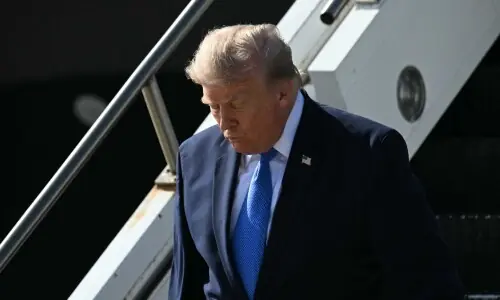
ISLAMABAD: Pakistan on Wednesday announced its decision to join US President Donald Trump’s ‘Board of Peace’, saying it would participate to support the implementation of a Gaza peace plan anchored in a United Nations Security Council resolution.
A statement issued by the Foreign Office said Pakistan had decided to join the board “as part of its ongoing efforts to support the implementation of the Gaza Peace Plan under the framework of the United Nations Security Council Resolution 2803.”
The charter of the ‘Board of Peace’ is scheduled to be signed on Thursday on the sidelines of the World Economic Forum in Davos. Diplomatic sources said around 60 countries have been invited to join the body, with more than 25 having conveyed their acceptance so far.
Pakistan’s announcement came at a time when seven other Muslim states welcomed the invitation to join the board. In a joint statement, the foreign ministers of Pakistan, Egypt, Jordan, the United Arab Emirates, Turkiye, Saudi Arabia and Qatar welcomed the invitation extended to their leaders. “The ministers announce their countries’ shared decision to join the Board of Peace. Each country will sign the joining documents according to its respective relevant legal and other necessary procedures, including Egypt, Pakistan, and the UAE, that have already announced to join,” the joint statement said.
It should be noted that all eight countries had worked with Trump in October last year on a plan to end Israel’s genocide and invasion in Gaza. The UAE had announced its decision to join the board on Tuesday.
Pakistan’s decision follows its growing involvement in US-led diplomacy on Gaza. The announcement came amid rising international concern that the scope of the ‘Board of Peace’ could be expanded beyond Gaza. Critics argued that what was initially presented as a UN-backed mechanism to oversee a specific peace plan risks evolving into a parallel forum that could dilute the role of the United Nations in conflict resolution.
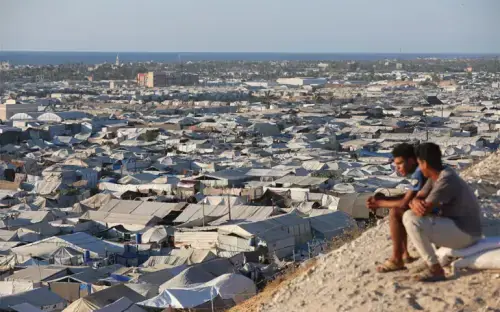
In its statement, FO said Pakistan hoped the creation of the new framework would translate into concrete outcomes on the ground. “Pakistan expresses the hope that with the creation of this framework, concrete steps will be taken towards the implementation of a permanent ceasefire, further scaling up of humanitarian aid for the Palestinians, as well as reconstruction of Gaza,” it said.
Reaffirming Islamabad’s long stated position on Palestine, the statement added that Pakistan hoped the process would lead to “the realisation of the right to self-determination of the people of Palestine, through a credible, time-bound political process, consistent with international legitimacy and relevant UN resolutions,” resulting in “the establishment of an independent, sovereign, and contiguous State of Palestine, based on the pre-1967 borders with Al-Quds Al-Sharif as its capital.”
The FO also underscored Pakistan’s intent to play an active role, saying it “looks forward continuing to play a constructive role as part of the Board of Peace for the achievement of these goals as well as to end the suffering of our Palestinian brothers and sisters.”
The decision drew criticism at home, with critics questioning Pakistan’s participation in an initiative driven by Washington and chaired by President Trump. Critics raised concerns over what they describe as a pay-to-play structure, arguing that financial contributions appear to translate into influence, undermining principles of equitable multilateralism.
Others recalled the description of initiative in international media, which described it as ‘a bait and switch’, contending that a body initially framed around the implementation of a Gaza-specific, UN-endorsed plan is being repurposed into a broader mechanism with an open-ended mandate. They warned that indications of an expanding scope could place the board in competition with existing UN institutions, weakening an already strained multilateral system.
‘Strategic necessity’
Amid the criticism, a state institution circulated a background explainer to journalists defending the decision to join the board as a strategic necessity. The explainer described participation as “a pragmatic step for political solution of ongoing genocide in Gaza”, undertaken alongside “multiple Muslim countries working collectively to safeguard Palestinian interests.”
The explainer said Pakistan’s inclusion reflected “recognition of Pakistan’s heft and importance in global comity” and was consistent with its participation in multilateral forums in an increasingly polarised and fragmented world. It argued that Pakistan’s ability to maintain working relations with major global powers gave it “the unique capacity to act as a bridge for peace”.
Addressing calls for abstention, the explainer warned that “as geopolitical fault lines harden, neutrality becomes indistinguishable from irrelevance,” adding that “portraying Pakistan as a bystander serves only those invested in paralysis”.The explainer also drew a distinction between the ‘Board of Peace’ and any potential international security force for Gaza, stating that “equating Board of Peace with participation in ISF is therefore illogical and out of place,” while reiterating that any such engagement would remain subject to Pakistan’s national interest, a UN mandate and the aspirations of the Palestinian people.
Published in Dawn, January 22nd, 2026