PTI-nominated MWM chief Raja Nasir Abbas appointed Senate opposition leader after months-long delay
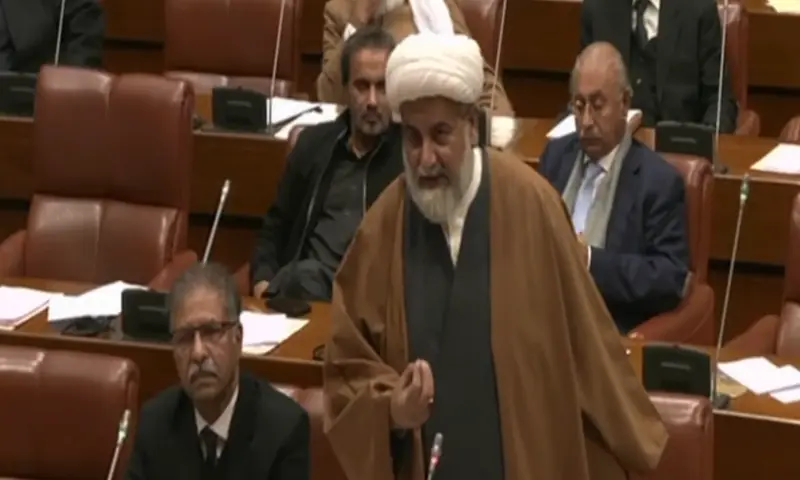


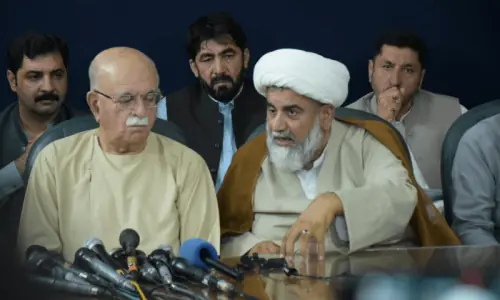
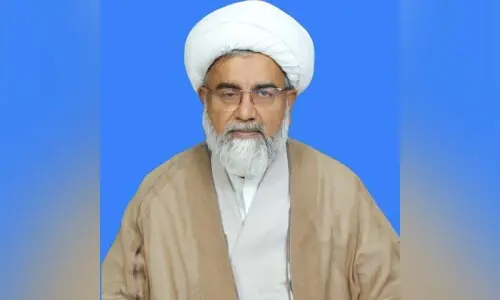
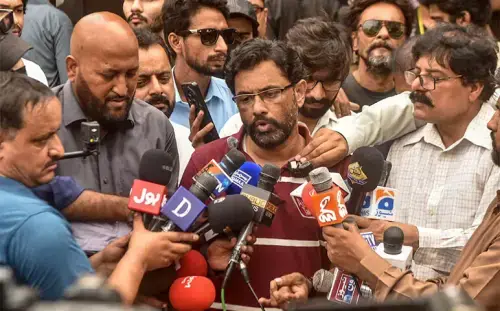
ISLAMABAD: Majlis Wahdat-i-Muslimeen (MWM) chief Allama Raja Nasir Abbas was appointed as the opposition leader in the Senate on Tuesday.
Abbas — vice chairman of Tehreek-i-Tahafuz-i-Ayin-i-Pakistan (TTAP) — had been chosen by PTI founder Imran Khan as the opposition’s choice for the seat, which had been vacant since August 2025.
“In pursuance of sub-rule (3) of Rule 16 of the Rules of Procedure and Conduct of Business in the Senate, 2012, the chairman Senate has been pleased to declare Senator Raja Nasir Abbas as leader of the opposition in the Senate, with immediate effect,” said a notification issued by the Senate Secretariat.
Senate Chairman Yousuf Raza Gilani also announced Abbas’s appointment as the opposition leader during Tuesday’s session in the House.
As the proceedings began, he said: “I want to give a ruling. Before proceeding further, I consider it necessary to place on record the legal and procedural background relating to the declaration of the leader of the opposition in the Senate.
“Rule 16 of the Rules of Procedure and Conduct of Business in the Senate, 2012 mandates that the chairman Senate should declare as leader of the opposition the member who commands the support of the majority of the members in opposition.
“Following the disqualification of former senator Syed Shibli Faraz by the Election Commission of Pakistan vide notification dated August 5, 2025 and the consequential notification of the Senate Secretariat dated August 8, 2025, the office of the leader of the opposition stood vacated.
“The said notifications were challenged before the honourable Peshawar High Court, which issued restraining orders prohibiting further action in the matter. In view of the pendency of judicial proceedings, the matter remained under consideration of the Senate Secretariat for legal examination and procedural guidance, in accordance with the established parliamentary practice and constitutional discipline so as to ensure that no step was taken which might conflict with or render infructuous the proceedings before the honourable court.”
Gilani explained that the “earlier deferment [of the appointment] was therefore procedural, occasioned by institutional prudence, due deference to judicial authority and rule of law”.
He further stated: “There being no legal bar, I now proceed in accordance with Rule 16 of the Rules of Procedure and Conduct of Business in the Senate, 2012 and hereby declare Senator Raja Nasir Abbas as the leader of the opposition in the Senate …”
At this point, Gilani was interrupted by the thumping of desks and slogans in favour of incarcerated ex-premier Imran.
Meanwhile, Gilani continued: “… Having secured the support of 22 members out of 32 members on the opposition benches. The secretary is directed to issue a formal notification accordingly right now.”
He then requested parliamentary leaders in the House to “assist the opposition leader on his seat”, following which Abbas rose and changed his seat amid applause, shaking hands with several senators on his way.
Later, before giving the floor to Senator Abbas, Gilani congratulated him for becoming the opposition leader.
Abbas’s maiden address as opposition leader
In his maiden address in the House as the opposition leader, Abbas credited Imran for “making me a senator”.
He asserted that he was “his (Imran) loyal companion, will never compromise on principles” and never violate his oath taken as a senator.
Abbas also expressed his commitment to making all-possible efforts and playing his role to ensure the security, betterment and national interest of the country.
He thanked treasury members for showing him respect and welcoming him. “It was a good gesture,” he said, adding that “we will try that this Senate play a role in addressing the difficulties of the people” and that legislation benefits the people.
The opposition leader then went on to elaborate on the significance of the Constitution, highlighting that it was a social contract with the people and represented people’s views and expectations.
“Laws are made in light of the Constitution, and under those laws, institutions and pillars of the state are established .”
He added that under the Constitution, it had been established that the three pillars of the state — ostensibly a reference to the legislature, judiciary and executive — would not interfere in each other’s affairs.
“The Constitution is sacred,” he remarked, adding that when laws are not respected, society “becomes a jungle”.
Abbas continued: “Presently, Pakistan is facing various difficulties. One among them is lawlessness.”
The senator said it was the government’s and the rulers’ job to ensure law and justice, adding that people also had a role to play in this regard.
But, he continued, people no longer “trust our system as there is no law and justice. Look at what has become of the judiciary. People are losing confidence in Parliament and they no longer trust the executive as well. The people of Pakistan do not trust this system”.
Abbas stressed that whenever a government loses the trust of the people, it loses its “soft and national power” as well. “And national power or soft power is not acquired through bullets, tanks or jets. […] That is why it is impossible to keep people united when there is no rule of law, justice and supremacy of the Constitution.”
He went on to say that the consequences of injustice were visible in Khyber Pakhtunkhwa. “Is it not injustice to displace people just to find a few terrorists? Had you taken the people’s help, the terrorists might not have been able to enter that region. How can you eradicate terrorism and restore peace without the support of the local people? How will there be peace if people do not get justice?”
This part of Abbas’s speech seemed to be a reference to the displacement of residents from KP’s Tirah for a military operation against terrorists.
The opposition leader also emphasised that it was the House’s responsibility to stand up for ensuring justice.
He also stressed the need for ending the political crisis in the country, adding that economic difficulties and law and order problems also could not be resolved until the political crisis was brought to an end.
The senator said the political crisis originated from what happened on February 8, 2024 — the day when general elections, which the opposition alleges were rigged, were held in the country.
He also alleged that TTAP members were subjected to violence when they recently visited Punjab.
“What law is this? Did we have weapons? We were peaceful,” he said, adding, “Why is this happening? Why is there lawlessness? Will we be able to run the system by suppressing, pressuring and harassing people? […] Let people speak. […] If people protest within the limits of the law and Constitution, it makes the country more powerful.”
He then said that the only solution to the ongoing political crisis was to release Imran from jail, claiming that progress on cases against Imran had been stalled.
“The country cannot progress if you keep a popular leader in jail,” he asserted, claiming that he had the support of 90 per cent people in the country.
He further called for the Senate to speak up for the release of “political prisoners”.
“We want these innocent people to be released from jail so that political instability in Pakistan ends.”
Moreover, he said under the Constitution, only those had the right to rule the country who were voted into power by the people, not those who were rejected by the people.
“Today, Imran Khan is a popular leader. The presence of a popular is necessary today for nation-building,” he said, adding that he could sacrifice his life for the country but would also impede any efforts to harm the country.
The senator then mentioned that ruling the country was only politicians’ job, recalling that some from the establishment had said that they had nothing to do with politics. “Can we swear about this on the Holy Quran?” he questioned, adding that “we all will salute” the army if it operated within its domain.
Addressing treasury members, particularly PML-N’s Rana Sanaullah, he said let’s steer the country towards a better political situation. “May no one have to face the injustice that Imran Khan is facing. The case against you was unjust, and you know who is behind those cases. When will we stop them? […] Politicians have built this country with the support of the people. Under the Constitution and law, only politicians have the right to run this country,” he said.
He stressed the importance of collective wisdom in Parliament and called for progress on cases against Imran. Moreover, he said Pakistan should take a stand against US President Donald Trump over his threats to Iran.
“We should call a session of the Organisation of Islamic Cooperation […] we should call a session of neighbouring and other countries and decide that no one will be allowed to attack any country in this region.”
Speaking after Abbas, Sanaullah addressed the House and began his speech by congratulating the new opposition leader.
He said Abbas had expressed “balanced and positive views” and even chose suitable words to express his disagreement on various issues. The PML-N leader said he expected that this practice would continue in the future as well.
Responding to Abbas’s remarks regarding February 8, 2024 elections, he recalled that allegations of electoral rigging at also surfaced in relation to 2018 elections, following which the PTI had come to power.
Sanaullah said neither could the opposition walk back on its allegations regarding the 2024 elections nor could it agree to the then-opposition’s stance on the 2018 elections.
“Then why don’t we agree that electoral [exercises] in Pakistan could not be fully trusted? … And if we agree on this, then we should sit together, ponder over these matters and make the [electoral] system better. […] We can talk about electoral rules. We can talk about the election commission,” he suggested.
Moreover, Sanaullah said he agreed with Abbas that politicians should be involved in politics, “that politicians should sit together and politicians should resolve political issues in a political manner”.
In this connection, he also mentioned the Charter of Democracy signed by former prime ministers Nawaz Sharif and Benazir Bhutto in 2006. But then, he continued while referring to Imran, “who began harping that he will not spare anyone?”
Sanaullah further questioned: “Does the establishment carry out long marches against politicians? Does the establishment stage months-long sit-ins against politicians?”
Concluding his speech, he stressed the need for dialogue between the opposition and government, saying that solutions to problems would only come through talks and Parliament.
Months-long delay
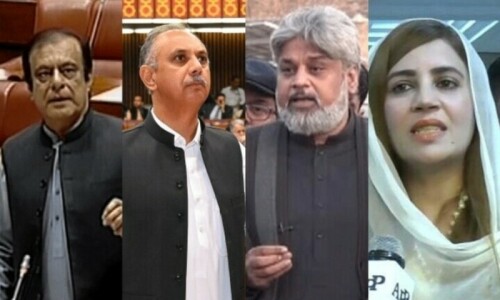
The opposition leader’s slot in the Senate had been lying vacant since August 2025, following the disqualification of the then-opposition leader, PTI’s Shibli Faraz. At the same time, PTI’s Omar Ayub, who was the opposition leader in the National Assembly (NA) back then, was also disqualified.
The two were disqualified by the Election Commission of Pakistan (ECP) after their convictions in cases related to the May 9, 2023, riots.
The PTI had then nominated in October last year Abbas as its candidate for the opposition leader’s position in the Senate and Pashtunkhwa Milli Awami Party chief Mehmood Khan Achakzai to fill the NA slot.
On Monday, PTI Senator Barrister Ali Zafar said Gilani had informed him that Abbas would be notified as the opposition leader in the upper house of Parliament by Tuesday (today).
Zafar had submitted a letter to the Senate chairperson, seeking the appointment of Abbas. In a post on X, Zafar had said that he also had a meeting with the Senate chairman regarding the appointment of the opposition leader.
Additional reporting by Iftikhar Khan