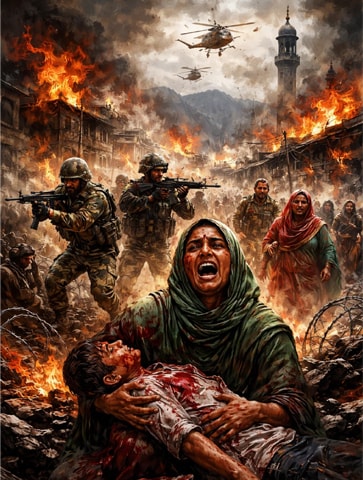
With well over half-a-million troops on the ground, the India-occupied Kashmir is practically a colony of India. The valley is a disputed state as per United Nations resolutions, but India regards Kashmiris as ‘terrorists’. The fact is that India has been practicing state-sponsored terrorism in occupied Kashmir, while it has been stoking terrorism in several countries.
Research and Analysis Wing (RAW) officer Bahukutumbi Raman, in his book The Kaoboys of R&AW: Down Memory Lane makes no bones about India’s involvement up to the level of prime minister in East Pakistan’s insurgency. Raman reminds the reader that Indian parliament had passed a resolution on March 31, 1971, in support of insurgency. Indira Gandhi had then confided with spymaster Rameshwar Nath Kao that in case Mujibur Rehman was prevented from ruling Pakistan, she would ‘liberate’ East Pakistan from the clutches of the junta.
Amar Bhushan in his book Terror in Islamabad reveals how he brazenly violated norms of diplomatic immunity to complete his missions. Bhushan happened to have served as a diplomat at the Indian High Commission in Islamabad. Before being posted to Islamabad, Bhushan had served as an intelligence officer at RAW and Border Security Force (BSF), among other such assignments, for a quarter of a century. His book mentions another RAW officer disguised as a diplomat who was posted in Pakistan.
Former Indian ambassador Bharath Raj Muthu Kumar, with the consent of Jaswant Singh, the then foreign minister, secretly coordinated military and medical assis-tance to the Northern Alliance, while India established a ‘Free Balochistan’ office in New Delhi under Naila Baloch. The inauguration was attended by many Indian intelligence officers.
India’s policy on Kashmir has been in a flux. On Nov 2, 1947, Jawaharlal Nehru declared in a radio broadcast that the Indian government was “prepared when peace and order have been established in Kashmir, to have a referendum held under international auspices like the United Nations”. The declassified Nehru Papers speak volumes about shifting Indian stands.
Till about 1953, New Delhi continued to reiterate that Kashmir was a disputed territory, and the Kashmiri people would be provided an opportunity to exercise the right to self-determination. Then India started saying that the UN resolutions on the dispute were of a mediatory nature, not mandatory. India had given a special state status to the disputed territory. It abolished that status and annexed the territory in 2019 in clear violation of the relevant UN Security Council resolutions passed in 1951 and 1957.
India’s attempt to equate freedom movement in Kashmir to ‘terrorism’ is futile. Kashmir is a simmering nuclear tinderbox. By violating UN resolutions, India qualifies to be labelled a rogue state. It should be subjected to sanctions. Besides Kashmir, there are other un-resolved disputes, like the annexation of Junagadh, Rann of Kutch and Kargil.
Amjed Jaaved
Rawalpindi
Published in Dawn, January 19th, 2026