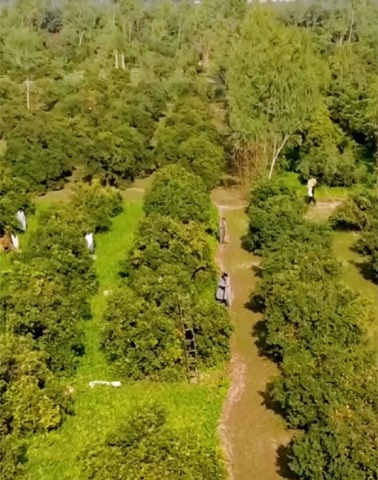
THE gate of a kinnow polishing and grading factory on the outskirts of Bhalwal, Sargodha district opens gingerly, and a middle-aged orchard owner steps in. His voice trembles as he makes an unusual request: “buy my kinnow at whatever rate you can”. The wedding date of his daughter is fixed, he says, and the fruit on his trees is the only asset he has left to turn into cash.
Factory managers hear such pleas daily this season. What was once routine commercial transaction has turned into human drama, reflecting a crisis engulfing Pakistan’s citrus economy — one shaped by closed borders, rising costs, policy neglect, and the shadow of international sanctions linked to Iran.
Pakistan’s kinnow exporters face a perfect storm as the traditional overland route to Russia and adjoining markets through Afghanistan remains effectively closed. For years, this corridor allowed kinnow to reach Russia, Ukraine and Central Asian Republics within six to nine days, keeping the fruit fresh and competitive.
With that route blocked due to tensions with Kabul on security affairs, exporters are diverting shipments through Iran — a route that takes around 25 days, significantly increasing transit time, costs and spoilage risk. What was once a backup option has become the primary route, and even that has become geopolitically risky.
The fruit, which could reach Russia within six to nine days through Afghanistan, now has to be routed through Iran. This journey takes 25 days, too long for perishable fruit. But Trump’s threat of 25pc tariff on countries trading with Iran has made even this backup route geopolitically risky
Adding to exporters’ anxiety are renewed threats by US President Donald Trump to impose a 25 per cent tariff on countries trading with Iran, raising fears that reliance on Iranian transit and markets could invite penalties or complicate access to Western destinations.
Govt claims vs reality
Last week, the federal government announced that Punjab’s farmers would be allowed to export kinnow and potatoes through “alternative routes”. Growers and exporters say the announcement offers little practical relief.
“Iran was never a newly opened route,” says Hanif Hanjra, a small orchard owner. “It has always been there, mainly used after Iran finishes its own mandarin crop. Calling it an alternative to Afghanistan is misleading.”
According to growers, Iran cannot replace the Afghan corridor in terms of speed or cost. “Through Afghanistan, kinnow would reach its destination fresh and competitive. Through Iran, the journey is simply too long for a perishable fruit. Resultantly, the shipment costs multiply manifold,” Hanjra says.
Growers recall that Pakistan’s presence in Russian, Ukrainian and Central Asian markets was built largely through exporters’ own initiatives, particularly after Asean countries restricted kinnow import as Pakistani authorities failed to meet required documentation due to alleged demands for bribes and bureaucratic inertia.
Sajid Wining, a grower-cum-exporter who remained Pakistan’s top fruit exporter for nearly 14 years, said he eventually exited the kinnow business due to chronic policy neglect. “At their peak, kinnow exports earned around $450 million annually,” he said. “Yet fruit and vegetable exports were never treated as a strategic priority.”
He also criticised the failure to develop seedless kinnow varieties, while competitors such as China and Egypt moved ahead with seedless mandarins, capturing premium markets.
Price crash amid bumper crop
The crisis has hit orchard owners brutally. A former MPA and ex-tehsil nazim of Sahiwal, Ghulam Ali Asghar Lahri, said juice factories are offering as little as Rs300 per maund.
He revealed that a contractor who had purchased his orchard for Rs27.5 million — paying Rs1.5 million as advance — walked away from the deal, forfeiting the amount because expected losses were far greater. “Some of my relatives are uprooting kinnow plants altogether,” Mr Lahri said. “They don’t see this crisis ending anytime soon.”
Mohammad Mohsin Warraich, patron of Anjuman Kashtkaran, Sargodha, said the irony is that this year’s kinnow crop is bumper and globally appreciated for its taste and appearance. Yet growers are being forced to sell at Rs1,200 per maund or even less, compared to Rs2,500–3,200 last season.
“Factory owners exploit growers by citing Afghan border closures,” he said. “But only C-grade kinnow goes to Afghanistan, and its production is very low this year. A-grade fruit is exported by sea, and that route is open.”
Mr Warraich added that Iran has, unlike previous years, reduced duties on kinnow imports and transit to Russia and CARs from the start of the season. “So why are prices collapsing?” he asked.
Former MPA and citrus grower Iftikhar Gondal said kinnow production costs have multiplied since the sharp devaluation of the rupee in 2022. Fertilisers, pesticides and labour have become prohibitively expensive, while returns have collapsed.
“One acre of kinnow orchard fetched around Rs100,000 last year; this season it is barely Rs30,000,” he said. “Many growers cannot even find buyers for their orchards.” This uncertainty has also led to a drastic drop in land contract rates — from Rs200,000 per acre annually to Rs70,000, he said.
Mr Gondal alleged that factory owners have formed cartels to fix rates, exploiting farmers while continuing exports. He estimated that nearly 30pc of kinnow orchards have already been uprooted, with farmers shifting to maize, sugarcane and other crops.
Zahoor Haral, a mid-level kinnow grower, warned that repeated crop shocks are pushing farmers toward selling land and migrating to cities or abroad. “The rural economy is collapsing,” he said, noting that contractors, labourers, transporters and shopkeepers all suffer when farmers lose purchasing power.
He dismissed the argument that low prices are driven by border closures alone. “Exporters buying kinnow at throwaway prices are not dumping it locally; they are shipping it abroad. So the excuse doesn’t hold.”
Shadow of sanctions
Hovering over the entire crisis is the geopolitical risk tied to Iran. Trump’s threat of a 25pc tariff on countries trading with Tehran has unnerved exporters, who fear that dependence on Iranian routes could expose them to penalties or market restrictions.
Growers are now calling for structural reforms: the creation of Kissan Markets to allow direct sales to consumers, promotion of value addition through juice, pulp and powder processing units, and the establishment of a Citrus Control Board —similar to the Sugarcane Control Board — to regulate pricing and transactions between growers and factories.
Until such measures are taken, orchard owners say scenes like the one at the factory gate — fathers pleading to sell fruit at any price to meet family obligations — will only multiply. And Pakistan risks losing not just export markets, but an entire citrus economy once considered a flagship of its agricultural exports, now squeezed between closed borders, rising costs and global politics far beyond farmers’ control.
Published in Dawn, January 19th, 2026