

FAST reveals insights into cosmic signals


 0
0
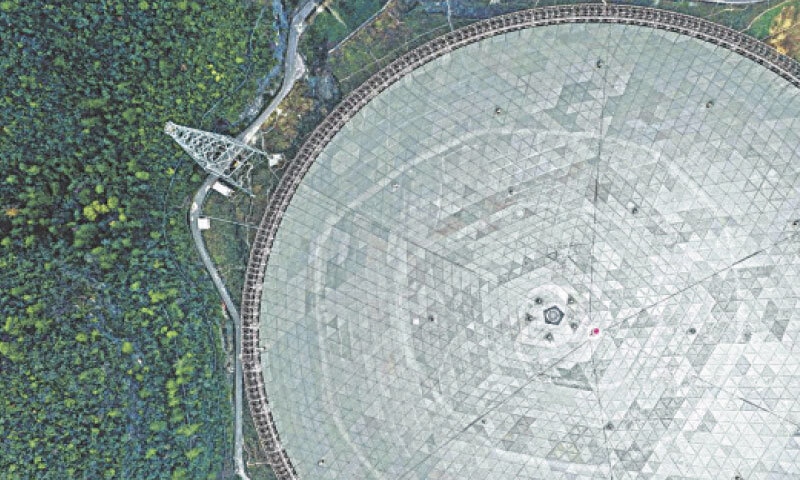

AN international research team using China’s 500-metre Aperture Spherical radio Telescope, or FAST, has found some of the strongest evidence yet suggesting that at least some fast radio bursts — mysterious flashes of radio energy from deep space — are produced by compact star binaries.
The discovery, published on Friday in the journal Science, comes from in-depth observations of a repeating fast radio burst known as FRB 20220529. This marks the first time globally that scientists have captured the evolutionary process of such a burst, aiding in narrowing down the long-debated origins of these brief yet powerful cosmic signals.
Fast radio bursts, akin to super lightning in the universe, are millisecond-duration phenomena of unidentified extragalactic origin, and are extremely bright and transient but release as much energy as our sun produces in over an entire week.
Since fast radio bursts were first discovered in 2007, astronomers have detected thousands of them, yet their exact cause has remained unclear. Many scientists suspect they originate from extremely dense stellar remnants such as neutron stars, but how they generate the bursts — and whether they do so alone or with a companion — has been an ongoing mystery.
The new study, led by astronomers from the Chinese Academy of Science’s Purple Mountain Observatory in Nanjing, Jiangsu province, utilized FAST — the world’s largest single-dish radio telescope — to monitor FRB 20220529 for more than two years, from June 2022 to August 2024.
Wu Xuefeng, corresponding author of the study and a researcher at the Purple Mountain Observatory, said, “This is the first time we have seen such a clear ‘surge and recovery’ in the magnetic environment of a fast radio burst.”
Published in Dawn, January 19th, 2026



























