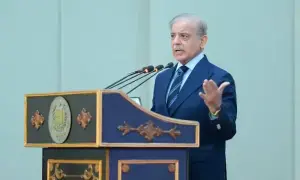
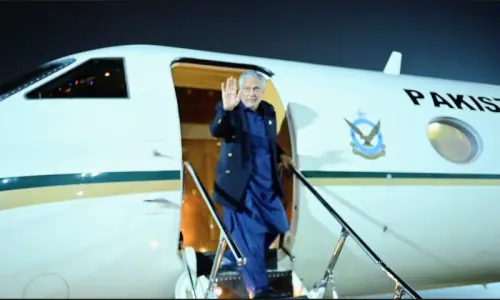
Deputy Prime Minister Ishaq Dar’s remarks at a business conference last week reflect growing political pressure on the government to redirect the sluggish economy, which has produced the decades-high levels of unemployment and poverty in the last two to three years, towards growth. He said Prime Minister Shehbaz Sharif’s government would now focus on increasing national output until the end of his tenure, arguing that jobs can only be generated through sustained economic expansion.
“After achieving stability, we will now move towards economic growth and will engage the International Monetary Fund [IMF] as well,” he declared at the Pakistan Policy Dialogue organised by the Policy Research and Advisory Council (PRAC) in Islamabad.
His pronouncement came days after planning minister Ahsan Iqbal had expressed similar thoughts, saying a panel led by him had proposed to the prime minister after consultations with stakeholders to declare “export emergency” to put the country back on the road to growth after a prolonged period of stabilisation under the IMF.
The planned export emergency will target to raise exports by 40 per cent over four years and by around 200pc in 10 years by removing administrative bottlenecks faced by exporters in order to end the country’s dependence on the IMF bailouts.
Critics of stabilisation highlight the increasingly visible socioeconomic costs of prolonged economic stagnation
Mr Dar said, given the country’s annual population growth of 2.6pc, an economic expansion below this rate effectively amounts to negative growth, and that this view was shared with the prime minister in recent discussions over the state of the economy. His assertion that the IMF programmes are “generally anti-growth” reflects both political pressure from within and beyond the ruling PML-N, as well as the economic fatigue being felt by businesses and ordinary people.
The statements of the two key government ministers, especially Mr Dar, who holds sway over most economic policy matters, signify the urgency of the situation amid reports that certain powerful quarters are not happy with the economy’s weak performance and are pushing for changes in the government’s finance team and economic strategy to accelerate growth.
Voicing these feelings, Younus Dagha, Chairman of PRAC, pointed out that high poverty levels, widespread unemployment, a punitive tax regime that increased the tax burden on the salaried class by 230pc, a freeze in investment and capital flight are outcomes of stabilisation policies.
“The critique of stabilisation does highlight the increasingly visible socioeconomic costs of prolonged economic stagnation. There is little doubt that poverty and unemployment have worsened. Tight monetary policy, sharp fiscal contraction and aggressive revenue measures have compressed demand, stalled private investment and eroded household purchasing power. The question is: what choice did the nation have?” discussed a professor of economics who requested anonymity.
“The issue is not stabilisation but lack of growth reforms. Attributing capital flight and investment paralysis solely to stabilisation policies risks oversimplification. Investors are deterred not just by austerity but by persistent structural failures: policy unpredictability, an inequitable tax system, weak contract enforcement, an unreformed energy sector and so on. Stabilisation did not create these problems; it just exposed them,” she said.
“The deeper issue is that adjustment in Pakistan has been extractive rather than reformative. Taxes were raised without broadening the base, and development spending was cut without public-sector restructuring. Energy prices are raised without fixing the power and gas sector losses. The stabilisation period was supposed to provide policymakers with an opportunity to implement politically tough, credible reforms for moving the economy back towards sustainable growth. However, this window is now closing fast. Going forward, the government will face mounting political pressure for rapid economic growth as it approaches the end of its tenure.”
That said, it seems that key government figures realise the impossibility of returning to growth without a strong external sector. Mr Dar also acknowledged at the conference that the external sector remains the economy’s most binding constraint and that repairing it would take time.
Mr Iqbal says Pakistan could potentially achieve 6pc economic growth by 2035, but warns that it would trigger another balance-of-payments crisis within two years unless the economy’s structural weaknesses were addressed and export revenues boosted quickly. Finance Minister Muhammad Aurangzeb, too, argued that sustainable growth, rather than short-lived expansion, must now be the policy priority. Even Mr Dar clarified that the government had no immediate plan to push growth to 6pc, and that reaching such a level would realistically take two to three years. “We are systematically addressing long-standing inefficiencies,” he said.
Yet, it is increasingly becoming clear that the current “stability” has its own innate contradictions and can hardly be sustained for long as it is achieved by stifling the economy, curbing development spending, restricting imports and accumulating expensive debt.
Three years of stabilisation may have prevented immediate collapse, but it is increasingly undermining its own sustainability by suppressing investment, productivity and exports. A way has to be found to return to growth before this stability turns into another crisis.
With official and private foreign inflows drying up amid stagnating exports, the government policymakers appear clueless as to how to turn the tide. That makes their job of putting the economy on a growth trajectory even more formidable. Political rhetoric sans credible reforms can do only so much.
Published in Dawn, The Business and Finance Weekly, January 19th, 2026