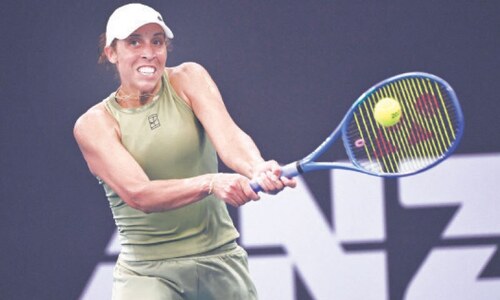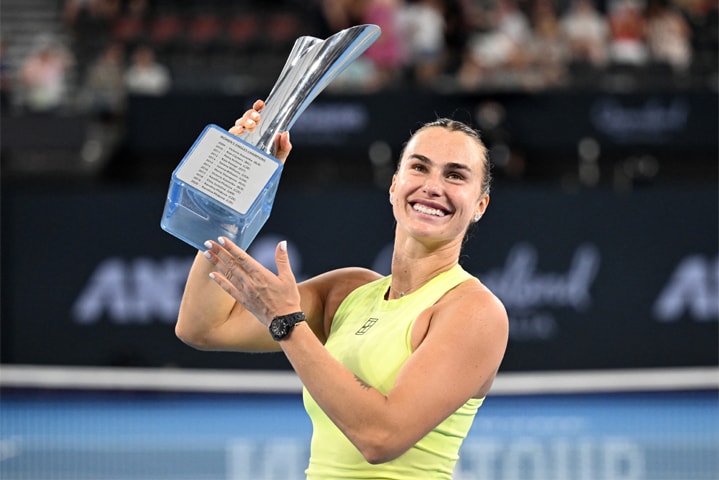
BRISBANE: World number one Aryna Sabalenka warmed up for a tilt at a third Australian open title in four years in ominous fashion by winning her second successive Brisbane International crown on Sunday.
Sabalenka scored a dominant 6-4, 6-3 win over Marta Kostyuk in just 78 minutes.
“Every day you go out there and prove your level, and I think this week I did it really well,” said Sabalenka after a tournament in which she powered to the title without dropping a set.
Looking ahead to the Australian Open, which begins next Sunday, Sabalenka said: “The only thing I know is that I’ll be there, I’ll be fighting.”
Salablenka lost in the Melbourne Park final last year to Madison Keys, having been Australian Open champion in 2023 and 2024.
“I’ll do my best to go as far as possible,” said Sabalenka. “And do a little bit better than last year. That’s my focus.”
Kostyuk, the world number 26, had enjoyed a spectacular week, beating three top 10 players on the way to the final.
But she had no answer to the power of Sabalenka and the Ukrainian’s serve, so reliable in the early rounds, also went off the boil.
Sabalenka was rarely troubled on her own delivery and faced only three break points.
The 27-year-old Belarusian said she had tried to introduce new elements to her game so she wasn’t relying just on power, and that had paid off this week.
“I finally found the touch game,” she said.“I figured something and I kind of changed my game style — now I’m not only the aggressive player, I can play at the net, I can be in defence, I can use my slice, I have a good touch.
“I’m super happy to see that things are clicking together.”
There has been animosity between the two players in the past.
Like many Ukraine players, Kostyuk refuses to shake hands with Russians or Belarusians because of the war in her homeland.
There was no handshake at the end of the final and in her speech at the trophy presentation, Kostyuk brought up the situation in Ukraine.
“I play every day with a pain in my heart and there are thousands of people who are without light and warm water right now,” she said.
“It’s minus 20 degrees outside and it’s very painful to live this reality every day.”
Sabalenka said she wasn’t concerned by Kostyuk’s attitude towards her.
“It’s their position, what can I do?,” she asked. “When I go out there, I think about my tennis and the things I have to do to get the win.
“It doesn’t matter if it’s Marta Kostyuk or Jessica Pegula there. I have nothing to prove. I go there and I just compete as an athlete.”
Kostyuk told reporters she was determined to keep what is happening in Ukraine in the public eye.
Published in Dawn, January 12th, 2026