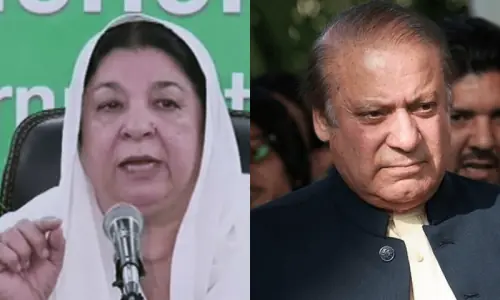
Tribunal cites court verdicts for rejecting Yasmin Rashid’s plea


LAHORE: An election tribunal has declared that the superior courts have passed a plethora of judgements holding that the non-compliance of statutory requirements under the Election Act 2017 results in the summary rejection of an election petition.
The tribunal presided over by retired justice Rana Zahid Mehmood issued a detailed judgment on an election petition filed by incarcerated PTI-Punjab president Dr Yasmin Rashid challenging the victory of PML-N president and former prime minister Nawaz Sharif from NA-130, Lahore.
Dr Rashid, who contested the election as an independent candidate, stood the runner-up in the election with 104,491 votes, and alleged that the official results—which declared Nawaz Sharif the winner with 179,312 votes—were the outcome of a systematic fraud.
Her petition outlined several grievances including allegations of rigging, the unlawful replacement of the returning officer and illegally changed results.
Finds petition legally untenable as it fails to meet statutory requirements
Her legal team argued that according to Form-45 data, she had actually won by a lead of 20,895 votes, securing 99,428 votes against Sharif’s 78,533.
The PTI leader was represented by a legal team led by senior lawyer Ahmad Awais.
Barrister Asadullah Chattha, the counsel for Nawaz, raised several patent statutory defects that barred the petition from proceeding to a full trial.
He pointed out that the petition was not filed by Dr Rashid herself but by her husband through a special attorney.
The tribunal noted that section 139 (1) of the Act strictly requires the candidate himself to file the election petition.
The election petition was filed on April 16, 2024, which the tribunal found to be 16 days past the mandatory 45-day deadline following the official gazette notification of the returning candidate.
The tribunal noted that the verification of the petition was also incomplete, failing to specify the exact day in April 2024 when it was signed.
The counsel for Dr Rashid also failed to provide an affidavit of service confirming that copies of the petition and all evidence were sent to all 17 respondents via registered post, a mandatory requirement under Section 144.
The counsel for the petitioner submitted that due to some human lapse the affidavit perhaps either could not be placed on record or somehow misplaced from the election petition.
Therefore, he argued, no adverse inference can be drawn against the petitioner in this regard.
In its verdict, the tribunal asserted that section 145(1) of the Elections Act acts as a legal barrier, mandating the summary rejection of any petition that fails to comply with sections 142, 143 and 144.
While the petitioner’s counsel argued that the alleged grave corrupt practices should outweigh technicalities, the tribunal maintained that adherence to the special statute’s procedures is a condition precedent for any election challenge.
To reject this argument of the petitioner’s counsel, the tribunal relied upon seven judgements of the superior courts including a judgement passed in a 2019 challenge to the victory of election of former prime minister Imran Khan in 2018 polls.
As the election petition of Dr Rashid was filed through an attorney, missed the deadline and lacked the necessary service affidavits, the tribunal found it to be legally untenable.
The tribunal, through a short order, had dismissed the petition on Dec 30, 2025.
Published in Dawn, January 8th, 2026