Rallies across AJK mark Right to Self-Determination Day


 0
0
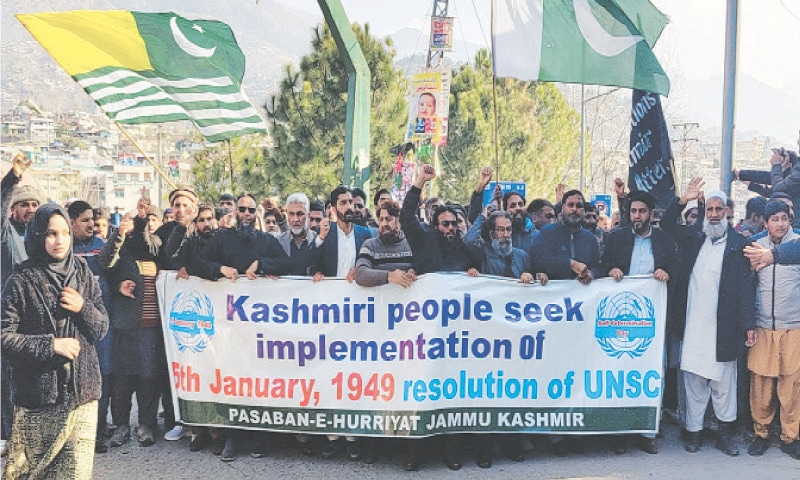

MUZAFFARABAD: Rallies and seminars were held across Azad Jammu and Kashmir (AJK) on Monday to mark the Right to Self-Determination Day, with participants urging the United Nations to implement its January 5 resolution on Kashmir as a prerequisite for lasting peace in South Asia.
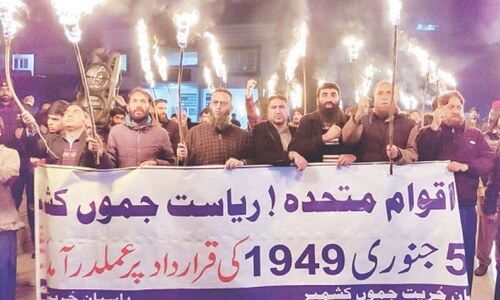
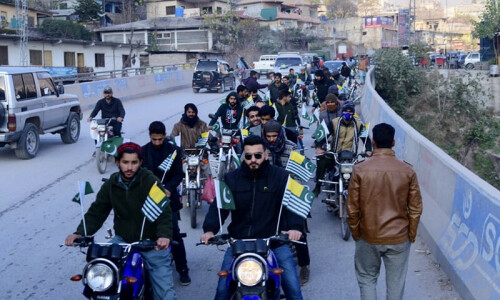
In Muzaffarabad, Pasban-i-Hurriyat Jammu Kashmir (PHJK), an organisation of post-1989 migrants from Indian-occupied Kashmir, organised a rally that drew a large number of participants, including women, children and elderly citizens. The march began at Burhan Wani Shaheed Chowk and proceeded to the UN Observers’ Office near Domel - the confluence of the Neelum and Jhelum rivers.
Participants carried banners and placards highlighting flagrant human rights violations in Indian-occupied Kashmir and demanding the right to self-determination, which they said had repeatedly been pledged to the Kashmiri people by the international community and India itself.
Addressing the gathering, Legislative Assembly Speaker Chaudhry Latif Akbar called upon the United Nations to ensure implementation of its own resolutions to resolve the Kashmir dispute. He said the January 5 resolution provided a clear roadmap for settlement of the issue and that the Kashmiri people had been waiting for its enforcement for decades.
PHJK chairman Uzair Ahmed Ghazali said the people of Jammu and Kashmir wanted to determine their political future through a UN-supervised process, as envisaged in the Security Council resolutions. He urged the international community and global human rights organisations to play a more effective role in addressing the situation in the disputed territory, including securing the release of political prisoners.
Participants raised slogans against Indian military presence and reaffirmed their resolve to continue their struggle for the right to self-determination until their demands were met.
Similar rallies were held at several district headquarters, while a seminar was organised at Kashmir House in Islamabad,with senior most minister Mian Abdul Waheed, former presidents Sardar Yaqoob Khan, Sardar Muhammad Masood Khan, former premiers Raja Farooq Haider and Sardar Attique Ahmed Khan, and APHC leader Altaf Ahmed Bhat among the prominent speakers.
Separately, AJK Prime Minister Raja Faisal Mumtaz Rathore, who was in Islamabad, attended a seminar organised by the Friends of Kashmir at the Pakistan Institute of Parliamentary Services.
He said January 5 served as a reminder of the UN’s unfulfilled commitments to the Kashmiri people and urged the world body to take effective notice of the situation in Indian-occupied Kashmir. He maintained that Kashmir remained a disputed territory and the Kashmiri struggle, marked by decades of sacrifices, could not be ignored indefinitely.
Meanwhile, speakers at a conference here on Monday urged the international community to prevail upon India to implement United Nations resolutions on Kashmir.
The Institute of Strategic Studies, Islamabad (ISSI), in collaboration with the Kashmir Institute of International Relations (KIIR) and the All Parties Hurriyet Conference (APHC), organised the conference titled “January 5: The Call for Self-Determination in Jammu and Kashmir.”
Altaf Hussain Wani, Chairman of the Kashmir Institute of International Relations, Islamabad, said there are a number of UN resolutions on Kashmir, but the UNCIP resolution of January 5, 1949, provided a roadmap towards a solution to the Jammu and Kashmir dispute. He said India knew from the outset that it would forcibly occupy the Muslim-majority princely state.
He said India approached the UN claiming that the Maharaja had already signed the Instrument of Accession with India and sought to have Pakistan declared an aggressor. However, he added, the Maharaja had already relinquished his authority and fled the region. The UN subsequently decided that the people of Jammu and Kashmir should determine their own future.
He said the UN maintained the same position even after India attempted to mislead it by holding Constituent Assembly elections in the region under its occupation and arguing that the polls reflected the will of the people to remain with India. He encouraged the younger generation to understand the Jammu and Kashmir dispute in its true perspective and to become future diplomats for the Kashmir cause.
Farooq Rehmani, a senior leader and former convener of the All Parties Hurriyet Conference, said India never intended to implement UN resolutions and therefore complicated the process by raising one objection after another.
He said the ceasefire was meant to bring peace to the region, but India used it to divide Azad Jammu and Kashmir from Indian-occupied Jammu and Kashmir.
He added that the 1990s witnessed one of the worst phases of human rights violations in Indian-occupied Jammu and Kashmir, during which unmarked graves were discovered across the region.
He said that since August 2019, India has been actively pursuing an agenda of demographic change, with thousands of domicile certificates issued to non-Kashmiri Indians, while the Kashmiri leadership continues to languish in jails.
Director of the India Study Centre, Dr Khurram Abbas, said that on this date in 1949, the UNCIP acknowledged the right of self-determination of the Kashmiri people. However, he said, after almost 78 years, the people of Jammu and Kashmir are still waiting to exercise this right. He added that the relevance of the resolution had increased manifold after August 5, 2019.
Members of the think tank community, intellectuals and a large number of students attended the event.
Published in Dawn, January 6th, 2026