

BORDERING a water-crisis riddled Iran, Iraq is enduring the worst drought of its recent history as 2025 has been registered as the driest year since 1933. The Tigris and Euphrates rivers, known as cradles of the Mesopotamian civilisation, are yearning for water. Flows have plummeted by one third in some areas. Pollution has intensified due to insufficient flows required for dilution. Upstream damming by Turkiye, climate change, drought and pollution have deprived these rivers of their past glory.
Rising from Turkiye, the two rivers traverse through eastern Anatolia, Syria, and Iraq, before debouching into the Gulf. These rivers have shaped society, economy, politics and livelihoods of over 60 million people in the region. The rivers have been shackled by a series of dams upstream. Turkiye’s appetite for hydel energy has diverted large quantities of water within its territory. The recently constructed Ilisu Dam by Turkiye on the Tigris has triggered a regional spat involving Iraq and Syria downstream. This dam has a colossal storage capacity of 8.4m acre feet. It is one of the 22 dams and 19 hydroelectric power plants under Turkiye’s Southeastern Anatolia Project. Iran has also built dams on some tributaries of the Tigris falling within its borders. The series of dams have reduced Iraq’s water supply from the two rivers by a staggering 80 per cent since the 1960s. As freshwater flows declined in the Tigris, its delta is being devoured by sea intrusion from the Gulf.
Climate change is further intensifying tensions on the Tigris and Euphrates. Temperature in the basin rises to twice the global average, thus making it one of the most vulnerable watersheds. In 2020 and 2021 the region witnessed the second driest seasons in four decades. Prognosis of water availability by the end of the century is ominous as the flows of the Euphrates and Tigris are projected to decrease by 30 and 60pc respectively. A war-withered Iraq harvested 40pc less wheat in 2022 due to drought. Syria also experienced a sharp decline in wheat output in 2022 with a production of one million tons compared with 2.8m tons in 2020. As the drought aggravates, the ministry of water resources in Iraq has issued a sinister warning that the Euphrates could run dry by 2040.
Iraq has warned that the Euphrates could run dry by 2040.
Iraq and Syria had state-of-the-art water infrastructure before the region descended into chaos. Operation Desert Storm in 1991 left devastating consequences for Iraq. The US strafed sewage treatment plants and destroyed vital water infrastructure. Iraq’s vibrant economy collapsed, depriving the government of the ability to repair the damaged sanitation system, and sewage continued to pollute water bodies. In 2018, 118,000 patients in Basra received treatment in hospital after consuming contaminated water.
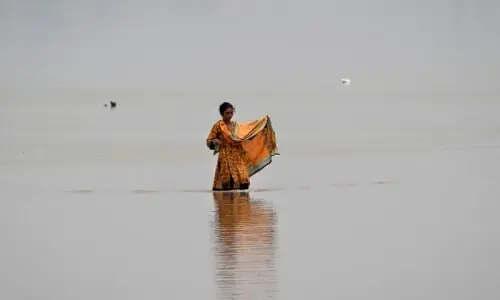
Iraq and Syria are ‘prisoners’ of their hydro-geography as Turkiye controls flows of the two rivers upstream. Both lower riparian countries hold Turkiye responsible for their plight by not releasing adequate water from its dams. Towns and villages along the rivers are facing acute water shortages and rationing. Farming and fishing, as sources of livelihood, are shrinking. People walk for miles to fetch drinking water. Climate change is adding more complexity as Iraq has recorded 30pc less precipitation amid ever-increasing water demand.
Recently, Baghdad and Ankara agreed on a mechanism of water governance that includes stopping pollution, adopting modern irrigation technologies, reclaiming agricultural land, and improving water governance. The deal, known as the
“oil-for-water” accord, makes Turkish companies responsible for constructing crucial water infrastructure against revenues from Iraqi oil. However, sceptics dismissed the agreement for both governments allegedly keeping a lid on critical details. Iraq and Syria accuse Turkiye of weaponising water. This complex situation has propelled a demand for a multilateral water agreement among all riparian countries, including Iraq, Iran, Turkiye, Syria and possibly Saudi Arabia and Jordan, two small shareholders on water from the Euphrates.
The plight of Iraq and Syria is a textbook lesson of typical downstream disadvantage on shared rivers. Our regional landscape is not much different. As Pakistan is grappling with Indian hegemony on three eastern rivers, interprovincial disagreement on its rivers is also testing internal political harmony. Spiralling population, poor water governance, controversy over new dams, ageing infrastructure, archaic irrigation practices, relentless pollution, distorted markets, ecologically devastated delta, weak institutions and transboundary conflict are some of the common features resembling the situation with Iraq and Syria.
The writer is a civil society professional.
nmemon2004@yahoo.com
Published in Dawn, December 25th, 2025