0
0
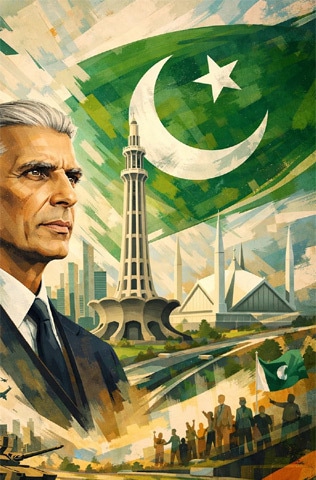
QUAID-i-Azam Mohammad Ali Jinnah’s vision was instrumental in shaping Pakistan as a unified, democratic and non-theocratic country out of a diverse collective of nationalities and communities. He was a man of firm principles and a courageous leader known for his integrity, uprightness and unwavering commitment to his vision and ideals.
He entered politics with the 1906 session of the Indian National Congress, and was elected to the Imperial Legislative Council in 1910. Jinnah soon became a leader of a group inside the legislature. His contribution to national politics was transformative, evolving from advocating Hindu-Muslim unity and constitutional reforms within Congress.
The Lucknow Pact in1916 represented a milestone in the evolution of Indian politics because it conceded Muslims the right to separate electorate, reservation of seats in the legislatures, and weightage in representation both at the centre and the minority provinces.
The Quaid-i-Azam played a key role for Hindu-Muslim unity, but subsequent events convinced him that a federal model would not adequately protect the rights and interests of Muslims. This in later years led to Jinnah’s decision to focus his energies on ensuring the political emancipation of Muslims.
Thus came the eventual demand for a separate Muslim homeland. Jinnah won the battle of independence in the shape of Pakistan. After winning the hard-earned battle, the Quaid envisioned a system based on the principles of Islam, which he saw as embodying equality, justice and fairness for all citizens regardless of their religion. The key elements of his political culture were based on equal rights, people’s participation in govern-
ment, promotion of social justice and economic prosperity for the people, and women’s empowerment in all domains of national life.
The country’s elite must learn the simple lesson that the success of civilian supre-
macy is a reality only in countries where the focus of people at the helm of affairs is on human, social and economic development. As we celebrate Quaid’s birth anniversary today, the political parties must realise that they have failed to put in place a system based on accountability, professionalism and integrity.
The Quaid dreamt of a parliamentary democracy based on multiparty system that could bring together diverse groups. But the present political culture is feudal, tribal and ultra-conservative, which has no sense of accommodation and compromise.
It is the negation of his ideals of a political culture that encourages constructive, continuous dialogue among different political groups, fostering a culture of democratic accommodation.
The Quaid’s vision reminds us that democracy’s greatest strength lies not in its ability to impose uniformity, but in its capacity to create unity while preserving diversity.
The country’s power elite, today, must remember that democracy is a tool for national integration because it is the only political system that has the potential to work wonders in societies with diversity.
Dr A.Z. Hilali
Islamabad
Published in Dawn, December 25th, 2025