Iran, UK foreign ministers in rare direct contact


 0
0


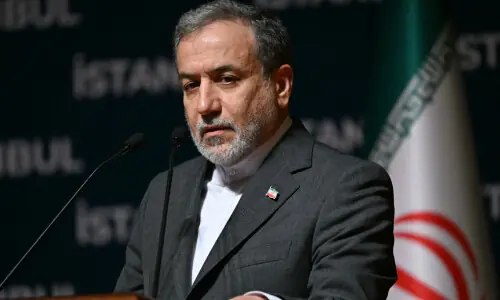
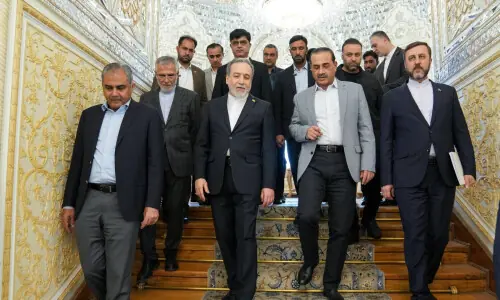
TEHRAN: Iran’s Foreign Minister Abbas Araghchi has spoken by phone with his British counterpart Yvette Cooper, an Iranian foreign ministry statement said on Saturday, in a rare case of direct contact between the two countries.
The ministry said that in Friday’s call the ministers “stressed the need to continue consultations at various levels to strengthen mutual understanding and pursue issues of mutual interest”.
A UK government source said Cooper “emphasised the need for a diplomatic solution on Iran’s nuclear programme and raised a number of other issues”.
The source in London said Cooper raised the case of Lindsay and Craig Foreman, a British couple detained in Iran for nearly a year on suspicion of espionage.
The Iranian ministry statement did not mention the case of the two Britons.
It said Araghchi criticised “the irresponsible approach of the three European countries towards the Iranian nuclear issue”, referring to Britain, France and Germany.
The three countries at the end of September initiated the reinstatement of UN sanctions against Iran because of its nuclear programme.
The Foremans, both in their early fifties, were seized in January as they passed through Kerman, in central Iran, while on a round-the-world motorbike trip.
Iran accuses the couple of entering the country pretending to be tourists so as to gather information for foreign intelligence services, an allegation the couple’s family rejects.
Before Friday’s call, the last exchange between the two ministers was in October.
Man executed
Iran has put to death a man accused of spying for Israel, the latest execution since a 12-day June war between the archenemies, the judiciary’s press agency announced on Saturday.
“The death sentence for Aghil Keshavarz, found guilty of spying for the Zionist regime, communicating and cooperating with the regime, and taking photographs of military and security sites, was carried out after being upheld by the Supreme Court and following legal procedures,” the Mizan agency reported.
The man, described as an agent of Israel’s Mossad foreign intelligence service, had been arrested between April and May in Urmia in northwestern Iran, it added.
The court was presented with the man’s confession, Mizan said.
“Photographing targeted locations, planting tracking devices, conducting opinion polling, and examining traffic patterns in specific routes were among the missions Aghil Keshavarz carried out on the orders of Mossad officers,” it added.
On June 13, Israel launched an unprecedented attack on Iran, striking military and nuclear sites, as well as residential areas.
That attack triggered a 12-day conflict in which Iran responded with drone and missile attacks on Israel, and later saw the United States join Israel in striking Iranian nuclear sites.
The June war derailed high-level diplomacy between Tehran and Washington aimed at reaching a new deal over Iran’s nuclear programme.
The war was the first sustained conflict between Iran and Israel after sporadic tit-for-tat attacks in 2024 that stopped short of open warfare. A ceasefire between Iran and Israel took effect on June 24.
Since the war, Iran has promised swift trials for those arrested on suspicion of collaborating with Israel. It has announced multiple arrests and the executions of at least 10 people convicted of working with Mossad.
Iran, which does not recognise Israel, has long accused it of conducting sabotage operations against its nuclear facilities and assassinating its scientists.
In October, Tehran toughened its legislation and penalties for people accused of spying for Israel and the United States, who will now “be punished by the confiscation of all assets… and subject to the death penalty”.
A previous law did not target any specific country, and espionage was not necessarily punishable by death.
Published in Dawn, December 21st, 2025