Dollar shortage continues as exchanges run dry


 10
10
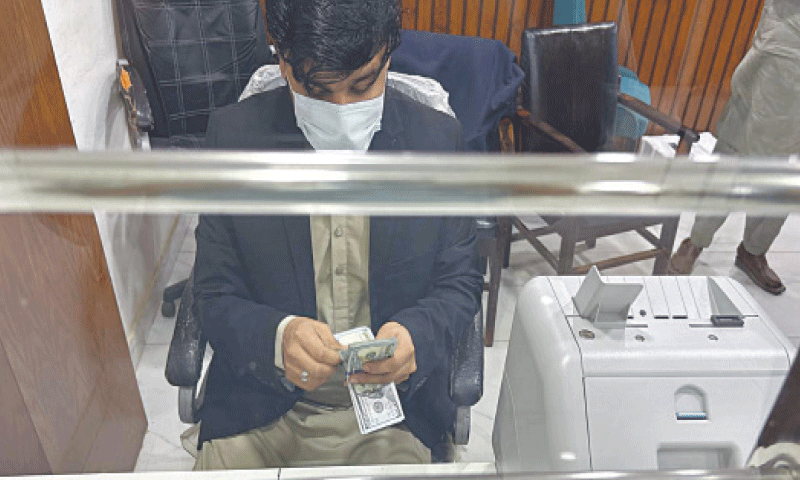

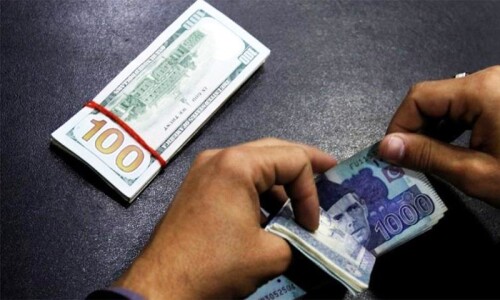
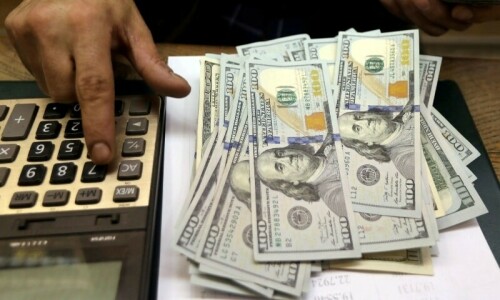
KARACHI: Despite authorities’ best efforts, there is a dire shortage of dollars in the open market, and many currency exchanges are “only selling what they buy”, causing consternation among those planning to travel abroad for the holidays, or in the new year.
Visits to multiple exchange outlets across different parts of the metropolis revealed that currency dealers are facing a dearth of greenbacks in their accounts. Some have stopped selling dollars altogether, while others are rationing their supply, only allowing customers to purchase up to $100 at a time.
In addition, a small number of exchanges only have old-design dollar notes in stock. These are not of much use to travellers who wish to exchange greenbacks for the local currency of their destination.
As a result, a number of passengers have been forced to purchase exotic foreign currencies in Pakistan, leading to them getting a ‘bad deal’ in terms of the exchange rate.
One such passenger, who was travelling to Malaysia at the end of November, told Dawn that they were unable to buy dollars at the airport, which they hoped to exchange for ringgit in Kuala Lumpur. Just hours before their flight, they settled for an exorbitant exchange rate in the open market: Rs74.5 for a ringgit.
Strict regulatory measures compound the situation; exchanges are only selling what they buy
According to them, they were worse off as the exchange rate should have been less than Rs70. Mid-market exchange rate (MMER) data available on Wise confirms this speculation for the given period, as it lists the MMER for a ringgit at roughly Rs68.
But the buck doesn’t stop at travellers. In fact, another group of non-speculative buyers has been hit hard by the shortage: students. Dawn spoke to a Lahore resident who was unable to buy dollars even after visiting 11 different exchange companies to support their siblings’ education expenses.
This shortage, some argue, can also be attributed to recent changes to SOPs surrounding the exchange of currencies. Biometric verification and the requirement of an original CNIC were among the changes previously made. But recent changes include an SBP circular dated November 14, mandating exchange companies to issue cheques to customers wishing to buy dollars for deposit into their foreign currency accounts. A more recent circular adds another layer of verification that is not easily accessible for women who wear veil: facial recognition.
Even with these new SOPs, one exchange we spoke to was willing to accept a digital CNIC, after initially hesitating to sell even a single greenback. While three other exchanges that initially hesitated became willing to sell up to $100, provided an original CNIC was available.
In contrast, only five exchanges visited by Dawn, were willing to sell dollars without hesitation, whereas seven exchanges outright refused to sell dollars. An employee highlighted the shortage and the lack of customers willing to supply greenbacks to the open market.
Exchange Companies Association of Pakistan Chairman Malik Bostan acknowledged the difference in demand and supply, said when a currency was not available, the exchanges were supposed to “note down customer information” and arrange it for them.
Impact of digital currencies
Despite shortage at the exchanges, dollars are still becoming more accessible than ever, through digital currencies pegged to the dollar, a type of transaction that is currently against SBP instructions for banks.
Pakistan Banks Association Secretary Mir Nejib Rahman said that “no bank can operationally engage with stablecoins or crypto rails” until SBP issues the relevant regulations and supervisory framework, which can only happen once Pakistan Virtual Assets Regulatory Authority (PVARA) published its detailed guidelines.
Mr Bostan also noted his concerns related to illegal activity moving towards unregulated crypto rails, and cited the PVARA chairman’s references to 40 million crypto users who may have lost money as a result of the recent drop in Bitcoin’s value. Experts previously warned that this shortage indicates illegal operators entering the market, and “while smuggling has been largely controlled, hoarding is becoming increasingly likely”.
Dawn reached out to SBP for comment, but no response was received.
Published in Dawn, December 21st, 2025