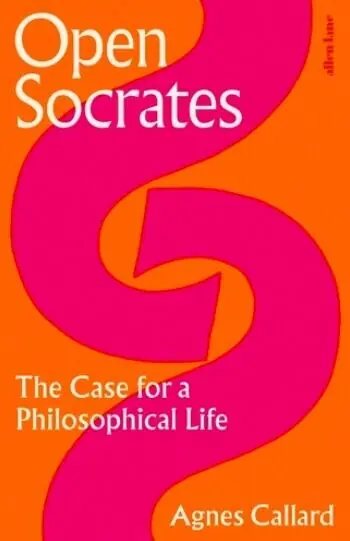
Open Socrates: The Case for a Philosophical Life
By Agnes Callard
Penguin Books
ISBN: 978-024147619-2
405pp.
We often encounter stories of people confronting life’s most profound questions only when death is near. Several books, written by those diagnosed with terminal illnesses, are filled with advice about what truly matters in life and refer to the prospect of death as a “putter of things in perspective”, as Simon Boas puts it in A Beginner’s Guide to Dying. Yet, to delay such reflection until life’s closing chapter is to put the cart before the horse.
In Open Socrates: The Case for a Philosophical Life, Agnes Callard, a philosopher at the University of Chicago, challenges the tendency to defer life’s most important questions — such as why we live as we do; what justice and courage are; how we ought to face death. Instead, she advocates for living reflectively and thoughtfully throughout our lives.
We avoid an engagement with fundamental questions because we assume we already possess the answers. Too often, those answers are driven by fleeting impulses of pleasure and pain, or by the social pressure to conform. By relying on those unexamined answers, Callard argues, we fail to ask life’s questions for ourselves and risk living only for “the next fifteen minutes in life.” This leads us to make inconsistent choices at different moments in life and consigns us to “a lifetime of wavering.”
As an alternative, Callard advances neo-Socratic ethics as a guide for navigating life’s complexities. She sets the Socratic approach against the three dominant ethical traditions of Utilitarianism, Kantianism and Aristotelian Virtue Ethics. Each of these traditions resolves moral dilemmas by suggesting adherence to a fixed principle, such as maximising the greatest good of the greatest number, respecting others’ dignity or cultivating character virtues. The Socratic approach offers no specific normative ideals and proposes ‘inquiry’ as a path to reach answers.
A book by a philosopher advances neo-Socratic ethics as a guide for navigating life’s complexities, arguing that constant critical self-examination is important and that thinking should be viewed as a social rather than a solitary enterprise
Callard, however, argues that the Socratic approach is more than a method or style of thinking. She presents it as an ethical system that calls for living a life “oriented towards knowledge.” From Socrates’ perspective, our struggles in life stem from a lack of knowledge, and the remedy lies in engaging in the “right kind of conversations” and committing to a life of inquiry. Such a life requires us to be open-minded, aiming to avoid error and striving to seek the truth.
Open-mindedness and the pursuit of truth require a willingness to admit when we are wrong. Socratic inquisitive conversations were characterised by revealing the ignorance of those who believed themselves to be knowledgeable. Through interrogation and refutation, Socrates led his interlocutors to the point where they were compelled to contradict themselves.
This kind of critical self-examination is challenging, since we rarely have the distance to view our beliefs objectively. Yet, it becomes possible when another person serves as a mirror, by questioning our assumptions. In this way, Socratic inquiry is not a solitary exercise but a fundamentally collaborative activity, which makes thinking a social enterprise.
When practised alone, the search for truth is a two-stage process that involves first discarding falsehoods and then affirming what is true. Socrates, however, saw these as inseparable tasks that are best carried out simultaneously in dialogue. In this exchange, one participant offers answers while the other tests their validity through questioning. Both are committed to the principle of “persuade or be persuaded.”
Socrates made intellectual progress on different subjects through dialogues. However, such progress is far less likely to be achieved if we start a conversation to win an argument and not to discover. As Callard observes, “People find it hard to accept that thinking is a social activity. We persist in seeing it as a private, inner activity. When someone is trying to think with you, you experience that as competitive — as though they were vying with you.”
Socratic inquiry is, thus, cooperative and not adversarial. It is not a contest in which one person’s benefit entails another’s loss. In the pursuit of truth, the refutation of false answers benefits both parties. Socrates was as pleased to be refuted as to refute, because either outcome marked intellectual progress. We, too, should welcome refutation, as it frees us from incorrect beliefs.
Socrates believed that if inquiry is carried through to its logical end, it can dissolve apparent moral dilemmas. Take, for instance, the claim that helping others may be disadvantageous for the one who helps. For Socrates, this is a false predicament. In the Socratic world, things are either “good” or “bad”. There are no separate kinds of good, such as good for me versus good for others. What appears as a conflict often reflects our inability to determine whether the act in question is truly good or bad. Such confusion typically arises when inquiry is abandoned too soon, and we disguise our uncertainty in a dilemma.
In a similar vein, Socrates dismisses the idea of revenge as a logical impossibility. The notion of retaliation suggests that a wrongful act can become justified when committed in response to provocation. Yet, if harming others is wrong, it cannot be made right by couching it as a “wrong in return.”
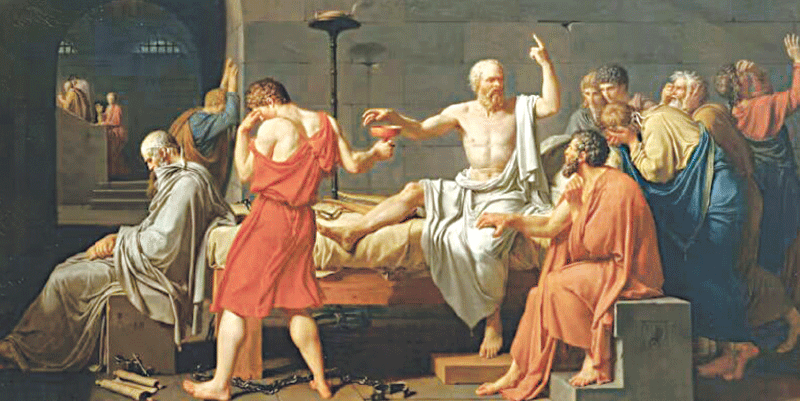
Socratic ethics, Callard suggests, can also equip us to face death with composure. Our panic at mortality stems from never having seriously thought about it before. To illustrate this point, Callard contrasts the experience of Ivan Ilyich in Leo Tolstoy’s The Death of Ivan Ilyich with Socrates’ final moments in Plato’s Phaedo.
Ivan Ilyich faces his impending death at the height of his mundane successes. His answer to the call of death is wavering. While acknowledging that the way he led his life could be wrong, he clings to the belief that it has been good. His hesitation reflects an effort to avoid confronting the collapse of his life’s justification in its final moments.
On the other hand, Socrates spends his last hours in dialogues with friends, reasoning about the immortality of the soul. Socrates presents his arguments and then invites objections to his arguments, even as death approaches. Socrates believed, “There is no greater evil one can suffer than to hate reasonable discourse.” In this spirit, Socrates faces death directly and willingly embraces it.
Callard’s approach is premised on the assumption that we have an inherent desire to live a coherent life. This is not a strong assumption, as individuals naturally seek a purpose in life that gives coherence to their actions. Still, Callard’s approach may appear daunting and a demanding intellectual project that not everyone has the time or privilege to pursue fully. Yet, we can distil a few takeaways that are both simple and practical.
We can recognise that truth is not the possession of a single individual but must be sought collaboratively. In conversations, we can learn to see others as fellow explorers, rather than opponents, on the journey toward truth. This acknowledgement has the potential to make us more open-minded, less rigid in our opinions, and more receptive to other perspectives.
We must also show gratitude when others point out inconsistencies in our actions and use such moments as opportunities to revisit our deeply held beliefs.
The reviewer is an academic based in the UK. He can be reached at naumanlawyer@gmail.com
Published in Dawn, Books & Authors, December 14th, 2025