Trump’s $100,000 H-1B visa fee draws legal challenge from US states

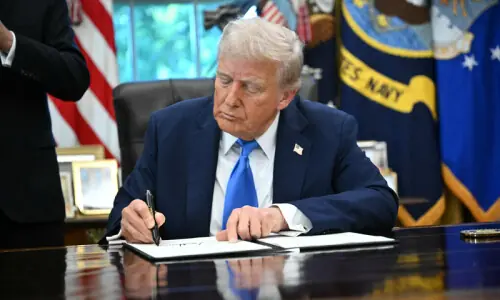
A coalition of unions, employers and religious groups filed a lawsuit on Friday seeking to block US President Donald Trump’s bid to impose, open new tab a $100,000 fee on new H-1B visas for highly-skilled foreign workers.
The lawsuit filed in federal court in San Francisco is the first to challenge a proclamation Trump issued two weeks ago announcing the fee as the Republican president moves to further restrict immigration to the United States.
Plaintiffs include the United Auto Workers union, the American Association of University Professors, a nurse recruitment agency and several religious organisations.
They argued that Trump’s power to restrict the entry of certain foreign nationals does not allow him to override the law that created the H-1B visa programme.
White House spokeswoman Abigail Jackson, in a statement, said Trump’s administration engaged in lawful actions “discouraging companies from spamming the system and driving down American wages, while providing certainty to employers who need to bring the best talent from overseas”.
The programme allows US employers to hire foreign workers in speciality fields, and technology companies in particular rely heavily on workers who receive H-1B visas.
Critics of H-1Bs and other work visa programmes say they are often used to replace American workers with cheaper foreign labour.
But business groups and major companies have said H-1Bs are a critical means to address a shortage of qualified American workers.
Employers who sponsor H-1B workers currently typically pay between $2,000 and $5,000 in fees, depending on the size of the company and other factors.
Trump’s order opens a new tab and bars new H-1B recipients from entering the United States unless the employer sponsoring their visa has made an additional $100,000 payment.
The administration has said the order does not apply to people who already hold H-1B visas or those who submitted applications before September 21.
Trump, in his unprecedented order, invoked his power under federal immigration law to restrict the entry of certain foreign nationals who would be detrimental to the interests of the United States.
He said that high numbers of lower-wage workers in the H-1B programme have undercut its integrity and that the program threatens national security, including by discouraging Americans from pursuing careers in science and technology.
He said the “large-scale replacement of American workers” through the H-1B programme threatens the country’s economic and national security.
The plaintiffs argue that Trump has no authority to alter a comprehensive statutory scheme governing the visa programme and cannot, under the US Constitution, unilaterally impose fees, taxes or other mechanisms to generate revenue for the United States, saying that power is reserved for Congress.
“The proclamation transforms the H-1B programme into one where employers must either ‘pay to play’ or seek a ‘national interest’ exemption, which will be doled out at the discretion of the Secretary of Homeland Security, a system that opens the door to selective enforcement and corruption,” the lawsuit said.
The groups argue that agencies, including the US Department of Homeland Security’s US Citizenship and Immigration Services and US State Department, likewise adopted new policies to implement Trump’s proclamation without following necessary rulemaking processes and without considering how “extorting exorbitant fees will stifle innovation.”
The H-1B programme offers 65,000 visas annually to employers bringing in temporary foreign workers in specialised fields, with another 20,000 visas for workers with advanced degrees.
The visas are approved for a period of three to six years.
India was by far the largest beneficiary of H-1B visas last year, accounting for 71 per cent of approved visas, while China was a distant second at 11.7pc, according to government data.