New visa rules shatter the American dream for many Indians


Indian aerospace engineering student Sudhanva Kashyap thought he had mapped out everything it would take to get to the United States, only to have his plans upended by Washington’s sudden and expensive change to its skilled worker visas.
Friday’s changes to the prized H-1B visas, which included a new $100,000 fee, rattled the tech industry and left US companies scrambling to figure out the implications.
Hasty clarifications from the White House that the new charge would be a one-off payment rather than the annual fee announced by US Commerce Secretary Howard Lutnick on Friday only added to the uncertainty.
The fee change rattled students like Kashyap, who hoped to get into an American university and from there into the US jobs market.
Kashyap, a 21-year-old from the southern Indian tech hub of Bengaluru, had pictured himself going to a top-tier American university, with Stanford his goal.
“Back when the fee was lower, it was still something that you could pin hopes on; it would be easier to convert the student visa to an H-1B,” Kashyap told AFP.
“I am very disappointed… my main dream is derailed as things stand now,” he said.
H-1B visas allow companies to sponsor foreign workers with specialised skills — such as scientists, engineers, and computer programmers — to work in the United States, initially for three years but extendable to six.
The United States awards 85,000 H-1B visas per year on a lottery system, with India accounting for around three-quarters of the recipients.
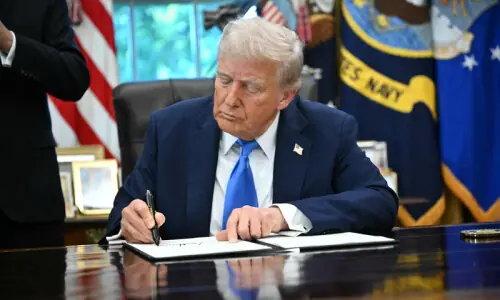
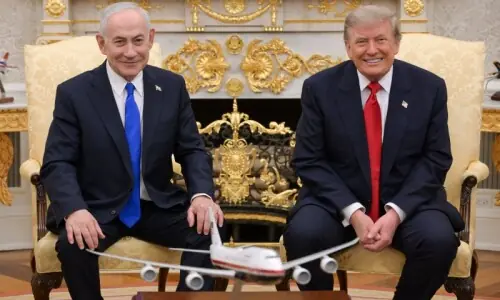
Lutnick detailed the new measure as he stood beside Donald Trump in the Oval Office, where the US president also introduced a $1 million “gold card” residency programme he had previewed months earlier.
Several leading companies quickly advised their employees holding H-1B visas not to leave the country while they figured out the implications. Some who had already boarded planes disembarked for fear they might not be allowed to re-enter.
The American dream
Data released by the US Department of Homeland Security showed there were 422,335 Indian students in the United States in 2024, an increase of 11.8 per cent on the year before.
India’s IT industry association Nasscom said soon after Friday’s initial announcement that it was concerned by the new visa measures.
It said “business continuity” at technology companies would be disrupted, and was quick to point out how Indian IT firms contributed to the US economy and were “by no means” a security threat.
Shashwath VS, a 20-year-old chemical engineering student in Bengaluru, said the new fee was too high for companies to think about sponsoring a foreign candidate.
“I will now explore other countries… going to the US was a priority for me, but not anymore,” Shashwath said.
He said many like him might try to find places elsewhere, such as Germany, the Netherlands and the United Kingdom.
Indians, he said, “contribute significantly to the American economy — be it students who go there or people who work there”.
“So they (the US) will also be hit, in one way or the other.”
Immigration crackdown
Trump has had the H-1B programme in his sights since his first term in office, and the current visa iteration has become the latest move in a major immigration crackdown in his second term.
Silicon Valley companies rely on Indian workers who either relocate to the United States or come and go between the two countries.
India’s own vast outsourcing industry has also depended on the work permits for decades, even though that has softened in recent years.
Industry leader Tata Consultancy Services alone received approval for more than 5,000 H-1B visas in the first half of the 2025 fiscal year.
Sahil, a 37-year-old senior manager at an India-based consultancy firm, returned from the United States last year after living there on an H-1B visa for almost seven years.
“I can tell every second or third person in the IT sector dreams of settling in the US or visiting to work,” he said.
“We will see fewer Indians migrating to the US in the future. That possibly means those people will now start looking at other countries.“