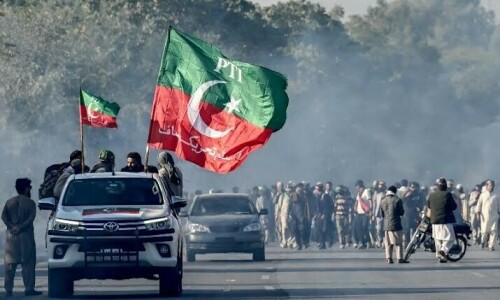
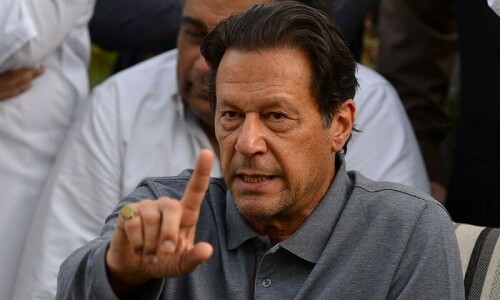
The Punjab Assembly on Tuesday adopted a resolution to ban incarcerated PTI founder and former prime minister Imran Khan and his party for being “anti-state”.
The development comes days after Inter-Services Public Relations (ISPR) Director General Lt Gen Ahmed Sharif Chaudhry assailed Khan for creating and spreading an “anti-army” rhetoric, stating that such narratives were now out of the realm of politics and had become a “national security threat”.
Since then a war of words continued between the leaders of ruling party Pakistan Muslim League-Nawaz (PML-N) and PTI over the presser, with Defence Minister Khawaja Asif saying Imran had used “harsh language” in the past for members of the opposition, insisting that the party had no right to object to the comments by the military’s spokesman, while the opposition party emphatically deplored “ridiculous” remarks by the military spokesperson against ex-premier Imran Khan, saying he was “not a security threat”.
PML-N MPA Tahir Pervaiz moved the resolution in the House, which was passed by the treasury members amid a boycott of the proceedings by PTI lawmakers. The resolution did not specifically name the PTI or its founder Imran.
“The institutions that safeguard Pakistan on every front and have successfully countered an enemy five times larger, such as India, are vital to the country’s integrity and stability,” said the resolution.
“A ban should be imposed on the political party and its founder for acting as a tool of the enemy state. He is also accused of making statements against the country and spreading chaos.”
The resolution demanded that action be taken against any leader, whether belonging to political or non-political groups, in accordance with the law, and that they be awarded “appropriate punishment”.
It also paid tribute to the personnel and leadership of the institutions working for Pakistan’s stability and security.
Earlier in 2024, the federal government decided to ban the PTI and sought Article 6 proceedings against Imran, ex-president Dr Arif Alvi, and former National Assembly (NA) deputy speaker Qasim Suri.
The move appeared to be an attempt to prevent the PTI from becoming the single largest party in the NA, following the apex court’s ruling in the reserved seats case. However, the government did not follow through with the ban.
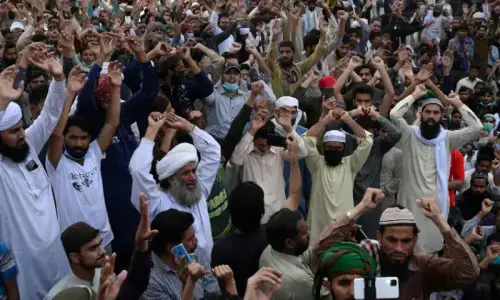
In October, the federal government approved a ban on the religiopolitical party Tehreek-i-Labbaik Pakistan (TLP) under the anti-terrorism act (ATA) following violent protests.
However, banning political groups is not a new practice in Pakistan. It has followed the country across decades — from martial laws to seemingly democratic setups.