Finance minister expects ‘good’ NFC output


 0
0
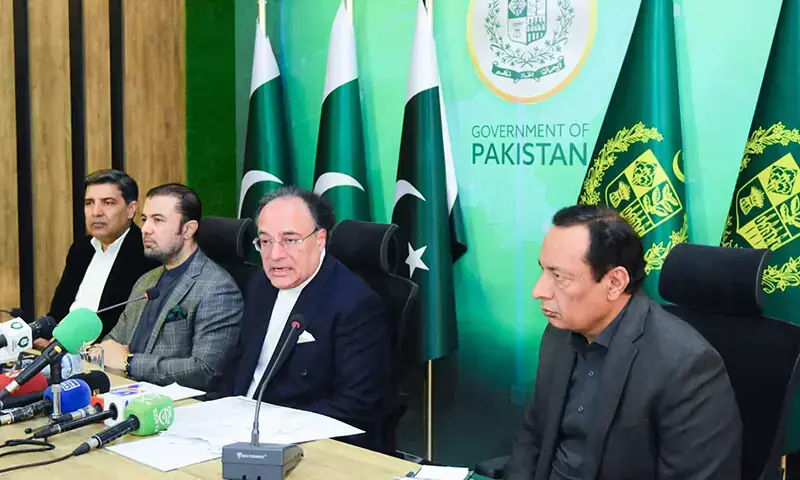

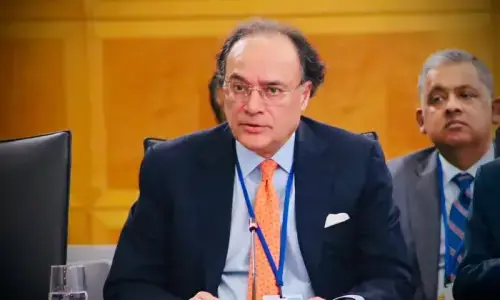
ISLAMABAD: Finance Minister Muhammad Aurangzeb on Sunday warns against an urge for ‘gold rush’ to economic growth and asserted that both the federation and its units would have to contribute greater revenues in upcoming National Finance Commission (NFC) parlays for sustainable and meaningful growth.
Speaking at a news conference, the minister expected the federal and provincial stakeholders of the national finance commission (NFC) would lead to an outcome in the spirit of “Pakistan First” like they had delivered National Fiscal Pact and introduced agriculture income tax (AIT) through provincial legislations. “I look forward to good and constructive discussions with provincial finance ministers and chief ministers” on Dec 4, he said.
He said the nature of NFC was to have consensus mainly on revenue, expenditure and governance and there was no dispute that as a nation the country required not only structural but institutional reforms as also highlighted in the IMF’s governance and corruption diagnostic assessment (GCDA) on the request of Pakistan government.
He said it was a separate discussion if there would be AIT collection but it was a fact that for the first time in history, the provinces have legislated AIT. Likewise, expenditures are also required to be made collectively on the pattern of KYC (know your customer) in the banking sector and in line with Anti-Money Laundering Act as Pakistan had only recent graduated out of Financial Action Task Force watch list and could not afford slipping back.
Warns against gold rush to economic growth
That was why the ToRs for the NFC meeting were set in a manner that all the provinces would present their positions and the centre would do the same and listen to each other and take the process forward in an appropriate manner. He said both the federation and the provinces would have to contribute to enhance revenue mobilisation to run the country sustainably. “You cannot run the country on 8-10pc tax-to-GDP ratio,” he said.
“We don’t have to go into gold rush. We have to make economic growth sustainable and for that we have to keep a close eye on balance of payments and current account,” otherwise which finance minister would not like such a key performance indicator, the minister said.
“It is very easy to pump liquidity and have consumption led growth but we would like to have export-led growth,” he said. It was in this direction that the government was making a decisive shift towards an inclusive, private-sector-driven and export-led growth model, he asserted, adding that the PM had set up seven to eight working groups of private sector leaders. He said the abolition of 0.25pc Export Development Surcharge (EDS) after almost four decades was a key demonstration of this commitment.
He said one of the working group had recommended transferring operations of export development fund (EDF) to the private sector and till addressing its governance-related issues, suggested suspending the EDS. But the premier abolished the levy imposed in 1991, he said, adding that a summary had already been moved to the cabinet for formal approval to abolish the EDS.
Shortfall
However, the minister sidestepped a question about the trigger points for contingency measures in the wake of revenue shortfall of about Rs580bn in first five months, saying the revenues should not be seen in the context of targets but a healthy 11pc growth.
About GCD report, the minister said it was part of the government’s broader agenda of institutional strengthening. He said the report had been requested by and developed in consultation with the government through more than 100 meetings. He said the report prioritised 15 key reforms many of which relating to taxation, governance, public financial management, and procurement were already under implementation phase.
He insisted the report’s findings should be viewed in the context of long-standing structural challenges and said the government was strongly determined to advance the remaining recommendations as structural reforms without institutional reforms were meaningless and unsustainable. “This is why the government considers the report a catalyst for accelerating reforms rather than a criticism of current policy direction,” he said.
The minister said export performance had strengthened, with overall exports rising 5pc and IT services exports growing by over 20pc year-on-year. He said the IT sector had recorded back-to-back monthly records in September and October, establishing itself as a critical pillar of the “new economy”.
He said the announcement of US Exim Bank joining the $3.5bn Reko Diq syndication, led by IFC had helped achieve financial close for the project following an end to US-government shutdown. He said the financial close will represent a transformational investment that will generate an estimated $2.8-$2.9bn in annual exports once production commences.
Also, the inaugural panda bond in the Chinese market would be issued in December, but no later than Chinese New year. Besides, remittance would be surpassing $41bn this year from $38bn last year, he added.
Responding to questions, he said the government would get out of commodity business sooner the better.
Published in Dawn, December 1st, 2025