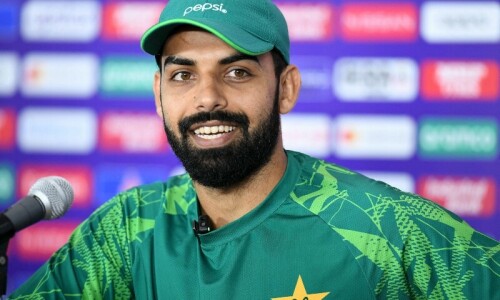
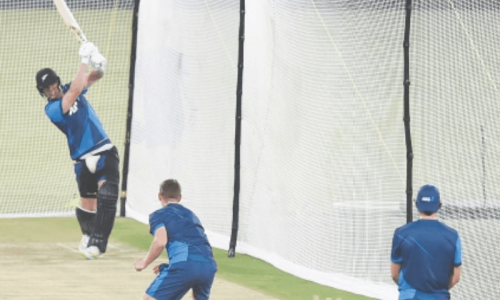
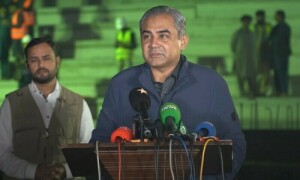
Doors are not yet closed on all-rounder Shadab Khan to make a comeback in the Pakistan side ahead of next year’s T20 World Cup, skipper Salman Ali Agha said on Saturday.
Shadab last featured for the national side back in June during the T20I series against Bangladesh before an injury ruled him out.
Since then, Pakistan have found their main all-rounder in Mohammad Nawaz, who has starred with both bat and ball across past six months as the team won a tri-series in the UAE before making it to the Asia Cup final.
On Saturday, Pakistan won another tri-series, this time at home, after beating Sri Lanka clinically in Rawalpindi — the match seeing Nawaz take three wickets to turn the game around for the hosts.
Apart from Nawaz, opener Saim Ayub has also consolidated his role as Pakistan’s impactful spin option while Abrar Ahmed and Usman Tariq have announced themselves as worthy specialists.
Salman, however, didn’t rule out the possibility of Shadab’s return when the teams flies out to Sri Lanka — the co-hosts of the T20 World Cup along with India — in the first week of February.
“He was the team’s vice-captain when he got injured unfortunately,” Salman said of Shadab in the post-match press conference.
“And when you have a player available who has played so many World Cups, who has experience, who can bat at number 5-6 and give you a spin option—if we feel he fits, then of course, why not?”
The growing depth in Pakistan’s spin department has been one of the defining themes of their white-ball resurgence in recent months.
With Saim providing regular breakthroughs in the powerplay, and the pairing of Abrar and Usman offering variety through the middle overs, Salman said the management was now confident of tailoring combinations according to conditions in Sri Lanka, where spin is expected to dominate.
“If conditions allow us to play two specialist spinners, or even more, we won’t hesitate,” he said.
“We have Nawaz, Saim, Abrar and Usman — four very different options. Our job is simply to field whatever combination is best for Pakistan. If the pitches support spinners, you may see all of them.”
Pakistan’s opponents at the World Cup will likely face surfaces that demand nuance rather than brute force, a factor that Salman believes could neutralise the trend of high-scoring T20Is elsewhere.
Asked whether Pakistan possess the batting strength to chase scores beyond 200 — a benchmark that has increasingly become common in the format — he was measured.
“For that, conditions have to allow 200 runs to be scored,” he said. “In Sri Lanka, you generally don’t get pitches where such totals are common.
“But if the surface demands it, we have the capability to both score and chase big totals. The players have shown that over the past few months.”
The captain also reflected on Pakistan’s overall progress this year, noting that the side had grown significantly since their disappointing start in January.
He pointed out that despite early setbacks, the team had stitched together a consistent run across white-ball cricket in the build-up to the World Cup cycle.
“Our start wasn’t good,” he admitted. “But we finished the year strongly. In the last two or three months, we have won almost all our white-ball series.
“Now the challenge is to carry this momentum into next year. We have no matches in December, so the next phase begins immediately in January. We want 2026 to be a year people remember — by winning the World Cup.”
With Pakistan currently employing different captains across formats, Salman acknowledged the added responsibility on his shoulders but insisted he had grown into the role after an initial period of adjustment.
“If you’re leading Pakistan, there will always be pressure,” he said. “Responsibility comes with the job. Maybe at the start I struggled to balance my batting with captaincy, but over the last five or six months I have understood how to manage both. I feel far more settled now.”