ROCK CLIMBING: THE SPIRIT OF THE ROCK
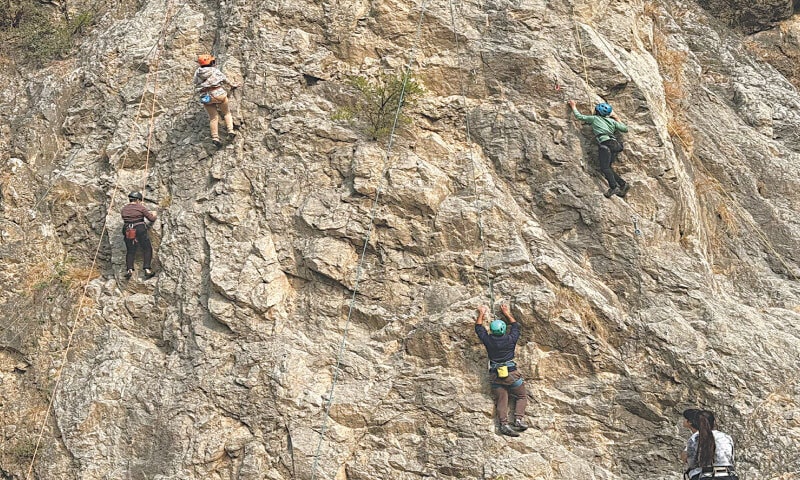

With the sharp focus of a seasoned professional, Sajid meticulously clips into the bolts and ensures every piece of his rock-climbing safety gear is secure.
He performs these checks because, as a trained rock-climber, he knows that all measures taken for safe rock-climbing are non-negotiable and essential for a secure ascent. His experience as a rock climber drives this commitment to safety.
Initially, an Islamabad-based banker, Sajid Aslam quit his job for the love of rock-climbing. What made him take up rock-climbing as an activity? Sajid says, “Although banking promised a stable financial future, the long hours left me with too little time for training and rock-climbing, so I had to make a choice.”
He describes himself as a runner, a rock-climber and, most importantly, a rock-climbing trainer. It has been 17 years now since he began his journey as an international trainer. In 2018, he participated in the Asian Games, representing Pakistan as a climber. Now, to his credit, Sajid has been interviewed in the recently published rock-climbing guidebook on the Himalayas, Himalayan Rocks, written by the German alpinist and author Kai Maluck.
Rock-climbing, an outdoor adventure sport, is fast developing in Pakistan, and the hills around Islamabad provide the perfect foil for it
The book, recently launched in an event held in Islamabad, covers guidelines for potential future rock-climbers and mountaineers, especially on the terrain of the Himalayas, and Saijd is the Pakistani hero who represents Pakistan.
DIFFERENT WAYS TO CLIMB
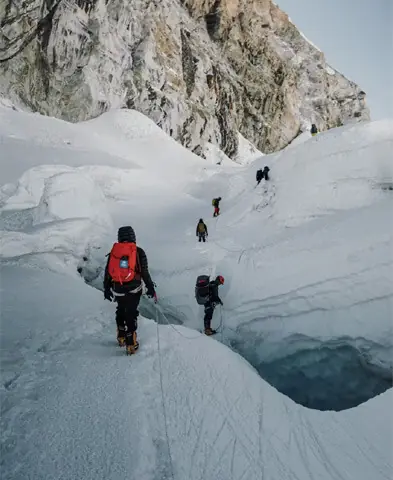
Rock-climbing is one of the many forms of mountaineering. Mountaineering is the activity of climbing to reach a summit or a peak, usually at high or moderate altitudes, while rock-climbing involves climbing on pre-equipped routes on natural rock walls outdoors.
Rock-climbing paved the way for other forms of climbing, such as indoor climbing — which has evolved into a competitive sport — and bouldering, a form of rock climbing that helps enhance motor coordination. Traditionally, recreational sociology scholars describe rock-climbing as a “lifestyle sport.” It is characterised by individualism, which means the absence of team competition; self-governance, which is the absence of a regulating body; and a distinctive subculture.
Rock-climbing involves determining and executing a sequence of moves — a series of actions used to ascend by controlling the body’s relationship to the ‘holds’. A move is the specific way a climber transitions between holds, primarily utilising foot and hand techniques such as ‘edging’, ‘jamming’, and ‘smearing’. Movement and technique are the most crucial factors in this sport, which requires the climber to build a broad repertoire of actions.

Success in climbing, however, is a complex mix of physiological and psychological factors, with arm strength and endurance being a key physical contributor. To discover a way through impossible-looking ascents, the climber must hold both fear and resolve in a delicate equilibrium. Rock-climbing, therefore, is not merely about solving cryptic sequences of holds; it requires a rare combination of strength, attunement and grace.
A discipline of rock-climbing, the combined format of bouldering, ‘speed climbing’, and ‘lead climbing’ — referred to as ‘Sport Climbing’ in the Olympics — debuted at the Tokyo 2020 Games in 2021. Its inclusion was a major milestone, which transformed the activity from a niche pursuit into a globally recognised competitive sport.
This Olympic exposure significantly boosted Sport Climbing’s worldwide popularity and spurred the development of indoor climbing gyms. However, while indoor climbing is increasingly accessible, outdoor rock-climbing continues to offer the unique experience of nature’s beauty and biodiversity.
THE ZEN OF CLIMBING
Undoubtedly, most experienced rock-climbers are motivated by the idea of seeking adventure and achieving physical excellence. In Sajid’s view, rock-climbing is inherently enjoyable at all levels, primarily because it takes one away from everyday places and situations, and also helps gauge one’s strength and endurance. “It’s the uniqueness of the experience that can never be explained in words,” says Sajid.
Sajid’s dedication and deep experience are evident; he has steered over 700 climbing training sessions. He points out that, while this outdoor adventure sport is developing in Pakistan, it has seen significant progress in recent years. He trains regularly on Saturdays and Sundays in Islamabad, and sees both foreigners and locals participating in his group and individual sessions. “In Islamabad alone, readily accessible rock-climbing routes make it an unusual recreational activity for foreigners, especially,” he says.
The Margalla Hills, in particular the Saidpur area that serves as the central hub for rock-climbing, boast numerous crags to which Sajid can guide climbers, even those in the most remote locations of the hills. These sites include the whimsically named Jasmine Corner, Raja Bazaar (distinct from the well-known Rawalpindi bazaar), Jungle Rock, Music Lounge, Holiday Rock, Safa Wall, God Rock, Beetle’s Nest, Legacy Wall, Hidden Rock, Well Hidden Rock and Shaddarrah.
When I ask about what kind of people take part in the activity, Sajid excitedly points out that almost 40 percent of the participants are women, and even children over the age of six regularly take part. Sajid assures me that the placement of bolts — hardware permanently installed to catch a climber in the event of a fall — is entirely error-free and foolproof.
CORE VALUES
Interestingly, both mountaineering and rock-climbing are based on ethical principles that have never been formally articulated but are passed down through the generations. One of the core values is the preservation of the environment. Sajid says that all climbers must diligently follow best practices to reduce their impact on the biodiversity surrounding the rock or the mountain.
The essence of the climbing experience lies in feeling the movement: the ability to move with precision, grace and economy. The perfect climbing moment occurs when the climber overcomes bodily struggle, mental anxiety and frustration to execute a flawless move — a delicate, scalpel-like action that eases the ascent up the rock.
Ultimately, the aesthetics of climbing are the aesthetics of the climber’s own motion, a harmony between the climber’s abilities and the challenge he or she faces.
The writer teaches at COMSATS University in Islamabad. She can be contacted at ayesharamzan83@gmail.com
Published in Dawn, EOS, November 30th, 2025