70pc decline in stubble-burning incidents, claims Punjab govt


 0
0
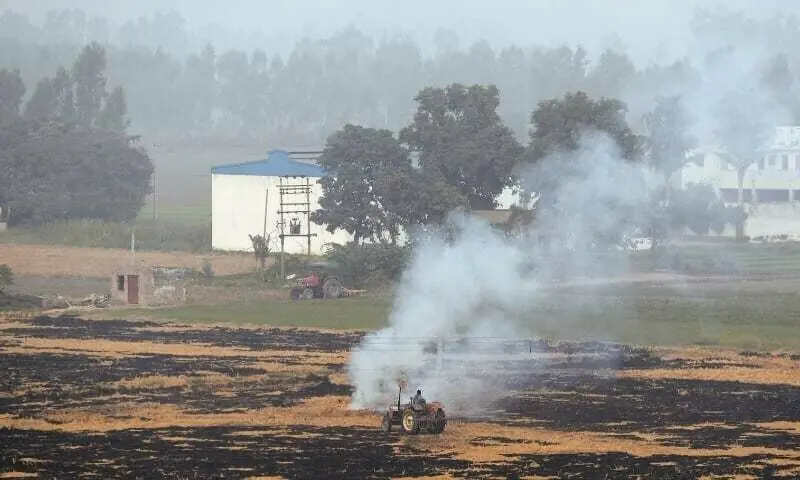

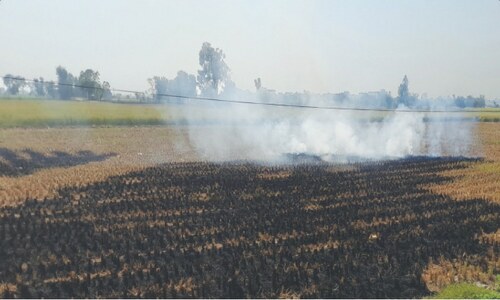
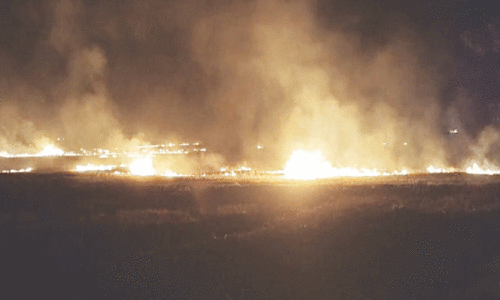
LAHORE: The Punjab government on Tuesday reported a 70pc decline in stubble-burning incidents across the province following the establishment of 67 quick response centres (QRCs) along the major motorways and in the key agricultural districts.
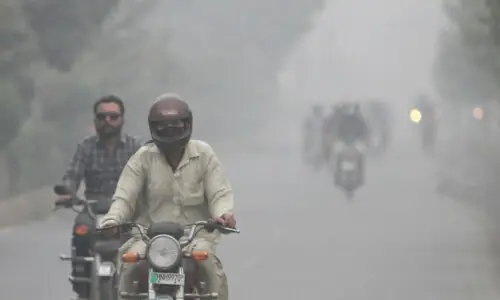
However, despite the claim, Lahore remained as the most polluted city of the world throughout the day with its air quality index (AQI) touching 380 at 8am. The AQI improved to 221 by 2pm but deteriorated again to 246 by 6pm. New Delhi replaced Lahore as the city with most polluted air at 8pm. The air quality in other cities, including Sialkot, Gujranwala and Jhelum, also remained very unhealthy throughout Tuesday.
According to a news release, Senior Minister Marriyum Aurangzeb inaugurated the rapid response initiative to curb crop-residue burning and mitigate the annual smog crisis.
Officials say the QRCs have so far extinguished fires across hundreds of acres of farmland while 117 cases have been registered against those involved in burning crops, residue and waste. The province implemented a coordinated surveillance-and-response mechanism ahead of the harvesting season, integrating real-time monitoring with immediate field-level fire suppression.
67 QRCs active in major districts; critics say farmers had nothing to burn after flood destroyed crops
The authorities said the strengthened deployment of QRCs, supported by surveillance squads, had significantly enhanced Punjab’s capacity to detect and extinguish crop residue fires.
As a part of the strategy, nine ‘Surveillance Squads’ were deployed across eight designated beats, covering critical stretches of the M-2, M-3, M-4 and M-11 motorways and adjoining agricultural zones. Each squad consisted of an inspector, a field assistant and a driver, operating round the clock in two shifts.
At the heart of the system are the 67 QRCs, each staffed with a driver, a firefighter and a helper, forming a three-member firefighting team. Every QRC is equipped with a 4×4 tractor towing a 6,000-litre fire bowser, fitted with a high-pressure water-monitoring gun capable of projecting water up to 120 metres.
The off-road mobility of the tractor, combined with the extended-range firefighting gun, enabled teams to control fires rapidly even in difficult terrain. This equipment allowed crews to respond within minutes to alerts, preventing crop fires from spreading and significantly reducing smoke emissions. The coordinated field operations, they added, had been instrumental in limiting environmental damage and improving air quality during the peak smog period.
The government distributed the 67 QRCs across key districts. Sheikhupura had the largest share with 22 QRCs, followed by Gujranwala and Sargodha with eight each, Faisalabad with six, Sialkot with five, Nankana Sahib with four, and Hafizabad and Kasur with seven each. The officials stated that concentrating QRCs in districts such as Sheikhupura—where agricultural burning had historically been high—allowed for swift deployment across vast tracts of farmlands.
The officials said reduction in stubble burning this season represents one of the most substantial improvements in Punjab’s environmental management efforts. They added that the integrated system of surveillance and rapid response had now become a core component of the province’s broader strategy to combat winter smog, which was exacerbated by agricultural emissions, vehicular pollution and industrial activity.
An environmental expert told Dawn that the government claim was not right as most of the crops were destroyed during floods in the province and the farmers did not have stubble to burn. He accepted that there was betterment in air quality as compared to last year but advised the government to stop making false claims and increase efforts to control smog.
Under the “Lungs of Lahore,” Parks and Horticulture Authority (PHA) launched efforts to combat air pollution and smog in the provincial capital Lahore.
The PHA launched a tree-washing campaign on major roads and heavily trafficked areas of the city in the morning and evening to remove dust from leaves and enhance trees’ oxygen-producing capacity.
PHA Managing Director (MD) Mansoor Ahmed Raja says that tree washing is currently being carried out along the greenbelts of the Mall Road, Ferozepur Road, Ring Road, Canal Road, Gulberg Road, Johar Town, Shahdara, and other key arteries of the city. In addition, plantation of trees, seasonal flower cultivation, and overall greenery maintenance are ongoing across various areas.
The PHA, in collaboration with public partners, is conducting a large-scale tree plantation drive. Priority is being given to shade-providing, fruit-bearing, and native tree species to ensure environmental sustainability.
Published in Dawn, November 19th, 2025