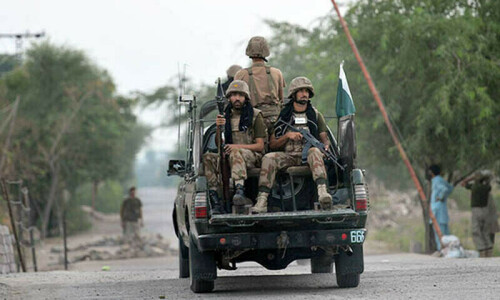
38 terrorists killed in four separate KP operations: ISPR

The Inter-Services Public Relations (ISPR) said on Tuesday that 38 terrorists were killed in four separate intelligence-based operations (IBOs) conducted over a period of three days in Khyber Pakhtunkhwa.
In a statement, the military’s media affairs said that the operations were carried out between November 15 and 16, adding that the terrorists belonged to Indian proxy Fitna al Khawarij.
Fitna al Khawarij is a term the state uses for terrorists belonging to the banned Tehreek-i-Taliban Pakistan (TTP).
The first IBO was conducted by security forces in the Kulachi area of Dera Ismail Khan district, the ISPR said, adding that troops effectively engaged the terrorists’ location. As a result, ten terrorists, including kharji ringleader Alam Mehsud, were killed, it said.
In another IBO conducted in Datta Khel in North Waziristan district, troops killed five more terrorists, the ISPR said.
In a separate statement later in the day, the ISPR said two IBOs took place between November 16-17 in Bajaur district and Bannu district, killing 11 and 12 terrorists, respectively.
It added that terrorist ringleader Sajjad alias Abuzar was also killed in the Bajaur IBO.
The ISPR said that sanitisation operations were being conducted to eliminate any other “Indian-sponsored” terrorists found in the area, asserting that the counter terrorism campaign by security forces and law enforcement agencies would continue to “wipe out the menace of foreign-sponsored and supported terrorism from the country”.
President Asif Ali Zardari paid tribute to the security forces for the successful operations. In a statement, he said that work would continue on eliminating foreign-backed terrorists with national consensus.
He attributed the killing of the terrorist ringleader to the successful strategy of the security forces. He further said that political moves to divert attention from the national consensus on terrorism would not be tolerated.
Prime Minister Shehbaz Sharif also paid tribute to the security forces. “Under the vision of Azm-i-Istehkam, security forces are achieving great successes against terrorism,” he said in a statement.
“We are determined to completely eradicate all forms of terrorism from the country,” he said.
Last week, the ISPR said at least 24 terrorists were killed by security forces in three separate engagements in KP and Balochistan.
Pakistan has witnessed a surge in terror activities, particularly in KP and Balochistan. The spike in incidents followed the TTP ending a ceasefire with the government in November 2022 and vowing to attack security forces, police, and personnel of law enforcement agencies.
Last month, the Islamabad-based think tank Centre for Research and Security Studies said that violence had surged over the past three months due to a spike in militant attacks and intensified counter-terrorism operations.