Federal Constitutional Court kicks off proceedings amid space constraints
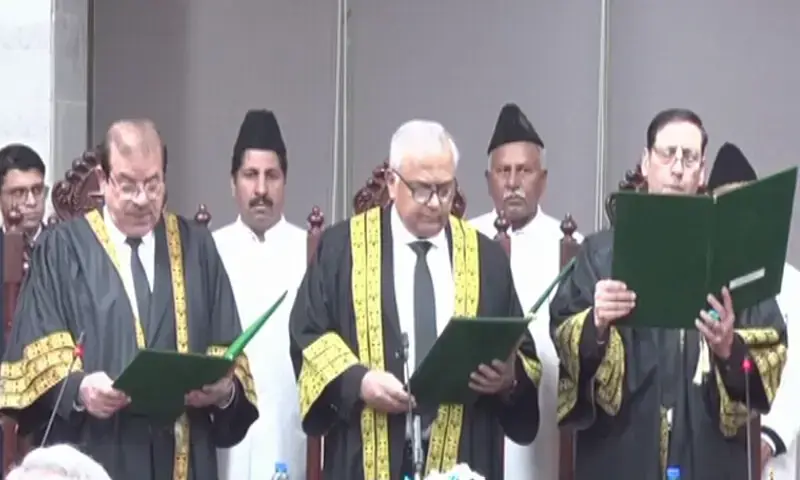


• Two more judges sworn in
• Seven courtrooms arranged on IHC floors
• Three benches hear several cases on first working day
ISLAMABAD: After the swearing-in of two more judges, the Federal Constitutional Court (FCC) finally commenced operations on Monday, hearing a number of cases within the Islamabad High Court (IHC) premises.
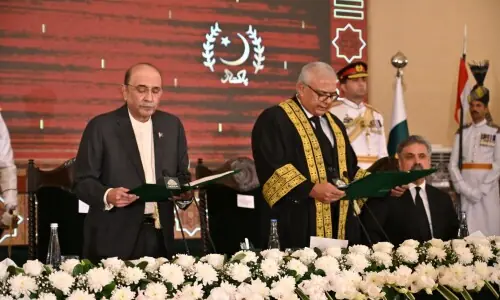
The day began with the oath-taking ceremony of Justice Rozi Khan Barrech and Justice Arshad Hussain Shah inside the conference room on the ground floor of the IHC building on Constitution Avenue. The oath was administered by FCC Chief Justice Aminuddin Khan, bringing the court’s existing strength to seven judges.
Earlier, the FCC chief justice had told the media that the total sanctioned strength of the court would be 13 judges. Seven courtrooms have been arranged for FCC judges on different floors of the IHC building.
After the ceremony, the formal proceedings commenced with the recitation of the Holy Quran at the main FCC courtroom situated on the first floor. Since the FCC’s arrangements are not yet complete, IHC Courtroom No. 2 has been converted into the main courtroom of the FCC chief justice, with a printed A-4 page affixed at the entrance to designate it as such.
Meanwhile, IHC Chief Justice Sardar Muhammad Sarfraz Dogar will continue holding court in his original Courtroom No. 1, located above the FCC’s main courtroom.
Formal proceedings began at 10:12am, with Bench-I hearing around five cases in half an hour. During the hearing, those present in the courtroom could hear discomforting sounds such as the dragging of furniture.
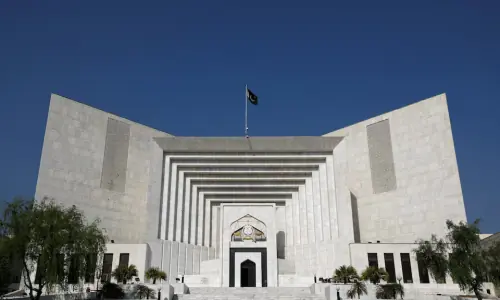
“With the Federal Shariat Court (FSC) refusing to hand over its building, and the FCC already reeling from myriad teething problems due to sharing its establishment with the IHC, this is the only court in the country without a formal building of its own,” commented a senior counsel on condition of anonymity. He added that even the rooms allocated for law officers have yet to be refurbished.
He further confided that there was a strong possibility that the IHC may revert to its old G-10 premises early next year, possibly in January, since litigants face difficulties entering the Red Zone to pursue their cases. The move would also ease logistical issues for lawyers who must shuttle between the district courts and the high court to file bail applications, appeals, etc.
There is also a possibility that a meeting of the Judicial Commission of Pakistan (JCP) may be called soon to consider the confirmation of Justice Miangul Hassan Aurangzeb, who was elevated as an acting judge of the Supreme Court on Feb 14 this year.
The counsel also disclosed that during hearings in one FCC courtroom, a lawyer was told that the FCC should be their first priority and that they should appear before it before attending cases at the Supreme Court.
Cases’ hearing
On Monday, three different FCC benches heard cases. Bench-I comprised FCC Chief Justice Aminuddin Khan, Justice Ali Baqar Najafi and Justice Arshad Hussain Shah. Bench-II included Justice Syed Hasan Azhar Rizvi and Justice Muhammad Karim Khan Agha, while Bench-III consisted of Justice Aamir Farooq and Justice Rozi Khan Barrech.
Meanwhile, Bench-I, while taking up a case relating to the change of status of an amenity plot, stayed the Aug 26, 2025 Sindh High Court judgement and issued notices to various respondents, adjourning further proceedings until Nov 27.
Declaring the matter a public-interest case, the FCC also directed the SHC not to proceed with a contempt of court case against the Karachi Metropolitan Corporation (KMC), which some respondents had moved before the high court.
The KMC, through its mayor, had challenged the SHC decision that declared void and illegal the corporation’s May 19 resolution allowing public-private partnership agreements under rental arrangements to initiate commercial activities on nine different amenity plots.
In the first round of litigation, the petitioners had questioned the conversion of nine Karachi amenity plots into sports grounds for commercial use, for which exorbitant usage fees were being charged.
The plots include Jheel Park, Hill Park, Umer Sharif Park, Bagh Ibn-i-Qasim, KMC Sports Complex, Hosh Muhammad Sheedi Park, St-4 Clifton Block 2, St-15 Clifton Block 1, and St-19 Clifton Block 1.
The petitioners argued that the SHC judgement was unwarranted in law and had created an administrative and executive vacuum. They contended that the verdict was based on presumptions and relied on precedents not applicable to the present issue. Most importantly, they argued, it failed to consider the contours of public purpose as presently relevant to ground realities.
Published in Dawn, November 18th, 2025