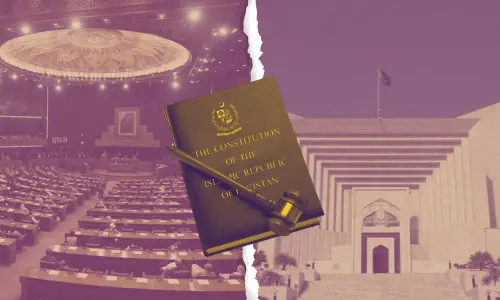
Adviser to the Prime Minister on Political Affairs Rana Sanaullah on Monday said that a 28th Constitutional Amendment, dealing with “public issues”, could be introduced if there is political consensus.
Last week, President Asif Ali Zardari gave his assent to the contentious 27th Constitutional Amendment, enacting it into law.
Speaking to reporters in Chiniot, the PM’s aide said that the amendment would deal with “public issues, such as local bodies, population, the National Finance Commission … health-related issues”.
“There is a need to review how we can better serve the people according to the present needs of the provinces and the Centre,” Sanaullah stated.
“This is being debated and if there is any consensus, then we can bring the 28th Amendment forward,” said the PML-N leader.
Referring to the recent resignations by judges of the Supreme Court and LHC, the PM’s aide said that “those who stepped down did so due to their personal motives”.
He maintained that the parliament has the constitutional right to pass amendments, while judges are meant to protect the laws of the state.
The 27th Constitutional Amendment bill was tabled in the Senate on November 8, just hours after it was approved by the federal cabinet in a meeting chaired by PM Shehbaz via a video link from Baku. It was subsequently referred to the parliamentary standing committees on law and justice, which approved it the very next day with some minor changes to the initial draft.
The bill proposed the creation of a Federal Constitutional Court (FCC) as well as changes to the military leadership structure.
The law minister tabled it in the Senate for voting on Nov 10. The contentious bill was approved by the upper house of Parliament after 64 lawmakers voted in its favour, with members of the opposition staging a noisy walkout. The PML-N led coalition government had managed to secure a two-thirds majority to get the bill passed with the unexpected support of two opposition senators who voted against their party lines.
On November 12, the bill was passed by the National Assembly after the introduction of some changes, mostly related to the chief justice of Pakistan.
In the house of 336 members, 224 votes were required to meet the mandatory two-thirds majority for the passage of the bill. The ruling lawmakers cast 234 votes in its favour, while four votes were polled against the bill by the JUI-F members. The JUI-F has 10 MNAs, but only four attended the sitting. The PTI members, meanwhile, boycotted the process by staging a walkout.
The bill, however, was referred back to the Senate due to the fresh changes and was approved after a second round of voting amid the opposition’s protest.