
A few days ago, I read about The Hunt for Gollum — Peter Jackson’s forthcoming official continuation of the Lord of the Rings film series, directed by Andy Serkis and featuring Serkis, Elijah Wood, Ian McKellen and, perhaps, Evangeline Lilly.
Unfortunately, my heart didn’t start beating faster and nor did any butterflies flutter in my stomach. Even with the talent involved and the potential for quality, it just felt like another piece of news. And one wonders… why is this the case?
Back in the late ’90s, the news of a Lord of the Rings or Harry Potter adaptation (a new series is currently in production) sparked excitement and made one count the days leading to their release. Today, that news equals a brief “Aha!” moment at best.
The culprits behind this lack of enthusiasm are well-known: oversaturation and the unending clichés when it comes to “content”. In comparison, films from 20 years ago seem fresher and better than those made today and, despite changes in taste and the pull of nostalgia, one has to ask:were movies really better in the ‘good ol’ days’?
Despite the fear of sounding like my (or anyone’s) dad, who is about to embark upon an “in my day” monologue, when one really thinks about it, there are many reasons why today’s movies don’t feel like films.
Were movies really better in the good ol’ days compared to those made today?
To clarify: the terms ‘movies’ and ‘films’ in critic-speak mean two entirely different things. Films — and their cousin cinema — refer to artistic works. The run-of-the-mill, factory-churned products, on the other hand, are called movies.
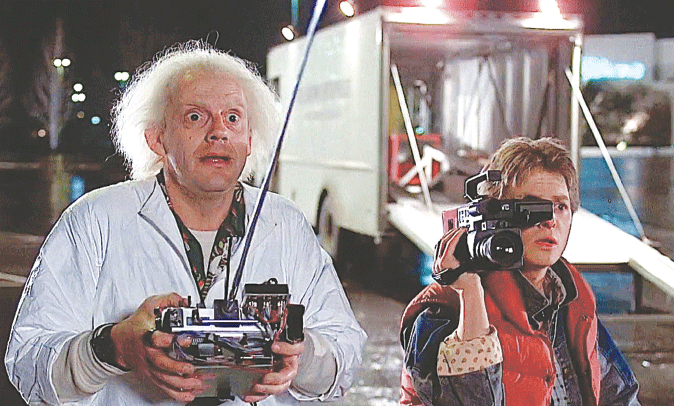
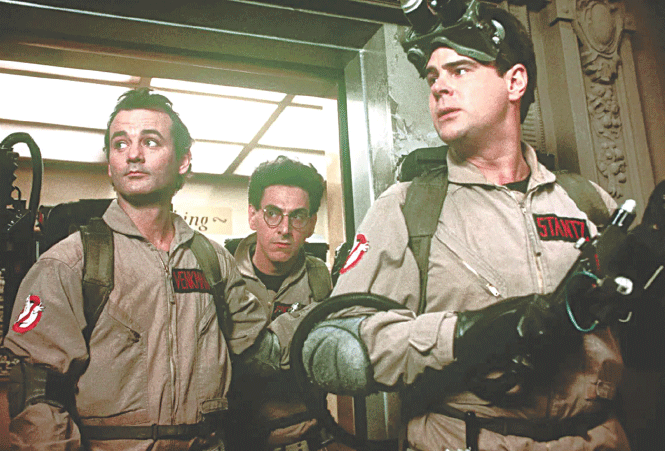
That’s not to say movies aren’t fun. They used to be, because the ’80s were full of them. At the time, what played to the crowd’s delight wasn’t called ‘cinema’, even if we count them as works that have cinematic merit today. For every Amadeus and Scarface, there was Top Gun, Beverly Hills Cop, Die Hard, Back to the Future, Ghostbusters, Star Wars and Indiana Jones. Even with their novelty long dead, most of these titles are still aired or streamed today.
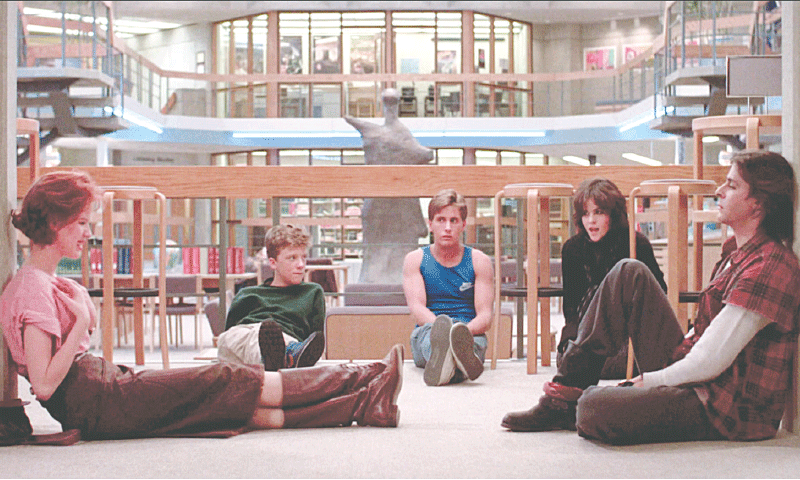
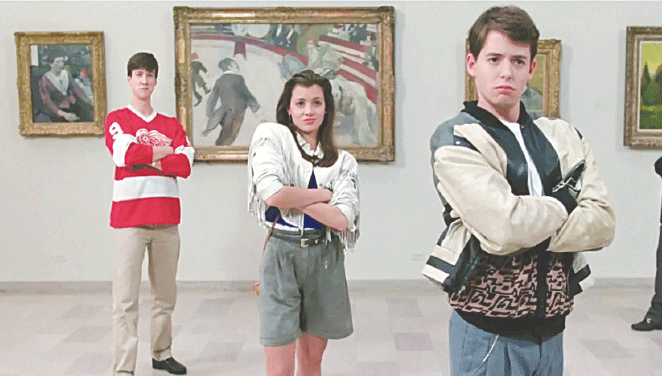
Then there were John Hughes’ coming-of-age, family-oriented productions: Pretty in Pink, Sixteen Candles, Ferris Bueller’s Day Off, and The Breakfast Club — or similar ones such as Adventures in Babysitting and Fast Times at Ridgemont High.
While the ’80s were filled with forgettable B-movies (the VHS rental catalogues were full of them), most of the aforementioned titles remain relevant — unlike movies from the last 15 or so years.
Meanwhile, the ’90s, with their extensive line-ups and greater variety, carried over the legacy of the all-family entertainer (along with star-backed steamy thrillers) but mastered technical and storytelling finesse at the same time. It was then that ‘movies’ and ‘films’ became interchangeable terms, as both eras helped design the movie business as we know it today.
The B- and C-movie boom was strong and cable television (HBO), operating largely outside the FCC (Federal Communication Commission) programming regulations, reigned supreme with steamy, low-budget, late-night content. With the worldwide rise of satellite television in the early 2000s, the demand for movies skyrocketed, and this demand was met by reruns of ’80s and ’90s movies that held nostalgic value for audiences.
Conglomerates became big, stars bigger, and budgets bloated. This led to the considerably cheap teen-movie era of the early-mid 2000s. The big, star-backed movies were failing, and Hollywood was yet to learn that franchises, spin-offs and remakes were the next big thing.
The 2000s felt like the ’60s all over again — an era stuck between the superiority and wholesomeness of the ’50s and ’70s, looking for a middle ground between grit, innovation and blockbuster sheen.
This is when things went belly-up for today’s cinema. Like a Looney Tunes cartoon, the last 20 years became akin to a snowball gathering moss as it rolled down the top of a hill.
Storytelling with constraints and clichés became a technical exercise. Instead of focusing on originality, screenplays relied on guidelines and formulaic structures — the three-act framework, “save the cat” moments, and other broad-stroke methods became the norm. To top it all off, the “agendas” of the changing world took priority over good storytelling.
That is why, when one looks at movies, series or television in the age of streaming, one finds little innovation and originality. Just techniques that were once impressive (or nauseating, like the wobbly shoulder-cam style of shooting) being turned into everyday occurrences. Believe it or not, technical innovation also affects one’s experience.
Before the advent of widescreen projections, cinema was mostly shown in the square-shaped 4:3 format. By the time televisions became a common fixture in homes, studios had to ensure that movies stood out, leading to 20th Century Fox’s anamorphic CinemaScope, Paramount’s VistaVision, and other variants. Irrespective of projection formats, filming stayed consistent, because film negatives came in only three sizes: 16mm, 35mm and 70mm.
Today, manufacturers still haven’t decided on a unified size for digital sensors. Taken from still-photography lingo, the common formats are APS-C (equivalent to Super 35mm — equal to a film negative with reference sound), Full Frame (equal to a full 35mm negative), and Large Format, which lingers between Full Frame and digital 65mm (such as the Alexa 65, used in The Revenant).
And now, sizes equivalent to Medium Format photography — such as Blackmagic Design’s massive 17K 65mm Ursa Cine — enable filmmakers to shoot on a bigger canvas, even when they haven’t mastered the smaller, inconsistent ones (Google Phil Holland’s sensor chart and prepare to get a headache).
While the standard 35mm frame was practised to perfection before, today’s staggering discrepancies in frame sizes lead to problems in production design and composition. That is why frames look wider and less dynamic and alive.
Another reason for this is streaming platforms’ insistence on putting less in the frame, reportedly because cell phones are the main medium of content consumption and production design is now viewed as “clutter” that causes visual strain.
That is why films are lit, colour-graded and shot with a sterile, flat approach — to appeal to a larger, global audience and avoid visual strain. Stories, too, are written to please the widest possible demographic, with narrative and casting decisions driven by myriad fears such as, “A lack of inclusivity might lead to cancellation.” There’s a genuine dearth of stars and star power and, in their stead, franchises and spin-offs still rule the day. The barrage of “content” now fights social media for attention.
With so much to worry about, is it a wonder that one craves simpler times, or why movies of the past, even with their drawbacks, provide a more complete cinematic experience?
Published in Dawn, ICON, November 16th, 2025