
THE experts will pore over the draft of the Constitution (27th Amendment) bill, which was tabled in parliament during a special session of the Senate on Saturday, to come up with their detailed critique but to a layman like me it seems aimed at cementing the status quo and also points to token resistance by the provinces.
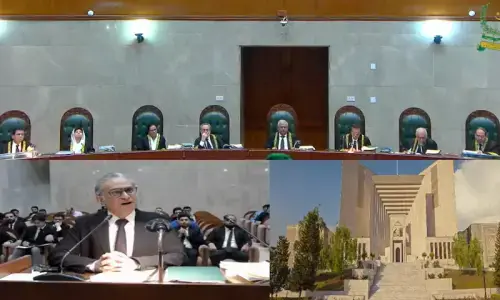
It largely expands on the thinking behind the 26th Amendment and plugs whatever loopholes that exercise left to ensure that the days of ‘judicial activism’ that some saw as politically motivated are long gone. The judiciary will find itself much more tightly corralled.
The irony won’t be lost on those who desired and campaigned for judicial independence that this tighter corralling of the judiciary will be accomplished with the help of some of the honourable members of the institution itself such as through a mechanism to transfer judges of the high courts. (I already have a list emerging in my mind, for example, of Islamabad High Court judges heading to far less salubrious and picturesque and definitely more turbulent and volatile centres than the federal capital).
The unity of the days of former chief justice Iftikhar Chaudhry is no more than a dot disappearing in the rear-view mirror, a distant memory. When we are lamenting the clipping of the judiciary’s wings it would be in bad taste to mention the excesses of the Chaudhry era. But how can one forget those?
The share of power and resources for the lead partner has been sought and is likely to be granted.
For it was those excesses that culminated in the unholy alliance between the judiciary and the establishment that marked the era of chief justice Saqib Nisar who presided over the first major rollback of democracy (in 2016) since its revival after the 2008 elections and triggered the downslide that continues to this day. Elements of the political class have been willing collaborators.
Those with far more legal competence and nous than I will ever have are commenting on this aspect of the amendment so I can move on to other areas such as the amendment governing Article 243 which deals with military appointments.
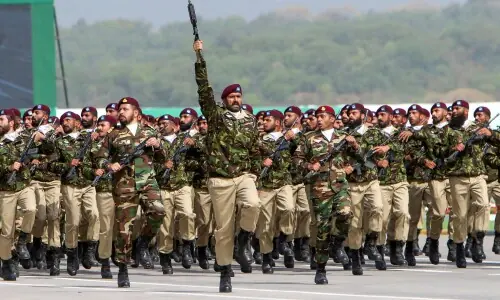
One of the changes to 243 will abolish the position of the Chairman of the Joint Chiefs of Staff Committee with the retirement of the incumbent Gen Sahir Shamshad this month. At which time the incumbent army chief Field Marshal Asim Munir will take over the newly minted dual role of the Chief of Army Staff-Chief of Defence Forces. The amendment states that the title of the field marshal will be for life. As far as my knowledge is concerned the title is always for life. So this part of the amendment is merely a reiteration. Also, a Commander of the National Strategic Command will be appointed by the prime minister on the recommendation of the COAS-CDF.
While it has not been spelt out, it is likely that the position will be a four-star general so the senior-most serving three stars will have something to aspire for, given the five-year tenure of their boss that is extendable for further period(s).
In essence, all of this represents the post-facto recognition and cementing of the status quo. The proponents of this move cite this May’s ‘victory in the war with India’ as the rationale or justification behind the changes to Article 243 as they reflect on the operational ‘lessons’ learnt about the demands of this new era of warfare.
Against this backdrop and Indian Prime Minister Narendra Modi’s insistence that his country’s Operation Sindoor was ‘on pause’ and not ended, there was considerable speculation about a 10 per cent cut in the provincial share of the federal divisible pool as enshrined in the National Finance Commission Award (NFC) to fund additional defence needs.
It was also suggested that the ministries of education and population welfare and planning that devolved to the provinces via the 18th Amendment in 2010 would revert to the centre along with their sizeable, donor-supplemented, budgets. On the reversion of these two ministries to the centre and the removal of the protection to the provincial share in the NFC, it seems, the PPP dug in its heels and, according to Law Minister Azam Nazeer Tarar, the PML-N agreed to exclude matters ‘for now’ from the amendment on which consensus was not reached.
While the PPP managed to block a constitutional (institutionalised) cut to its share, it would not be surprising if the extra Rs500 billion needed for defence needs is offered up voluntarily by the provinces including Sindh and Balochistan (where too the PPP claims it leads the provincial government) with dangers looming large on the eastern as well as the western fronts.
It would be difficult to describe the KP government’s posture under its belligerent new chief minister. If Sindh and Balochistan were to offer up their share, Punjab would follow suit, given that the PML-N has the government there.
Yes, democrats and those who believe in the independence of the judiciary will be crestfallen when this amendment is passed by parliament (and passed it will be, rest assured) but all it does is to once again underline the reality: power flows through the barrel of a gun.
In the past, takeovers have happened a few years (1977) or a few months (1999) after military debacles major or minor. Now, after a Trump-rubber-stamped win, an institutionalised increase in the share of power and resources for the lead partner of the hybrid set-up (this last a term used by Defence Minister Khawaja Asif) has been sought and is likely to be granted.
This is the reality. Notwithstanding the token provincial resistance. And sadly, for some of us this is how it will remain for the foreseeable future: save for a dramatic turn of events, that, for now at least, is improbable and not even a distant possibility.
The writer is a former editor of Dawn.
Published in Dawn, November 9th, 2025