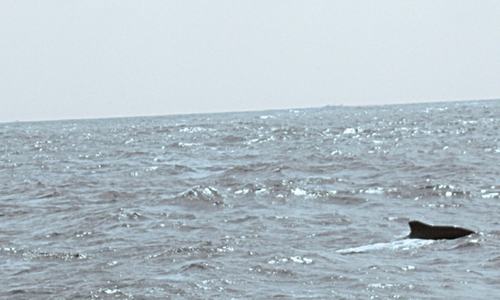
Rare pod of endangered Arabian humpback whales spotted off Gwadar

KARACHI: A rare large pod, comprising more than six endangered Arabian humpback whales, identified by the shape of their spouts and distinctive diving patterns, was sighted on Sunday night off Gwadar, the World Wide Fund for Nature-Pakistan (WWF-Pakistan) said on Monday.
Previously, the organisation had reported several sightings of this species from Pakistani waters; however, most of those involved only one or two whales.
According to experts, a group of fishermen led by Nakhuda Amir Dad Karim spotted more than six Arabian humpback whales migrating from west to east in the offshore waters about 11 nautical miles south of Gwadar headland.
Muhammad Moazzam Khan, technical adviser of WWF-Pakistan, considered the occurrence of such a large pod along the Pakistan coast an indicator of recovery for the species’ once-declining population.
“Whaling operations in the Arabian Sea, including off Pakistan’s coast from 1963 to 1967, by Soviet fleets used to target humpback whales. They are believed to have severely impacted the population of the Arabian Sea humpback whales, which have been struggling to recover since then,” he said.
WWF-P adviser says the occurrence is a sign of recovery for the once-declining species
Senior Director Biodiversity WWF-Pakistan Rab Nawaz said that the recent sightings of the large pod of whales, along with frequent reports of Bryde’s and blue whales along the Sindh and Balochistan coasts, reflected the high productivity of Pakistan’s Arabian Sea.
“These observations highlight the richness of our marine ecosystems and the importance of continued monitoring. I deeply appreciate the fishermen’s community, who remain vigilant and regularly report sightings of marine species to the organisation. Their efforts are a remarkable contribution to citizen science. The awareness we’ve created among coastal communities and the public is generating invaluable information for the conservation of these magnificent species, and that deserves recognition,” he said.
Arabian humpback whales, inhabiting the Arabian Sea, are a small subpopulation of humpback whales, which are considered to be the most isolated whale population on Earth. A population estimation study suggests that they have remained separate from other humpback whale populations for perhaps 70,000 years, which is extremely unusual in a species famed for long-distance migrations.
Most whales migrate to the Antarctic waters during the summerto feed on the abundant pelagic shrimp (krill) and small fish. This rich food source allows them to build up thick layers of blubber, which is essential for their energy during the colder months when they migrate to warmer, tropical waters to mate and give birth.
The major population of the Arabian Sea humpback whale inhabits the waters of Oman and, after the cessation of the southwest monsoon, migrates to Pakistani waters for feeding on rich planktonic shrimp and other pelagic fishes.
Last week, a pod of Bryde’s whale was reported from Gwadar (East Bay), which indicates the biodiversity potential of the Balochistan coast. So far, 27 species of cetaceans (dolphins and whales) have been reported from Pakistan, which reflects the abundance and productivity of its coastal and offshore ecosystems.
Published in Dawn, November 4th, 2025