Hybrids save $27m in fuel imports


KARACHI: More than 30,000 hybrid electric vehicles (HEVs) have hit Pakistani roads over the past two years, saving an estimated 30 million litres of fuel and reducing the oil import bill by around $27 million.
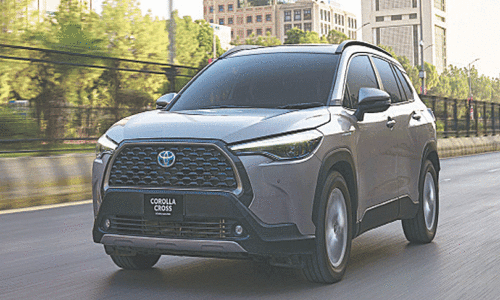
Lucky Motor Corporation (LMC) Chief Executive Mohammad Faisal said the savings could multiply if hybrids accounted for 25-30pc of the overall vehicle market. Pakistan’s auto market, including cars, vans, SUVs and pickups, averages 180,000-200,000 units annually, with HEVs now holding over 50pc share in the sport utility vehicles (SUV) segment during the first quarter of FY26.
Since 2021, 13 new electrified models have been launched in Pakistan, nine of which are hybrids from Korean, Chinese and Japanese assemblers. Mr Faisal said the trend reflects growing consumer confidence in HEVs due to easier maintenance, consistent fuel savings and better resale value compared to battery electric vehicles (BEVs) and plug-in hybrids (PHEVs).
Current estimates show fewer than 3,000 BEVs and under 1,000 PHEVs are operational across the country.
Mr Faisal said all major assemblers have invested significantly in local hybrid production over the past three years, introducing nine hybrid models. LMC claims to have achieved 35pc localisation in its Sportage and Picanto models. He noted that locally produced hybrids consume less foreign exchange, as their smaller battery packs are cheaper and allow greater localisation than those of BEVs and PHEVs.
Over 30,000 hybrid vehicles hit the roads in two years
He described HEVs as a practical and scalable solution for Pakistan, where affordability drives adoption. While hybrids are 15-20pc more expensive than conventional petrol cars, they remain significantly cheaper than BEVs or PHEVs.
“BEVs are the future, but consumers are not yet ready for a full shift due to resale concerns, range anxiety and the absence of charging infrastructure,” Faisal said.
He pointed out that frequent loadshedding, transmission losses and limited charging facilities outside major cities make BEVs difficult to sustain, while hybrids are self-charging and usable even in rural areas.
He added that HEVs perform reliably on rough terrain, during urban flooding, and in areas without grid connectivity. Across Asia, he said, around 30pc of ride-hailing fleets are hybrids, highlighting their fuel efficiency and resilience.
He said recent urban flooding in major cities has underscored the risks of operating BEVs or PHEVs in such conditions, as Pakistan lacks local capacity to repair or replace their costly battery systems.
According to LMC, hybrids can cut CO2 emissions by up to 40pc compared to conventional petrol cars. Unlike PHEVs, which rely on regular charging to reduce emissions, HEVs maintain lower emissions in all conditions, supporting Pakistan’s climate goals without requiring large-scale infrastructure.
He further noted that HEVs need less fiscal support than BEVs or PHEVs, which require nearly double the tax and duty exemptions per vehicle. Given Pakistan’s limited fiscal space, Faisal said hybrids offer a cost-effective path to cleaner mobility by lowering oil imports, easing pressure on foreign exchange, and reducing emissions.
Published in Dawn, October 31st, 2025