Business leaders term SBP move ‘anti-growth’

KARACHI: Barring foreign investors, Pakistan’s business community on Monday strongly criticised the State Bank of Pakistan’s (SBP) decision to maintain the policy interest rate at 11 per cent since May, terming the move “anti-growth” and damaging for industrial competitiveness.
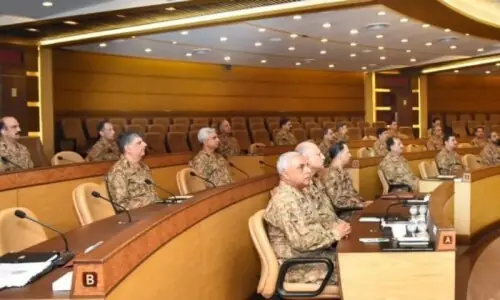
Trade and industry leaders have been urging the central bank to bring the rate down to single digits to revive industrial activity and boost exports. However, the SBP’s Monetary Policy Committee adopted a cautious stance, citing volatile global commodity prices, trade tensions, and domestic supply chain disruptions as risks to the macroeconomic outlook.
M. Abdul Aleem, Chief Executive and Secretary General of the Overseas Investors Chamber of Commerce and Industry, supported the SBP’s decision, saying, “Imports are increasing rapidly, whereas exports remain under stress. We did not expect any room for a rate cut at this stage, and maintaining stability is a prudent choice.”
In contrast, Federation of Pakistan Chambers of Commerce and Industry (FPCCI) President Atif Ikram Sheikh said the policy rate should have been reduced to 7pc, given September’s headline inflation of 5.6pc. “A lower rate would not only spur growth but also cut the government’s debt burden by about Rs3.5 trillion, providing crucial fiscal relief,” he said.
Warn high borrowing costs cripple industries, stifle economic recovery
FPCCI Senior Vice-President Saqib Fayyaz Magoon added that single-digit rates would reduce production costs, making goods more affordable and helping tame inflation. “High interest rates restrict access to finance and slow down growth,” he warned.
Karachi Chamber of Commerce and Industry President Muhammad Rehan Hanif said even a modest cut would have been a positive signal. “If a reduction to 9pc was not possible, the SBP could at least have cut to 10pc,” he said. He pointed out that government borrowing remains high while credit to the private sector is limited, adding that “businesses are still burdened by the 11pc rate despite improvements from the record 22pc peak.”
Mr Hanif cautioned that industries are already struggling with record energy and gas tariffs. “If the government truly wants to revive industrial activity, create jobs, and boost exports, it must urgently reduce both interest and utility costs,” he urged.
Korangi Association of Trade and Industry President Muhammad Ikram Rajput said high borrowing costs have made it nearly impossible for small and medium enterprises to access financing, hurting production, exports, and employment. “If policymakers continue to ignore industry concerns, recovery will become even harder,” he warned.
Site Association of Industry President Ahmed Azeem Alvi said the prime minister’s efforts to revive the economy through industrial incentives were being undermined. “This is the fourth consecutive time the rate has not been reduced, contradicting the prime minister’s economic vision,” he remarked.
Pakistan Chemicals and Dyes Merchants Association said sustainable growth and investment revival were impossible without cheaper credit.
Published in Dawn, October 28th, 2025