

Despite truce, Israel insists it calls the shots in Gaza

• Netanyahu asserts right to strike freely, veto power over nations included in international peacekeeping force
• Tel Aviv dismisses US dominance over its security, frames relationship with Washington as a ‘partnership’
• Egyptian technical team enters Gaza to locate remains of 13 deceased Israeli prisoners
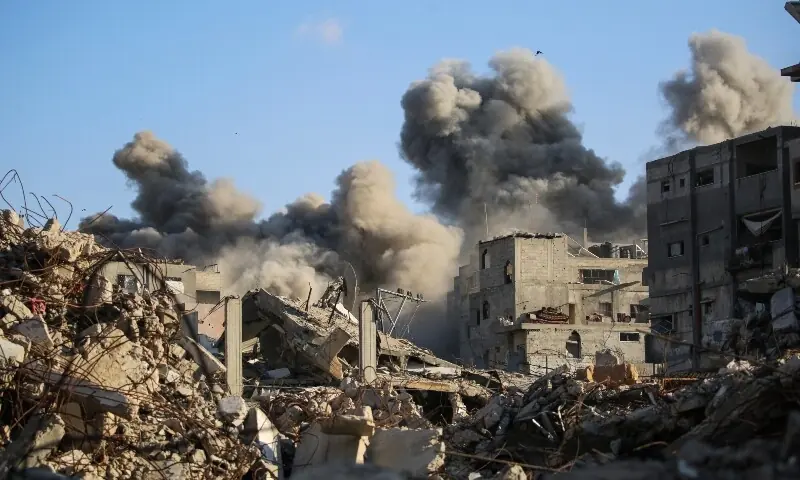
JERUSALEM: Despite agreeing to a US-brokered ceasefire after two years of a brutal assault on Gaza, Israel’s insisted on Sunday that it will maintain security control over the besieged territory and unilaterally decide which nations can participate in a planned international peacekeeping force.
PM Benjamin Netanyahu struck a defiant tone, telling ministers that Israel would decide for itself where and when to strike foes and which countries would be allowed to send troops to police the truce that followed a devastating war.
“Israel is an independent state. We will defend ourselves by our own means, and we will continue to determine our fate,” Netanyahu said. “We do not seek anyone’s approval for this. We control our security.”
During the session, Israel’s cabinet also dismissed any notion of American dominance over its security policies, emphasising that the relationship is strictly a partnership.
Since October 2023, more than 68,500 Palestinians have been killed by Israel, according to figures from the health ministry.
Amid the vast destruction, aid agencies complain that humanitarian convoys still lack sufficient access to alleviate famine-like conditions gripping parts of the territory.
Egyptian team in Gaza
At the same time, the bodies of 13 deceased Israeli prisoners remain in Gaza, with Hamas citing obstacles to locating them in the rubble left by Israeli bombardment.
An Israeli spokesperson asserted that Hamas is aware of the bodies’ locations, while the group maintained its commitment to the recovery efforts for the remaining bodies.
However, Israel had allowed the entry of an Egyptian technical team to work with the Red Cross to locate the bodies.
AFP footage showed an Egyptian convoy bringing rescuers and heavy machinery to speed up the search for the remains.
Low-loader lorries flying the Egyptian flag transported bulldozers and mechanical diggers into Gaza, accompanied by tipper trucks sounding their horns and flashing their lights, en route to an Egyptian aid committee based in Al-Zawayda.
Israel has withdrawn its forces within Gaza to the so-called “Yellow Line” but remains in control of more than half the territory, where it approves every UN aid convoy and has carried out at several strikes since the ceasefire began.
To underline this, Netanyahu boasted that Israel had pummelled Gaza with 150 tonnes of munitions on October 19 after two of its soldiers were killed and conducted a strike on Saturday.
Israel opposed to Turkish role
Under the terms of the ceasefire, an international force drawn mainly from Arab or Muslim countries is supposed to secure Gaza as Israeli forces withdraw.
While the Trump administration has ruled out sending US soldiers into the Gaza Strip, it has been speaking to Indonesia, the UAE, Egypt, Qatar, Turkiye and Azerbaijan to contribute to this force.
However, Netanyahu, under fire from hardliners in his own coalition, has specifically opposing any role for regional rival Turkiye.
On Friday, US Secretary of State Marco Rubio stated that the international force must include “countries that Israel’s comfortable with.” However, he made no comment on Turkish involvement.
Rubio said that Washington did not foresee the Yellow Line as Gaza’s new border, anticipating Israel’s eventual withdrawal.
“I think, ultimately, the point of the stabilisation force is to move that line until it covers hopefully all of Gaza, meaning all of Gaza will be demilitarised,” Rubio told reporters on his plane as he flew on to Qatar.
Published in Dawn, October 27th, 2025



























