Palestinian groups agree on technocrat body to rule Gaza
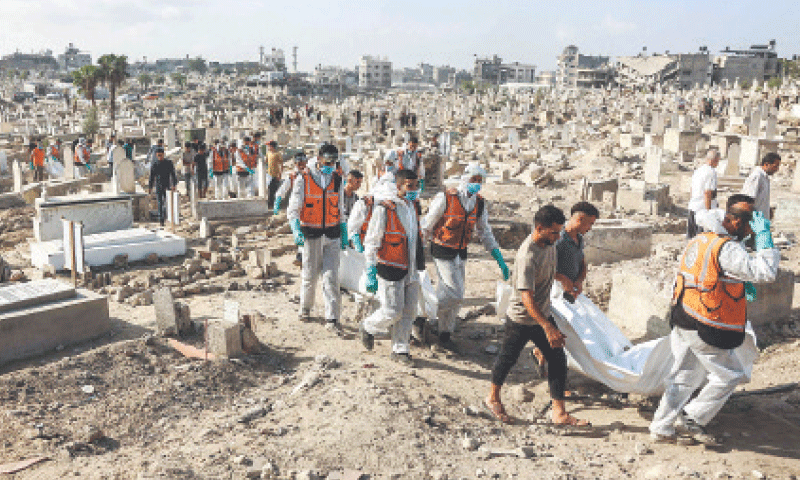


• Rubio rules out Hamas role in future governance; says international force being put together
• Israel to have veto on which country’s forces can be part of such a force
• Career US diplomat picked to monitor ceasefire
CAIRO / KIRYAT: The main Palestinian political factions, including Hamas, have agreed that an independent committee of technocrats would take over the running of post-war Gaza.
During a meeting in Cairo, according to a joint statement published on the Hamas website, the groups agreed to hand “over the administration of the Gaza Strip to a temporary Palestinian committee composed of independent technocrats”.
It said the committee would “manage the affairs of life and basic services in cooperation with Arab brothers and international institutions”.
The statement also said the factions had agreed to work on unifying a common position “to confront the challenges facing the Palestinian cause”.
It called for a meeting of all forces and factions to “agree on a national strategy and to revitalise the Palestine Liberation Organisation (PLO) as the sole legitimate representative of the Palestinian people”.
Hamas is not part of the PLO, which is dominated by its longtime rival Fatah.
An informed source told AFP on Thursday that delegations from Hamas and Fatah met in Cairo to discuss the second phase of a US-backed ceasefire plan in Gaza.
The source, who spoke on condition of anonymity, said that both sides agreed to “continue meetings in the coming period and to work on organising the Palestinian internal front in the face of the challenges posed by the Israeli government”.
Alongside the Hamas-Fatah talks, Egypt’s intelligence chief Hassan Rashad met senior officials from key Palestinian factions.
They included Islamic Jihad, an ally of Hamas, as well as the Democratic Front for the Liberation of Palestine and the Popular Front for the Liberation of Palestine – both factions within the PLO.
International force
The development coincided with remarks made by US Secretary of State Marco Rubio, who said on Friday that Hamas could not be involved in the future governance of the war-ravaged Palestinian enclave.
During a visit to the Civil-Military Coordination Centre, set up to observe the ceasefire for any violations and handle aid delivery into war-ravaged Gaza, Rubio said: “There’s going to be ups and downs and twists and turns, but I think we have a lot of reason for healthy optimism about the progress that’s being made”.
In his remarks, Rubio also said that an international force to police the ceasefire in Gaza would be put together soon.
He said it was critical for the deal to create “the conditions for the stabilisation force to come in as soon as it possibly can be put together”.
The arrival of an international security force may unlock reconstruction funds — US officials vow none will go to Hamas-held areas — but the troop-contributing countries have yet to be confirmed.
Rubio confirmed that Israel would enjoy vetoes on the force’s composition, amid reports Israel has objected to Turkey’s participation.
“There’s a lot of countries that have offered to do it. Obviously as you put together this force, it will have to be people that Israel is comfortable with,” he said.
Indonesia has also said it is ready to send troops to Gaza. The United Arab Emirates, which normalised ties with Israel in 2020, has already been involved in ceasefire monitoring.
Rubio said the US may seek a UN mandate for the force, as some countries need the world body’s imprimatur to deploy troops.
But he again rejected any future role for UNRWA, which Israel has banned from its territory.
Meanwhile, the US named Steve Fagin — a career diplomat – as the civilian lead in a body monitoring the Gaza ceasefire. He will work alongside US Army Lt Gen Patrick Frank, the military head already appointed to the hub set up after the Oct 10 ceasefire.
Published in Dawn, October 25th, 2025