

As long as wars and armed conflicts are tolerated, obliterating in moments what took years of effort to build, the global drive for equitable, sustainable development will falter, casting doubt on leaders’ intent and commitment to collective prosperity.
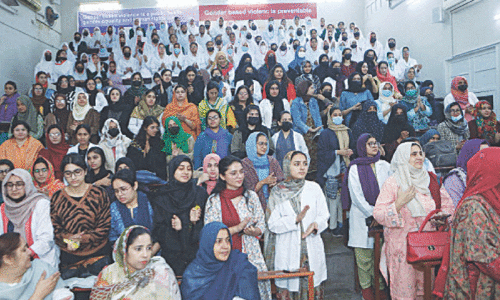
It is hardly surprising that with multiple global flashpoints, especially the tragic situation in Gaza, the 10th Annual Sustainable Development Goals (SDGs) Conference, held in New York last month on the sidelines of the United Nations (UN) General Assembly, struggled to capture public attention despite strong stakeholder turnout. Key themes included the digitalisation of development and the role of women and youth leadership.
The value of the SDG Index and similar studies for tracing and tracking progress is undeniable, but the UN and global civic bodies must also assess the aggregate economic and financial costs of wars and armed conflicts in this millennium to place global goals in perspective. At this point in history, it seems that peace must precede, not follow, prosperity or its sustainability.
The reckless pursuit of commercial interests at any cost, even at the expense of our shared habitat, coupled with governments’ reliance on military might to subdue internal opponents and external foes, has stifled human potential and diverted resources away from the constructive causes essential for a happy, healthy and dignified future.
The reckless pursuit of commercial interests at any cost has stifled human potential and diverted resources away from a dignified future
“The Gaza ceasefire has rekindled hope for peaceful coexistence everywhere. It underscores that wars and military conflicts entail costs that spill across borders and are ultimately borne by vulnerable people both inside and outside war zones. I was somewhat disappointed, however, that officials and civil society leaders at the SDG Forum did not call for an end to all inter- and intra-state armed conflicts, a prerequisite for growth and development,” a senior economist observed anonymously.
“We are well aware of the perils of militancy in Pakistan and the heavy cost of instability. In my firm view, without investment and growth, the grave challenges of unemployment, poverty and climate change cannot be addressed, even with multilateral bailouts or support from friendly nations.
“Pakistan was among the first to design a detailed framework with defined targets for all 17 goals, properly benchmarked to track progress soon after SDGs were adopted in 2015. Yet the effort faltered as the country lurched from crisis to crisis. Our slippage on the 2025 SDG Index is testimony to that failure,” he added.
Soon after the release of the 2025 SDG Index in July, senior officials from the planning ministry disputed its findings on Pakistan, calling them biased and based on questionable data and methodology. “The situation is far from ideal, but in my view, better than portrayed in terms of relative performance. We will be able to substantiate this once current social indicator data becomes available,” a senior officer stated.
A senior official confirmed that the Household Income and Expenditure Survey had been delayed, as the Pakistan Bureau of Statistics was occupied with the census, leaving only outdated data for assessment.
A senior source in Islamabad disclosed privately that a document assessing progress and shortcomings on all 17 SDGs had been completed but was deemed too damning to release publicly. “The painstakingly prepared report is probably gathering dust somewhere. For political reasons, I doubt it will ever see the light of day,” he remarked.
Several officials and members of the government’s economic team were approached for updates on Pakistan’s participation in the SDG Forum and their assessment of progress, but no response was received before the deadline. Civil society leaders, meanwhile, blamed the government for the dismal state of affairs.
Renowned philanthropist Dr Muhammad Amjad Saqib, speaking from overseas, blamed the government’s lack of focus on implementation plans. “Pakistan’s progress on the SDGs has been slow due to poor governance, weak implementation, lack of commitment, and limited resources. As founder and CEO of Akhuwat, I care deeply about the SDGs, particularly those on poverty, education, environment, and gender equality. Through Akhuwat’s programmes in interest-free microfinance, education, health, and social inclusion, we have advanced multiple SDGs by empowering millions to achieve self-reliance and dignity,” he said.
Business leaders from major sectors, including textiles, autos, cement and pharma, were contacted for their perspective. Shahid Sattar, Secretary General of the All Pakistan Textile Mills Association, said the body is working hard to ensure its members comply with the EU’s trading partner requirements.
“These conditions span several SDGs, from working conditions and labour welfare to climate change. I admit many medium and small textile units are not yet fully compliant, but we recognise the importance of meeting global standards to promote and sustain exports, and are striving to drive this home,” he explained.
Mashood Khan, Director, Small and Medium Enterprise Development Agency (SMEDA) and a leader of the auto sector, said: “It’s not promises but delivery that secures the nation’s future. Federal and provincial governments must prioritise people’s welfare, education, health, and sustainable industry over rhetoric.”
He noted Pakistan’s SDG progress remains poor: poverty is rising with inflation and unemployment; health spending is under one per cent of GDP, leaving hospitals overstretched; education gets under 2pc, keeping millions out of school; and a long-delayed clean water project reflects weak coordination. While 35,000 firms registered in FY25, 1,600 textile units shut down. Karachi, once thriving, now suffers neglect and crumbling infrastructure.
Published in Dawn, The Business and Finance Weekly, October 13th, 2025