Tax relief, policy support urged to promote Pakistan’s medical device sector
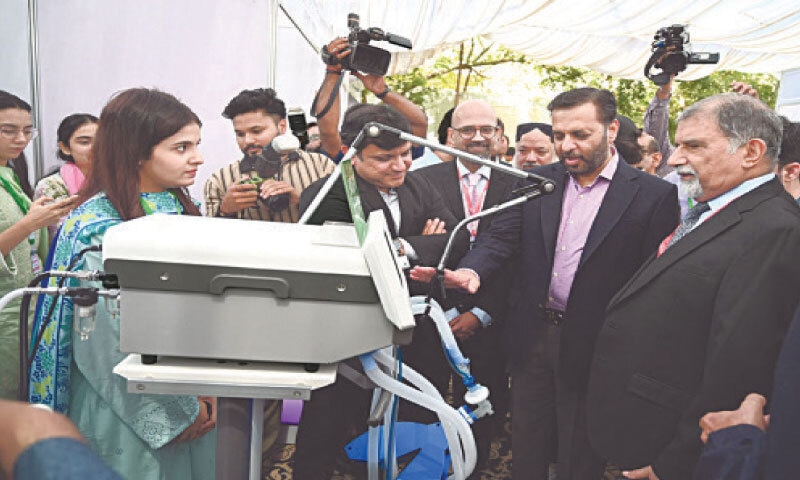

KARACHI: Speakers at a seminar on Saturday highlighted the critical role Karachi-based manufacturers were playing in advancing Pakistan’s medical device sector and the challenges the industry faced, including high taxation and lack of subsidies.
The seminar, titled “Made in Karachi-Medical Devices”, was organised by the Faculty of Pharmacy and Pharmaceutical Sciences, Ziauddin University (ZU), in collaboration with the Drug Regulatory Authority of Pakistan (Drap), Karachi.
Speaking at the seminar as the chief guest, Federal Minister for National Health Services Syed Mustafa Kamal talked about the current state and potential of Pakistan’s medical and pharmaceutical industry.
“Pakistan currently has a $1 billion medical and pharmaceutical market, and our vision is to expand it to $30bn within the next five years,” he said.
Drap now issues medical device licences within 20 days, Kamal claims
“In the past, it used to take around three and a half years to register a medical device through Drap. Today, the process has been fully digitalised, and licences are now issued within just 20 days. This reform shows our commitment to efficiency, transparency, and facilitation for our local manufacturers,” the minister noted.
Reassuring continuous support to stakeholders, he added: “I am a representative of the people and am available around the clock to address your concerns. No issue can be resolved unless it is brought to light, and I encourage everyone to speak up so that together, we can bring real change.”
While talking about how Karachi serves as the economic hub of Pakistan, Mr Kamal acknowledged: “Whatever is made in Karachi is close to my heart, because this city is the economic artery of Pakistan and the hallmark of our industry.
“Karachi symbolises resilience, innovation and the spirit of hard work that drives our national economy. Strengthening local manufacturing here means strengthening Pakistan itself.”
In his speech, Prof Abbas Zafar, acting ZU vice chancellor, appreciated the federal minister’s “Made in Pakistan” vision and reaffirmed the university’s support for this national initiative.
“The theme ‘Made in Karachi’ symbolises the city’s industrial and scientific strength and reflects its growing capacity to become a hub for medical device innovation and manufacturing in Pakistan,” he said.
Speaking on the challenges of high taxation and lack of subsidies in the medical devices sector, Syed Omer Ahmed, chairman of the Healthcare Devices Association of Pakistan (HDAP), urged the government and Drap to facilitate local manufacturers.
“Pakistan has nearly 100 factories producing medical devices. Yet, no formal system for toll manufacturing exists. Sales tax and customs duties on medical devices remain disproportionately high compared to medicines, despite their vital role in healthcare delivery,” he said. He emphasised the need to balance import and local production policies to strengthen the country’s export potential, which could tap into a $600 billion global medical devices market.
Representing Drap, Dr Shoaib highlighted the authority’s commitment to strengthening Pakistan’s regulatory framework in alignment with international standards.
He said: “Our goal at Drap is to create a transparent, efficient and innovation-friendly regulatory environment that encourages local manufacturing while ensuring patient safety and product quality.
We are moving towards harmonisation with global best practices to help Pakistani manufacturers access international markets with confidence.”
Published in Dawn, October 12th, 2025