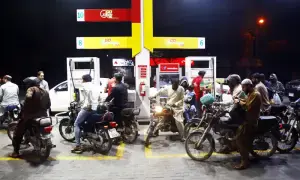
Twin cities under siege sans TLP protest

. Authorities block roads with containers to thwart TLP march . Public transport suspended, flights delayed due to security measures
ISLAMABAD/RAWALPINDI: A massive security lockdown to stop Tehreek-i-Labbaik Pakistan’s (TLP) planned march on the federal capital brought life to a standstill in Islamabad and Rawalpindi on Friday, cutting off the capital from the rest of the country and leaving thousands stranded.
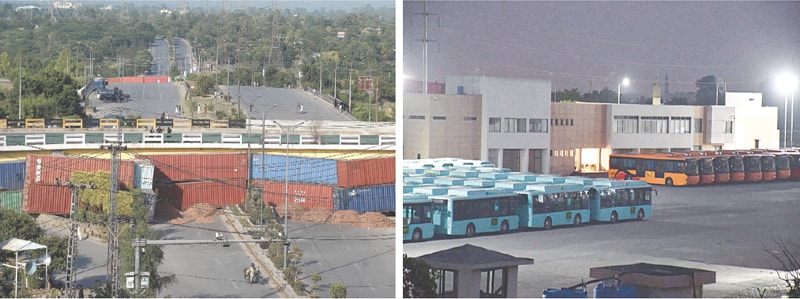
The federal capital remained under partial siege as key entry and exit points, including Rawat T-Cross, Chungi No 26, Faizabad and Zero Point, were sealed with containers. Access to the Red Zone, High Security Zone and Diplomatic Enclave was also restricted.
A police officer told Dawn that the capital was likely to remain sealed for at least another day or maybe more.
“Contingents of police and paramilitary troops will stay deployed until the TLP call is withdrawn or the authorities decide otherwise,” he said.
Though there was no sign of TLP leaders or activists in the city, the security clampdown alone was enough to cripple citizens’ movement. Roads within the capital were blocked, isolating neighbourhoods from one another.
. Authorities block roads with containers to thwart TLP march . Public transport suspended, flights delayed due to security measures
The TLP had announced plans to march toward Islamabad from across the country, but mainly from Lahore, and later head to the US Embassy in the Diplomatic Enclave to protest Israeli actions in Gaza.
Faizabad, the main interchange connecting the twin cities, was blocked. Other key routes, including 9th Avenue, Double Road, Faisal Avenue and Park Road, have also been completely sealed.
The capital presented a deserted look throughout the day as residents stayed indoors.
Public transport, including metro bus service and CDA’s electric buses, was suspended. Office workers and some of the students attempting to reach their destinations early in the morning were forced to return home.
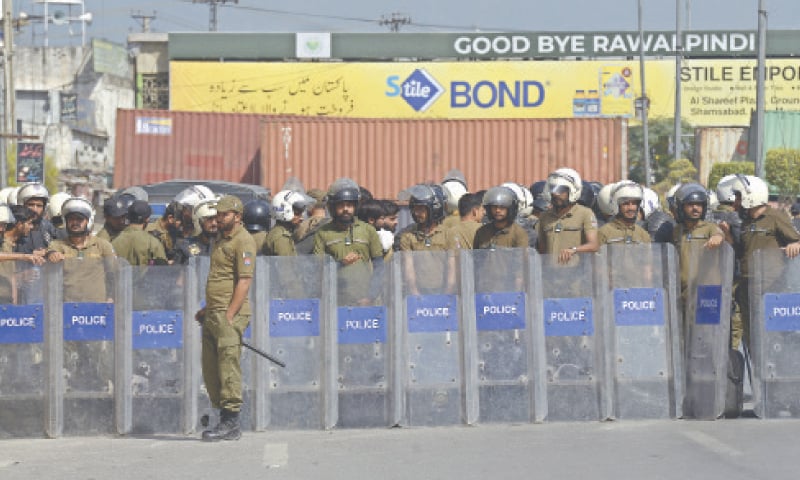
More than 7,000 law enforcement personnel, including 5,500 police, 1,000 Frontier Constabulary, and 500 Rangers, were deployed across Islamabad. Around 500 containers were used to seal major entry points.
Interior Minister Mohsin Naqvi and Minister of State Talal Chaudhry visited Faizabad with Inspector General of Islamabad Police Syed Ali Nasir Rizvi on Friday night to review security arrangements.
Mr Naqvi met the police and constabulary personnel deployed at the venue, shook hands with them and appreciated their efforts, directing the IGP to ensure proper care, meals, and water for all on duty.
Rawalpindi
In Rawalpindi, similar scenes of disruption unfolded. Ambulances with sirens blaring were stuck in traffic, motorcyclists searched for passageways and pedestrians struggled to cross container blockades.
Many students were unsure if their schools and universities would remain open, as the district administration had made no formal announcements.
Mobile and internet services were also disrupted in several areas of the twin cities. Flight operations at Islamabad International Airport were affected as airline staff and passengers were unable to arrive on time.
A Pakistan International Airlines (PIA) spokesman confirmed that two flights from Islamabad and Lahore were delayed and advised passengers to verify flight status before leaving for the airport.
Over 6,500 police personnel, equipped with anti-riot gear, were deployed in Rawalpindi to maintain order. More than 300 containers were placed at key intersections, including Marrir Chowk, Soan Bridge, Jhelum Road, Peshawar Road and Pirwadhai Mor.
Despite the heavy deployment, no protest or violence was reported in any part of the city.
Ambulances struggled to reach major hospitals such as Holy Family, Benazir Bhutto and Rawalpindi Teaching Hospital as roads remained blocked.
A resident described the situation as “a city under siege, without any protest.” Public transport was off the roads, while banks, offices and markets reported thin attendance. Although Friday is typically a weekly holiday in Raja Bazaar and adjoining markets, shopkeepers in Saddar, Murree Road and Commercial Market opened their shops but reported no business activity.
“Buyers stayed away due to the road closures,” said Zafar Qadri, Secretary General of the Rawalpindi Cantonment Traders Association. “Even those who tried to come turned back.”
Shahid Ghafoor Paracha, president of the Rawalpindi Traders Association, said, “We opened shops hoping for business, but there were no customers. The environment is not conducive to trade.”
He lamented that continuous political and religious protests had badly affected business.
“It’s the government’s duty to regulate demonstrations like in the developed countries so people are not held hostage,” he added.
According to a police spokesman, City Police Officer (CPO) Syed Khalid Hamdani, Senior Superintendent of Police (SSP) Operations Kashif Zulfiqar and SSP Investigation remained in the field, monitoring the situation. More than 7,500 officers were assigned security and traffic duties, while Dolphin Force, Elite Commandos and Safe City cameras kept a close watch on key areas.
Section 144 was imposed in Rawalpindi, prohibiting public gatherings. The spokesman said the situation remained peaceful throughout the day, and “anyone involved in mischief or law violations will be dealt with an iron hand.” He added that protecting citizens’ lives and property and maintaining the rule of law were top priorities.
— Aamir Yasin also contributed to this report.
Published in Dawn, October 11th, 2025