Security tight after deadly Ladakh autonomy protests in India



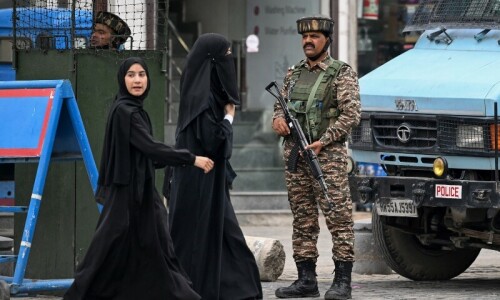
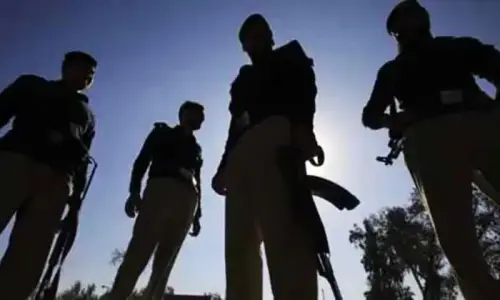
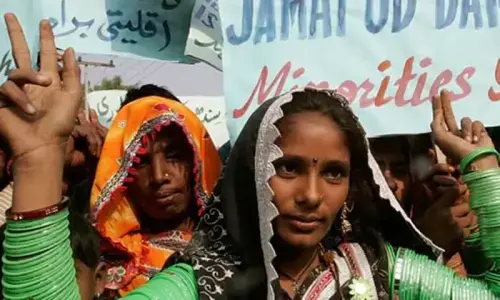
Indian police patrolled the northern city of Leh on Thursday, a day after protests demanding greater autonomy for India-held Ladakh turned deadly when security forces opened fire.
At least five people were killed, 30 police officers were injured and several more protesters wounded.
The city — usually bustling with tourists — appeared deserted, with most main roads blocked by coils of razor wire and guarded by police in riot gear, an AFP reporter said.
Protests erupted on Wednesday, with crowds demanding greater autonomy in the sparsely populated, high-altitude desert region that is home to some 300,000 people and which borders China and Pakistan.
India’s Ministry of Home Affairs said that an “unruly mob” had attacked police, reporting in a statement issued late on Wednesday that “more than 30” officers were injured.
Protesters torched a police vehicle and the offices of Prime Minister Narendra Modi’s Hindu-nationalist Bharatiya Janata Party (BJP), while officers fired tear gas and used batons to disperse crowds.
“In self-defence, police had to resort to firing, in which unfortunately some casualties are reported,” the statement said.
It did not give any details about deaths.
However, a police officer told AFP that “five deaths were reported after the protests”. The officer spoke on condition of anonymity because he was not authorised to speak to journalists. He said the “number of injured is in the dozens”.
A police unit guarded the vandalised BJP office on Thursday, alongside the wreckage of a burned armoured vehicle.
Around half of Ladakh’s residents are Muslim and about 40 per cent are Buddhist.
It is classed as a “Union Territory” — meaning it elects lawmakers to India’s parliament but is governed directly by New Delhi.
Wednesday’s demonstrations were organised in solidarity with prominent activist Sonam Wangchuk, who had been on hunger strike demanding either full federal statehood for Ladakh or constitutional protections for its tribal communities, land and fragile environment.
New Delhi said the protesters were “instigated by his provocative speeches” and pointed out that efforts were continuing to discuss its governance.
Modi’s government split Ladakh off from India-occupied Kashmir in 2019, imposing direct rule on both. New Delhi has yet to fulfil its promise to include Ladakh in the “Sixth Schedule” of India’s constitution, which allows people to make their own laws and policies.
Omar Abdullah, chief minister of India-occupied Jammu and Kashmir, said people in Ladakh felt “betrayed and angry”.
India’s army maintains a large presence in Ladakh, which includes disputed border areas with China. Troops from the two countries clashed there in 2020, killing at least 20 Indian and four Chinese soldiers.