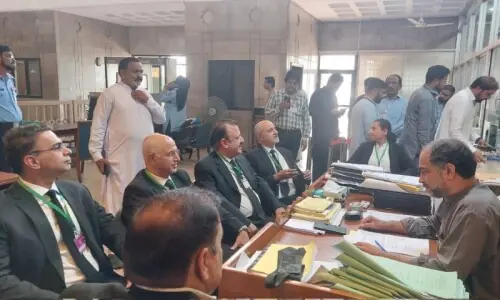
ISLAMABAD: The Supreme Court’s registrar office on Monday raised administrative objections to the petitions separately filed by five sitting judges of the Islamabad High Court (IHC) before the apex court.
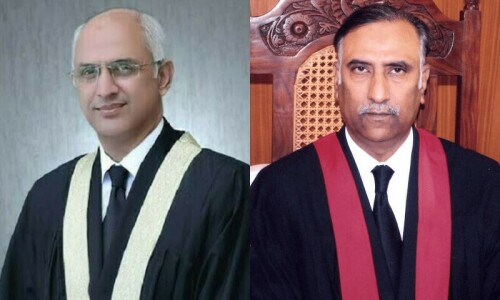
Justices Mohsin Akhtar Kayani, Tariq Mehmood Jahangiri, Babar Sattar, Sardar Ejaz Ishaq Khan and Saman Raffat Imtiaz had appeared in person before the Supreme Court last Friday to institute constitutional petitions challenging the exercise of administrative powers by the IHC chief justice.
According to the objections, the petitioners invoked the apex court’s original jurisdiction under Article 184(3) of the Constitution for the enforcement of fundamental rights, but the grievances raised were of an individual nature and thus not maintainable in view of the 1998 Zulfiqar Mehdi case.
In that judgement, the SC had held that Article 184(3) could not be pressed into service for redress of personal grievances.
Incidentally, the same case law was cited by the SC registrar while returning Mustafa Nawaz Khokhar’s petition, seeking a hearing of challenges to the 26th Amendment, on the same day. The registrar office further observed that the petitioners had not demonstrated what questions of “public importance” were involved for the enforcement of fundamental rights — a condition precedent for invoking Article 184(3), sources said.
It added that the notices issued to the respondents — IHC Chief Justice Sardar Muhammad Sarfraz Dogar, the registrar of the high court, and the federal government through the law secretary — had not been properly drawn up, since they failed to specify the purpose of the petitions.
In their petitions, the judges sought a declaration that the administrative powers of the IHC chief justice could not be exercised in a manner that undermined judicial authority. They argued that once a bench was seized of a matter, the IHC CJ was not empowered to transfer cases or reconstitute the bench, nor to exclude available judges from the roster at will.
The pleas further contended that constitution of benches, transfer of cases and issuance of rosters could only be undertaken in terms of Articles 192(1) and 202 of the Constitution, and that the “Master of the Roster” doctrine had already been set aside by the SC in its 2024 judgement in the Practice and Procedure case.
They also challenged the formation of the IHC administrative committees through notifications issued on Feb 3 and July 15 this year, terming them mala fide, illegal and coram non judice, and requested the apex court to declare such notifications void.
Published in Dawn, September 23rd, 2025