0
0

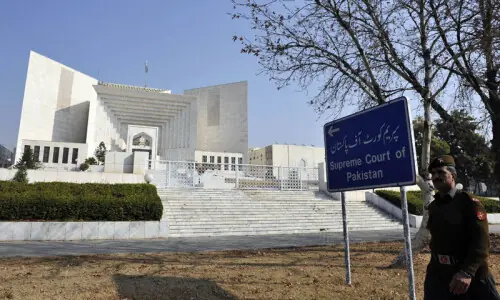
KARACHI: Noting widespread and systematic refusals or delays in the registration of first information reports (FIRs), the Supreme Court has ruled that no reason can justify the dereliction of the mandatory statutory duty of the police, as violations would erode public trust in the criminal justice system.
A three-judge bench of the apex court, comprising Justice Muhammad Ali Mazhar, Justice Athar Minallah and Justice Salahuddin Panhwar, also noted that the registration of an FIR under Section 154 of the criminal procedure code (CrPC) was exclusively an executive function and violation of the statutory duty has profound consequences for the parties involved in a criminal case.
“A dysfunctional criminal justice system for citizens who are not privileged or powerful manifests lack of constitutional governance. The onus is on the respective governments to establish that every citizen is dealt with in accordance with the obligation enshrined under Article 4 of the Constitution,” it added.
The bench made these observations while deciding a criminal appeal filed by two murder convicts, impugning a judgement of the Sindh High Court.
Denial of FIRs erodes trust in justice system, notes Justice Minallah
Authored by Justice Minallah, the SC verdict said that a functional and effective criminal justice system was premised on the foundation of fairness, integrity and impartiality of FIRs about the commission of a cognizable offence under Section 154 of CrPC and pursuing investigation.
It also noted that these two executive functions were so crucial that they ultimately determine whether justice would be served and whether the actual perpetrator will be held accountable, or rather making an innocent person suffer the unimaginable agony of carrying the stigma of being an accused.
“The bedrock of constitutional governance and rule of law is profoundly undermined when there is dereliction of the two aforementioned statutory duties vested exclusively in the executive branch of the State. It is an onerous duty of the State and its functionaries to protect the fundamental rights of the citizens by protecting them from being victims of crime and if a crime takes place, then to hold the perpetrator accountable,” it added.
The bench further observed that various factors may contribute to the failure or refusal by a police station in-charge to register a criminal FIR for a cognisable offence. These may include attempts to avoid adding to an already heavy workload, concealing the deterioration of law and order, inability to prevent crime, or even corruption and misuse of statutory powers to benefit, or act at the behest of, politically or socially influential individuals or groups in the area, it said.
However, the bench emphasised that no reason can justify the dereliction of the mandatory statutory duty imposed under Section 154 of the CrPC. “A violation of this duty not only undermines the fundamental rights of citizens but also severely erodes public trust in the criminal justice system.”
“A citizen would be justified in perceiving that the criminal justice system merely serves the interests of the privileged and those who wield political and social power. The phenomenon also gives rise to the perception that the registration of a criminal case is subject to seeking permission from the superior officials or the politically or socially powerful persons of the area. If so, then it erodes the rule of law and amounts to a grave violation of a mandatory statutory duty,” it added.
The apex court also stated that it was an onerous task of each provincial government to dispel such perception by ensuring that in each case there must be no dereliction of the statutory duty imposed under section 154 of CrPC and in case of violation, to take such appropriate action which creates deterrence for the future.
About the systemic phenomenon of refusal or delay in registration of FIR, the bench further observed that this phenomenon appeared to be widespread because it has been persistently observed in most of the criminal cases and it has also been witnessed that this phenomenon was generally prevalent in cases relating to vulnerable and marginalised classes.
The bench directed its office to send copies of this judgement to the secretary of the ministry of interior and chief secretaries of the respective provinces for placing the same before the competent forums for consideration of these observations and taking effective measures regarding the mandatory statutory duties highlighted in the judgment.
It also acquitted both the appellants by overturning the orders of the SHC as well as the trial court.
A sessions court in Shikarpur had sentenced Mir Muhammad alias Kuraro and Allah Wadhayo to death for killing a man named Ghulam Qadir in May 2013. In 2021, the SHC had converted the capital punishment into life term and the convicts had challenged the same before the apex court.
Published in Dawn, September 23rd, 2025