0
0

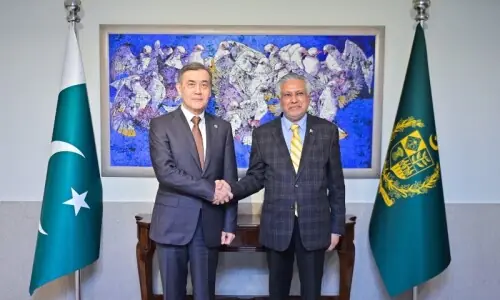
THE Strategic Mutual Defence Agreement, signed between Pakistan and Saudi Arabia, is making an impact far beyond Islamabad and Riyadh.
While there is talk of extending the bilateral pact to other states, thus creating a larger regional security framework, there has also been unnecessary speculation about the use of Pakistan’s nuclear assets. Indeed, the expansion of defence cooperation is a project worth pursuing as currently both the Middle East and South Asia are experiencing geopolitical volatility. But where questions about nuclear arms are concerned, Pakistan should reiterate that its atomic weapons are a deterrent, meant solely for self-defence.
Pakistan has joined military alliances earlier, including the Cold War-era Seato and Cento pacts, which put it squarely in the Western camp. In these US-led alliances, Pakistan was little more than a bit player. However, the defence pact with Riyadh is different, as Pakistan today has a combat-hardened military and much-improved defence capabilities. The country’s profile was strengthened following the military clash with India earlier this year, sending the message that Pakistan could defend itself against a much larger foe. All these factors, as well as the irresponsible Israeli attack on Qatar, likely convinced the Saudis that it was the right time to seal the deal.
Now, there are indications that the military partnership could expand. Defence Minister Khawaja Asif told an interviewer that “the doors are not closed” on other states. As we have argued, the Islamic Military Counter Terrorism Coalition could be repurposed for a larger defence role, bringing together Muslim states under one banner. Such an alliance, along the lines of Nato, would strengthen the security of all member states, and deter enemies from violating the sovereignty of Muslim and Arab countries. But the doors of membership should remain open to all Muslim states.
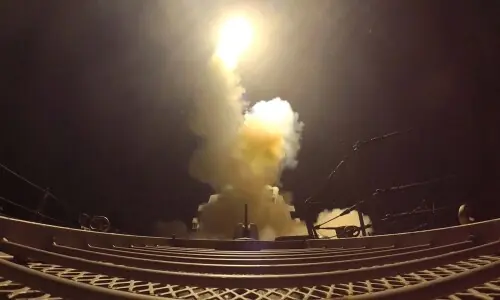
Meanwhile, all relevant circles should exercise caution in their words and actions. There is much speculation in the Western media that the Pakistan-Saudi deal would make this country’s nukes available to Riyadh — perhaps because some Saudi officials have been quoted as saying that the pact ‘encompasses all military means’. When asked about the nuclear issue, Khawaja Asif said that “our capabilities, will absolutely be available under this pact”, though he added that Pakistan remains a responsible nuclear power.
Any concerns on this front must be allayed immediately, and government officials in particular should unambiguously state that, as per Pakistan’s nuclear doctrine, the atomic weapons are meant as a deterrent.
Meanwhile, Pakistan and the other Muslim states should pool their conventional defensive resources. Numerous Muslim states in the Middle East have been attacked by Israel, while Pakistan has increasingly faced Indian aggression. A defence pact could thus make adversaries think twice about launching strikes.
Published in Dawn, September 20th, 2025