0
0

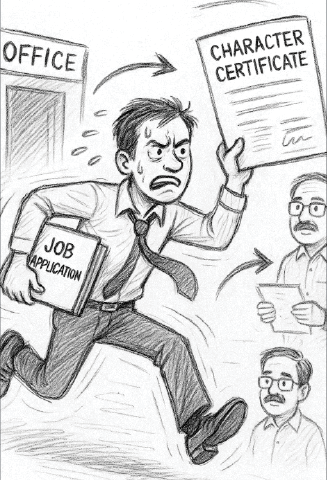
IN Pakistan, where students and fresh job applicants already struggle with job insecurity, limited opportunities and fierce competition, they are additionally burdened by an outdated and cumbersome requirement: getting all the documents attested by a gazetted officer and submitting character certificates. This rule is uniformly enforced across the country, regardless of regional accessibility or practicality.
In today’s digital age, most academic documents and CNICs contain QR codes and can be easily verified online, not involving any lengthy process. Why are applicants required to chase government officers for basic attestations? This wastes time and often leads to delays due to the unavailability of officials. It even opens the door to unethical demands.
Moreover, government departments also verify documents after a candidate is selected, making this pre-application attestation largely redundant. If some people submit fake documents, they will still be caught during the post-selection verification phase. Even more questionable is the requirement of a so-called character certificate. How can a gazetted officer, who likely has no personal connection with the applicant, credibly vouch for someone’s moral character? In many cases, such certificates are issued by clerical staff for a small ‘fee’, further undermining the credibility of the whole process.
Recently, I personally experienced how dysfunctional this process can be. At the City Court in Karachi, I approached several public prosecutors for attestation of my documents.
Despite the presence of public pro-secutors from multiple districts, none was willing to help. It became clear that this essential requirement depends not on merit, but on navigating bureaucratic roadblocks and arbitrary conditions.
Therefore, to improve transparency, efficiency and accessibility, the government should implement a centralised digital verification system. Institutions such as Higher Education Commission (HEC), National Database Registration Authority (Nadra) and educational boards should directly validate documents online.
This would eliminate the need for any manual attestation, reduce lower-level corruption, and save valuable time for thousands of applicants. Reforms in this area are long overdue, and must be prio-ritised to align Pakistan’s recruitment processes with global best practices.
Muhammad Ishaque Gabol
Karachi
Published in Dawn, September 19th, 2025