“IT is hard fate — to be banned — by the world, only because one has sought to be wiser than the world is,” quipped Edward Bulwer-Lytton. So it does not seem strange when we see a major poet like Josh Maleehabadi (1894-1982) being banned for seeking to be wiser than the society. But the society thought his notions were tantamount to rebellion. Josh Maleehabadi not only believed differently on several issues but also expressed them openly and at times landed himself in controversies.
Irreverent, outspoken and fearless, Josh did not mince his words and in interviews, too, often openly expressed his views on religion, love, sex, politics and his “hobbies”, sometimes totally disregarding the norms of a conservative society like ours. Some of the remarks he made during some interviews became quite controversial and he had to pay dearly. For instance, he was removed from Urdu Dictionary Board (formerly Taraqqi-i-Urdu Board) after an “anti-Pakistan” interview he gave while on a visit to India. His another interview, broadcast from Radio Pakistan, was labelled as “too bold” and Josh was banned from being broadcast or telecast. After such episodes, his peers, and even some friends, shunned Josh as they feared the spillover effect of the repercussions he was facing.
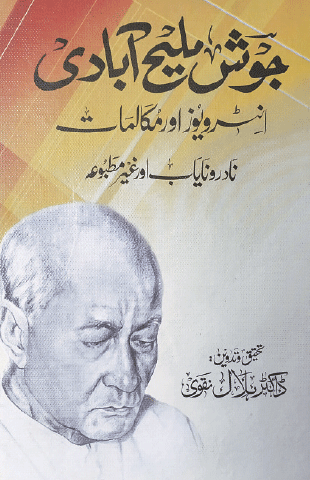
Strangely enough, the interview — published in India and alleged to be “anti-Pakistan” — was never reproduced here (Pakistan) nor does anybody here know of its contents. Hilal Naqvi, a scholar who has spent decades researching Josh and compiling his works, says he has not been able, despite his constant efforts, to trace the controversial interview either. In his new book, titled Josh Maleehabadi: Interviews Aur Mukaalmaat, Nadir-o-Nayab Aur Ghair Matboo’a (Josh Maleehabadi: interviews and dialogues, rare and unpublished), Hilal Naqvi quotes Mushfiq Khwaja who wrote that the interview in question was published by Times of India in its Nov 19, 1967 issue. Naqvi has also quoted Kunwar Mohinder Singh Bedi as saying in his autobiography Yaadon Ka Jashn that the interview was taken by Zoe Ansari and I [Bedi] was very much there. During the interview Josh expressed his love for India but did not say even a single word against Pakistan (pp.13, 14).
Dr Hilal Naqvi has compiled and annotated in this book the interviews that Josh gave between 1957 and 1980. It also includes the controversial, longish interview given to Radio Pakistan in 1978, for which Josh incurred the wrath of the then government and he was banned. Josh had requested Shah Hasan Ata, the interviewer, to not broadcast the interview during his lifetime as he wanted to answer his questions candidly but “had fewer friends and many foes”. Ata showed his intention to record some straightforward conversations and promised that the contents of the interview “would not be misused”. But, writes Naqvi, a part of the interview was leaked and it appeared in daily Jasarat and monthly Urdu Digest. It was Ziaul Haq’s reign and on the basis of those leaked contents Josh was banned from being telecast or broadcast.
Hilal Naqvi in his intro expresses his amazement and dismay at how “naïve” Josh was. Naqvi thinks it was Josh’s naivety that often landed him in hot water as Josh perhaps did not know that in our society expressing one’s thoughts unguarded and unvarnished can cause all hell to break loose. The question Naqvi asks is: do we not have a right to express our views without taking care of worldly gains and losses? Josh did not know, says Naqvi, when one should stop telling the truth and start applying humbug and sycophancy. Though Naqvi has tried to defend Josh on some of his views, especially on politics and religion, some of them cannot be justified in any way. Of course, everybody has a right to express their views, but it cannot be taken in absolute terms and one must take into account the societal and ethical considerations, especially when discussing the sensitive issues like religion.
In another interview, a part of the book, Josh informed that in the post-interview days some permits and licenses previously issued to him by the government authorities, including one for a cement agency, were revoked. But Z. A. Bhutto’s government showed sympathy and Bhutto himself ordered Josh’s appointment in the ministry of education (pp.112-116).
Published by Karachi’s Welcome Book Port, the 512-page book offers 27 interviews. Some of Josh’s conversations with Raghib Muradabadi, too, are made part of the book. Also included are the transcriptions of Josh’s conversations recorded and preserved at Lutfullah Khan’s studio. These pieces are arranged in chronological order and Hilal Naqvi’s annotations provide the readers with vital background information.
Published in Dawn, September 15th, 2025