Transport routes, logistical infrastructure top priority for Kazakhstan
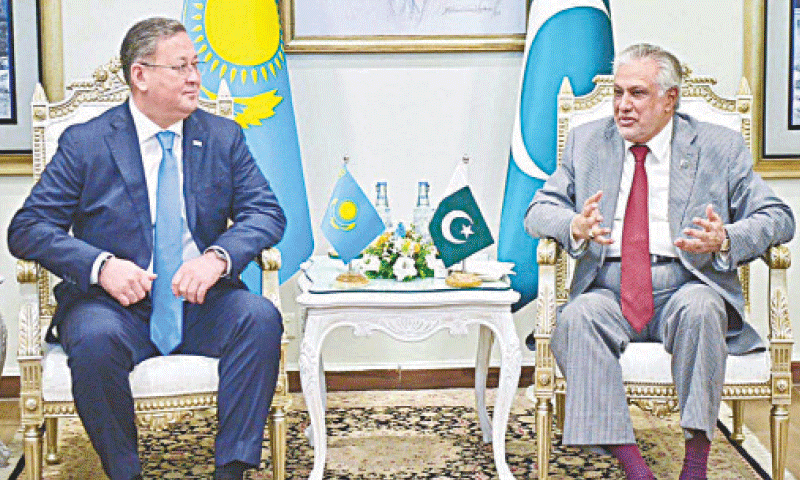

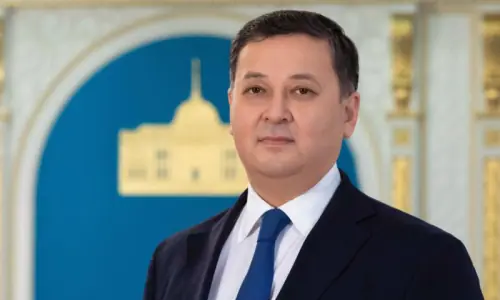
ISLAMABAD: Kazakhstan’s Deputy Prime Minister and Foreign Minister Murat Nurtleu said on Tuesday that developing transport and logistics infrastructure was a top priority for Astana as his country and Pakistan sought to deepen trade and connectivity ahead of a landmark Kazakh presidential visit to Pakistan in November — the first in almost 22 years.
Mr Nurtleu, leading a high-level 13-member delegation including Kazakhstan’s trade and transport ministers, was on a two-day official visit to Islamabad to lay the groundwork for President Kassym Jomart-Tokayev’s planned trip later this year.
During bilateral talks at the Foreign Office, “special emphasis was placed on enhancing transport connectivity and improving the efficiency of transit logistics”, the Kazakh foreign ministry said in a statement.
Mr Nurtleu echoed the priority in meetings with Pakistani business executives, saying Kazakhstan aimed to construct a railway through Afghanistan that would link Eurasian and Central Asian markets with Pakistan, providing access to the Persian Gulf, Africa and Southeast Asia.
He held focused discussions with Pakistan’s National Logistics Corporation and courier company TCS on developing cooperation in the logistics sector. The Kazakh side proposed creating a joint Kazakh-Pakistani transport and logistics consortium involving key operators from both countries.
Islamabad, Astana agree practical steps needed to boost trade to $1bn
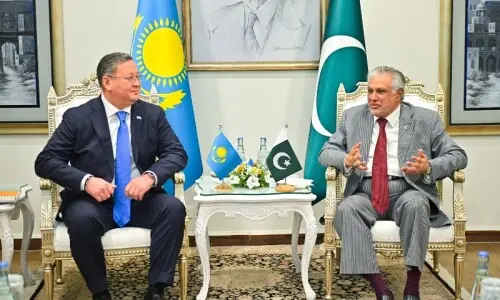
Both foreign ministers — Mr Nurtleu and Pakistan’s Ishaq Dar — agreed that practical steps were needed to increase trade turnover to $1 billion in the coming years.
Current bilateral trade stands at around $239 million. The expectation for an increase in trade volume is driven by initiatives like the Pakistan-Kazakhstan Transit Trade Agreement, which is expected to be signed soon. The agreement is expected to enhance regional connectivity and facilitate trade flows between Central Asia and South Asia.
“Pakistan is fully committed towards enhancing regional connectivity and shared prosperity by facilitating global trade of Central Asian Republics through Pakistan,” Commerce Minister Jam Kamal Khan said during separate talks with Kazakhstan’s Minister of Trade and Integration Arman Shakkaliyev.
Mr Shakkaliyev identified agriculture, leather, small and medium enterprises, and information technology as key sectors for cooperation, while Pakistan offered access to its ports and advanced leather processing industry.
The Pakistani side, during the trade meeting, offered collaboration in technology transfer, training and joint ventures. It was agreed to connect the Kazakhstan Leather Association with the Pakistan Tannery Association to formalise this partnership.
Prime Minister Shehbaz Sharif, in a meeting with Mr Nurtleu, expressed Pakistan’s “keen desire in enhancing bilateral trade, investment, connectivity (through air, rail and road) and people-to-people exchanges with Kazakhstan”.
He said Islamabad was ready to dispatch a delegation to Astana to finalise memorandums of understanding and agreements ahead of Mr Tokayev’s visit.
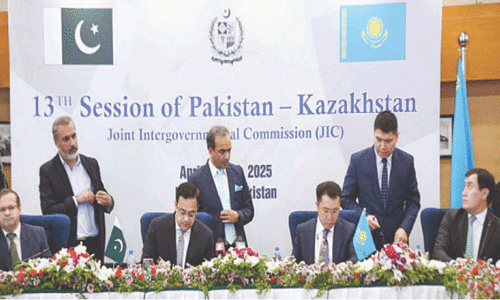
Following the delegation-level talks at the Foreign Office, the two foreign ministers signed the Action Plan of Cooperation 2025-26 between their ministries, establishing a roadmap for deeper ties in politics, trade, economy, defence, science and technology, culture, tourism, humanitarian assistance and consular services.
The plan institutionalises regular consultations and underscores both countries’ resolve to strengthen cooperation at bilateral and multilateral levels.
“The adoption of the Action Plan is a significant milestone that reflects the robust political will of the leadership of Pakistan and Kazakhstan to elevate bilateral relations to a new level of dynamism,” the FO said in a statement.
The Kazakh foreign ministry said the plan would serve as an important tool for the “consistent implementation of the agreements reached”.
Before the high-level talks, Mr Nurtleu’s delegation met with Pakistan’s ministers of communications, railways and commerce, and attended meetings of joint working groups on information technology and agriculture. The delegation also visited the National Aerospace Science and Technology Park to explore IT cooperation.
High-level exchanges between the two countries have been infrequent, with the last Kazakh presidential visit in 2003 and former Pakistani Prime Minister Nawaz Sharif travelling to Kazakhstan in 2015, though the two sides have been meeting on the sidelines of multilateral events.
PM Shehbaz and the Kazakh president recently met on the sidelines of the SCO Summit in China.
Both countries now aim to deepen ties in agriculture, logistics, pharmaceuticals and IT, while leveraging Pakistan’s ports to boost Central Asian connectivity.
Published in Dawn, September 10th, 2025